Anger at political corruption is one of the defining themes of the 2026 midterms. As a Brennan Center survey of 2,000 registered voters found earlier this year, Americans across the political spectrum see corruption as a major problem in politics and government — findings echoed in many subsequent polls, including two released in just the lastweek. This is true across every region of the country and demographics that are likely to help decide the outcome of many close races.
Unsurprisingly, many candidates have focused on corruption in their closing pitch to voters, promising to take specific actions to combat self-dealing at the highest levels of government and reduce the role of concentrated wealth in political campaigns. No matter who wins, the question for after the election is what leaders will do to deliver on their promises.
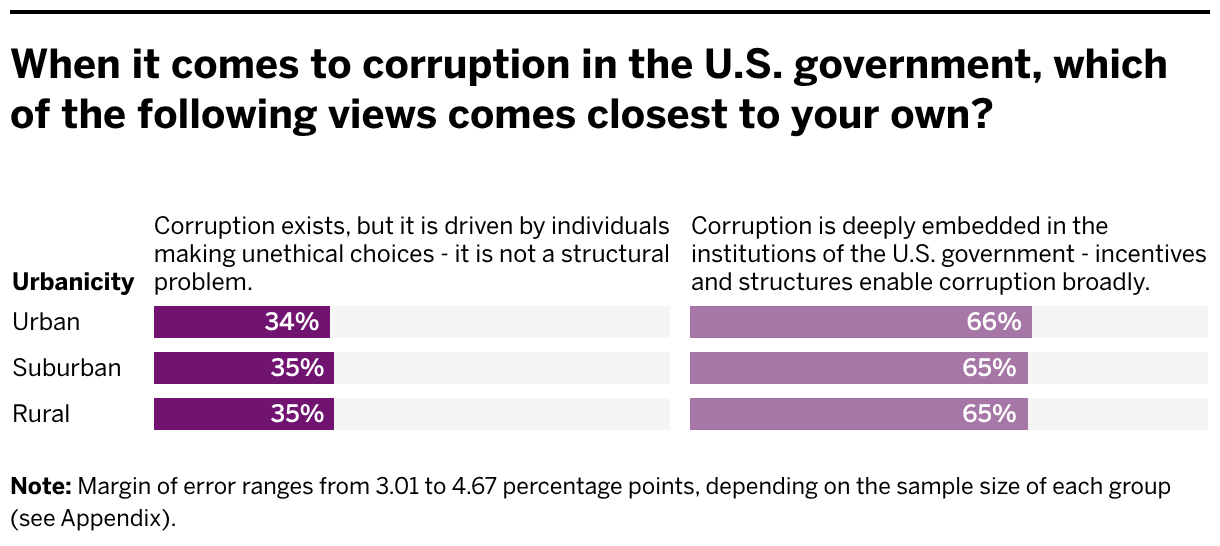
The extent and unanimity of Americans’ frustration about corruption is striking, especially at a time of heightened political polarization and division. Recentpolls have found that voters across the country see corruption as a top campaign issue. Our own survey found that more than 9 in 10 voters in the Midwest, Northeast, South, and West consider corruption in politics and government a big problem. Voters across urban (89 percent), suburban (93 percent), and rural (94 percent) communities share this sentiment.
Anger over corruption is especially intense among voters in several key demographics.
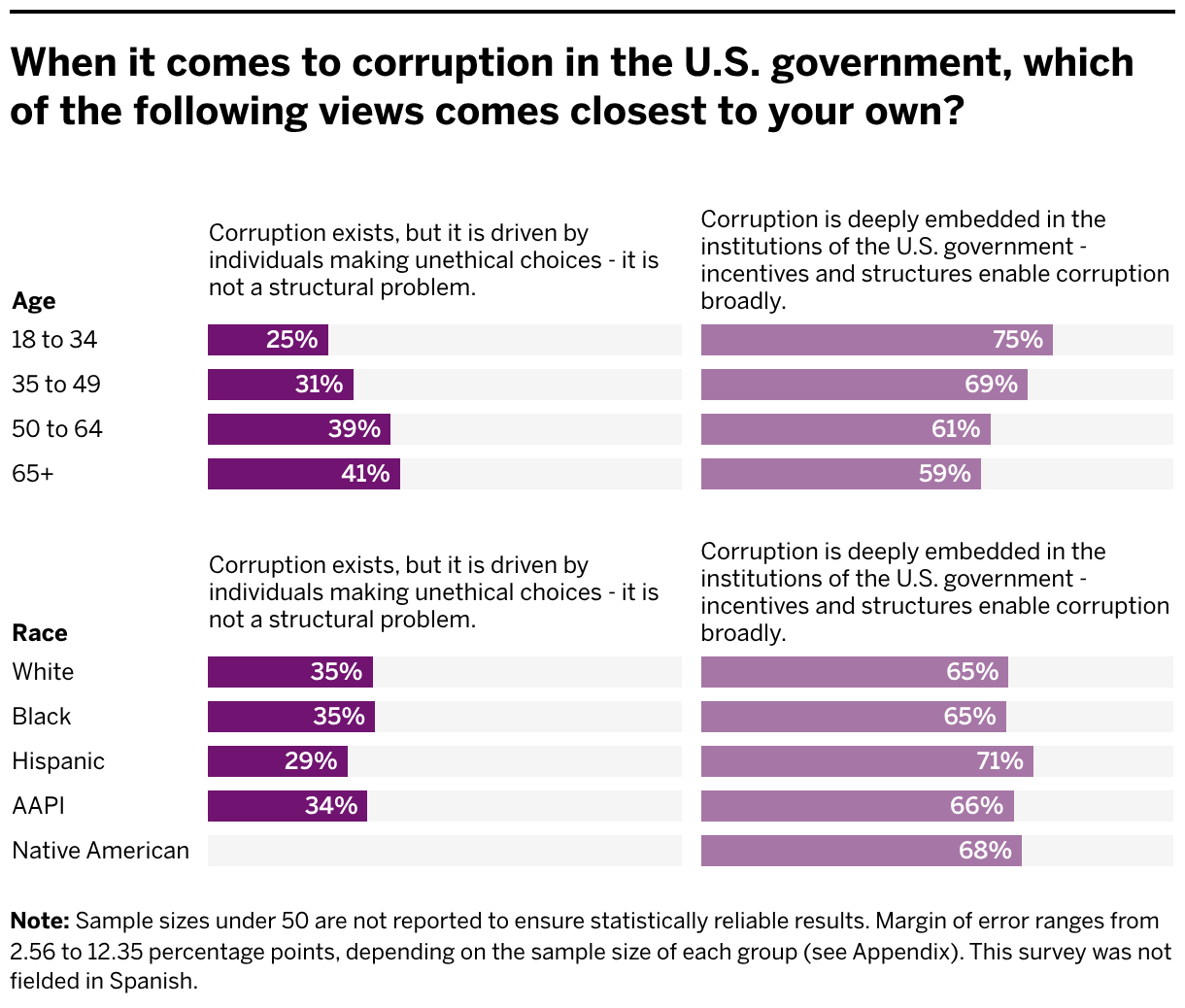
For instance, our survey’s sample of voters below age 35 suggests that they are among the most likely of any age group to see corruption as deeply embedded in government institutions rather than driven by the bad choices of individuals. Young voters, who are the most likely to identify with neither major party, could be a major determinant for several of the highest-profile races this cycle.
Another group that has become a major focus on the campaign trail — and that could be critical in determining which party controls Congress — is Hispanic voters. Seventy-one percent reported seeing corruption as endemic to U.S. government, among the highest proportion of the racial and ethnic groups we surveyed.
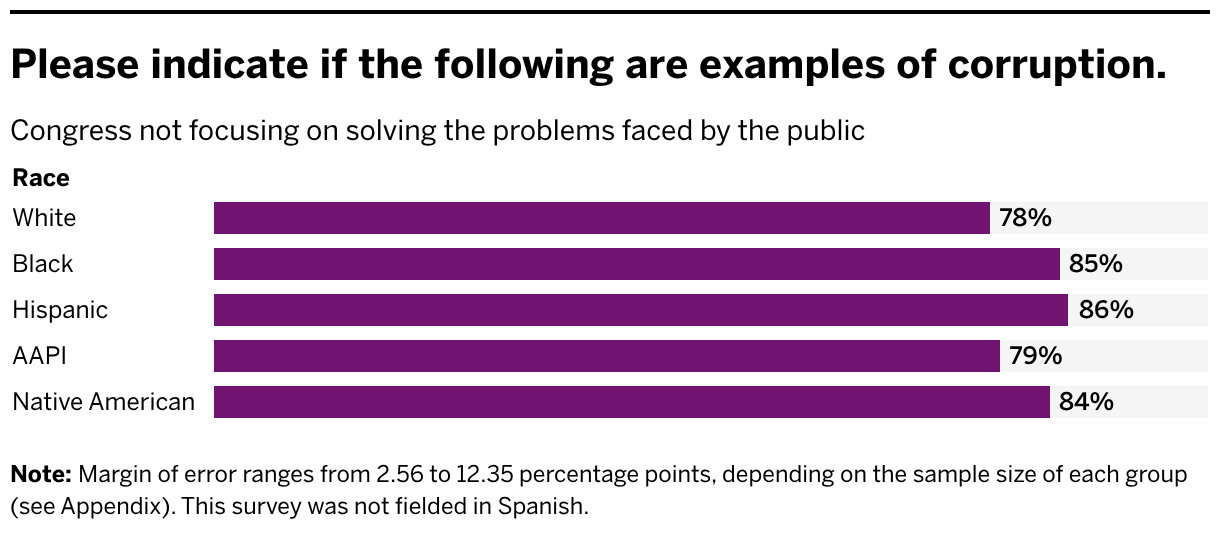
Hispanic voters were also among the most likely to associate corruption with Congress not focusing on the problems faced by the public (86 percent).
According to our survey, rural voters not only agree with urban and suburban voters that corruption is a major systemic issue, but they also are aligned in blaming corruption for big problems the government has failed to solve, including the high cost of living. A recent poll of 2,000 rural registered voters by the Associated Press and KFF shows cost of living is a top concern. And if this year’s primaries are any indication, rural voters will be critical for many consequential races.
Young voters and Hispanic voters, too, see corruption as connected to their daily well-being. Overall, 88 percent of voters blame corruption for the government’s failure to solve big problems such as the economy, the most dominant issue this cycle.
Another thing voters of all demographics share is the desire for sweeping change. Large majorities of voters — no matter their age, race, or zip code — support major anticorruption policy proposals. At least 70 percent of young voters, Hispanic voters, and rural voters support legislation to end dark money, or election spending where the source is secret, as well as a constitutional amendment to overturn Citizens Unitedand other Supreme Court rulings that have eviscerated limits on money in elections. They also back reforms to address the misuse of government power for self-dealing, such as a ban on congressional stock trading, at similar rates. These specific reforms garnered large majority support across all demographics tested, including political party, education, income, and geographic region.
Congressional candidates from both parties are taking note of voters’ frustration with corruption and their demands for change. The issue is featuredprominently across campaign advertisements and on candidate websites. In Texas, for instance, Democratic senatorial candidate James Talarico has made fighting corruption a campaign policy priority. Similarly, in Iowa, Rep. Ashley Hinson (R), who is running for the Senate, has featured “government accountability” as one of her top issues, calling for a ban on congressional stock trading and stronger lobbying restrictions. And in Michigan, Rep. Tom Barrett (R), running in one of the most tightly contested House races, has touted his support for a constitutional amendment giving Congress and the states more authority to regulate political spending.
On the campaign trail, candidates often link corruption to voter concerns about their daily well-being. Hinson’s Democratic opponent, Josh Turek, declared in a recent debate, “We have a corruption crisis in this country, and it is leading to an affordability crisis.” Sen. Jon Ossoff (D-GA) has told voters, “Corruption is why nothing works for ordinary people.” Rep. Young Kim (R-CA) has promised voters, “I will always show up for our community, work to make your life more affordable and continue to root out corruption in Washington.”
While corruption messaging is popular, diagnosing the problem is not enough. Whoever wins must know that voters will expect real, ambitious solutions. Ignoring this demand risks deepening Americans’ belief that the government can’t, or won’t, solve their problems.