

A new Brennan Center survey finds that large majorities of Republicans, Democrats, and independents share deep-seated concerns about government corruption, which most voters define broadly and blame for many of the country’s biggest problems going unaddressed. The survey, fielded to 2,000 registered voters across the country between April 28 and May 6, also finds widespread support for key anticorruption reforms, such as new limits on money in elections and stronger protections against self-dealing by high-ranking government officials.
The key findings include:
- Voters see corruption as a big problem that permeates every government institution. More than 9 in 10 voters (92 percent) — including supermajorities of Republicans (90 percent), Democrats (93 percent), and independents (93 percent) — believe corruption is a big problem in politics and government. Large majorities of voters also view the last two presidents, Congress, and the Supreme Court as corrupt.
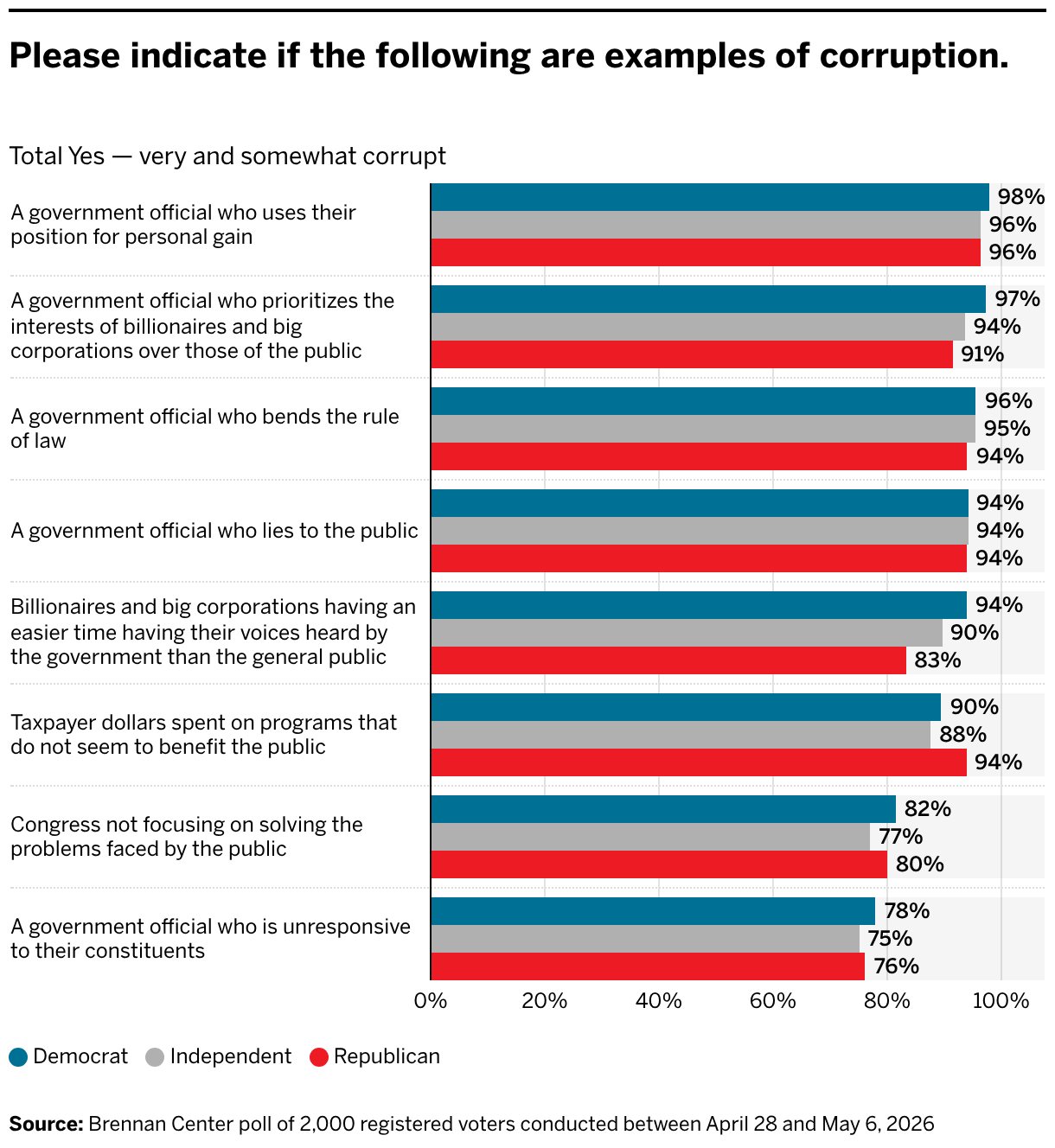
- Voters define corruption broadly. Most voters say corruption covers a range of conduct, including officials using their position for personal gain (97 percent) and prioritizing the interests of billionaires and big corporations over those of the public (94 percent), waste of taxpayer dollars (90 percent), and officials who are unresponsive to their constituents (76 percent).
- Voters identify several causes of corruption in elected officials. Voters point to a lack of consequences for corrupt behavior (79 percent), officials prioritizing personal financial gain (79 percent), and campaign contributions from billionaires (64 percent) and big corporations (62 percent) as top causes of corruption.
- Voters blame corruption for kitchen-table issues going unaddressed. Overwhelming majorities believe corruption is responsible for big problems that government has failed to solve (88 percent) and for dysfunctional public services (83 percent).
- Voters want significant reforms. Major anticorruption policy proposals command widespread support across self-identified partisanship, including a constitutional amendment to restore limits on money in elections (79 percent), mandatory disclosure for all federal campaign contributions and spending (85 percent), the creation of a new federal ethics enforcer (81 percent), and a constitutional amendment limiting the president’s pardon power (69 percent).
Voters See Corruption as a Major Systemic Problem
Voters across the political spectrum identify corruption as a widespread, systemic problem. The poll finds that 92 percent of voters say corruption is a big problem in U.S. politics and government, with 62 percent — including 71 percent Democrats, 64 percent independents, and 53 percent Republicans — calling it a very big problem. Ninety-three percent of voters are somewhat or very concerned about corruption influencing elected officials.
Voters see corruption as endemic to U.S. government. When asked whether corruption is driven by individual choices or is instead an embedded structural problem, nearly two-thirds of voters said the latter. More than half of respondents (55 percent) say the process of running for office and serving in government makes officials corrupt, compared with 45 percent who say people who run for or serve in office tend to be corrupt.
Voters identify the major institutions of the federal government as corrupt, including Congress (85 percent), the president (68 percent), the cabinet (81 percent), and the Supreme Court (62 percent). With respect to Congress, these findings are broadly consistent across every demographic tested: political party, race, education, income, age, urban/suburban/rural, and geographic region.
Voters Define Corruption Expansively
As for what qualifies as corruption, voters across party lines are in agreement. They understand corruption broadly, centered in part on the perception that government primarily works for the ultrawealthy and well-connected and doesn’t prioritize the interests of most voters. The poll finds that while 97 percent of voters say that a government official using their office for personal gain is corrupt, almost as many (89 percent) say the same about billionaires and big corporations having an easier time being heard than the general public.
Large swaths of the electorate across party lines also associate corruption with government inefficiency and inaccessibility. Ninety percent say that taxpayer dollars spent on programs that do not seem to benefit the public constitutes corruption, and 79 percent point to Congress not focusing on the problems faced by the public as another example.
Voters Agree Corruption Has Many Causes
Voters across the political spectrum most often say corruption is caused by a lack of consequences for corrupt behavior (79 percent) and elected officials prioritizing personal gain (79 percent). Not far behind, and again with large bipartisan majorities, were campaign contributions from big corporations and billionaires, with 62 and 64 percent.
Voters Believe Corruption Has Serious Consequences for Their Daily Lives
Voters link corruption directly to kitchen-table issues and the problems with government they experience daily. Eighty-eight percent blame corruption for the persistence of today’s biggest problems that government has failed to solve, and 83 percent say corruption is responsible for public services not working properly.
Eighty-nine percent of voters — overwhelming majorities of Democrats, Republicans, and independents — say corruption is responsible for policies that benefit billionaires and big corporations at the expense of the American people.
Demand for Change Across Party Lines
Voters’ perception of widespread corruption and its consequences for their daily lives translates into a mandate for solutions. Every reform tested in this survey polled nearly at or above 70 percent — with majority support across party lines. In fact, most proposals commanded supermajority support from each party and independents. They also garnered widespread support across other demographics, including race, income, age, gender, education, and geographic region. Even among the small minority of voters (8 percent) who do not view corruption as a big problem, nearly every anticorruption proposal received majority support.
An overwhelming majority of voters across party lines support campaign finance reforms. These include legislation to end “dark money,” or funds from groups that do not disclose their donors (85 percent overall, with 88 percent support among Democrats, 84 percent among independents, and 85 percent support among Republicans) and a constitutional amendment to overturn Supreme Court rulings that have struck down limits on money in elections (79 percent overall, including 84 percent support among Democrats, 81 percent support among independents, and 75 percent support among Republicans).
Supermajorities in regions across the country support amending the Constitution to restore campaign finance limits, with backing from more than three-quarters of voters in the West (82 percent), South (78 percent), Northeast (81 percent), and Midwest (76 percent). The same is true across the urban (81 percent), suburban (79 percent), and rural (76 percent) divide.
Voters also support major reforms to curb self-dealing at the highest levels of government. Voters of all political affiliations, for example, are aligned in wanting to strengthen federal ethics laws for all three branches of the federal government. That includes banning presidential conflicts of interest (83 percent), requiring the Supreme Court to adopt a binding code of ethics (84 percent), banning congressional stock trading (81 percent), creating a new federal agency to enforce anticorruption laws (81 percent), and passing a constitutional amendment to limit the president’s unilateral power to issue pardons (69 percent).
At least 70 percent of young voters (ages 18 to 34) back the reforms aimed at addressing the misuse of government power for graft. These solutions also have large majority support across all other age groups, with voters 65 or older often showing the highest levels of support.
The Brennan Center’s survey shows that the public believes corruption is serious and exists in all corners of government. It also offers some hope: Americans across party lines overwhelmingly support solutions that address the role of concentrated wealth in politics and unchecked self-enrichment by those in power in order to restore the government’s ability to serve the public and confidence in government.
Research Analyst Emily Gill made substantial contributions to the survey instrument and underlying research for this analysis.

