


As the midterm election year starts up, the Brennan Center continues its periodic roundup of news in the world of money in politics. This installment examines the scale of Trump’s monetizing of the presidency, early signs of big spending in state and congressional elections, and the court cases threatening campaign finance regulations.
Expert Brief
Money in Politics Roundup — February 2026
These stories on campaign finance and influence peddling are shaping the midterms.
Preface
Unprecedented White House Profiteering
By Eric Petry
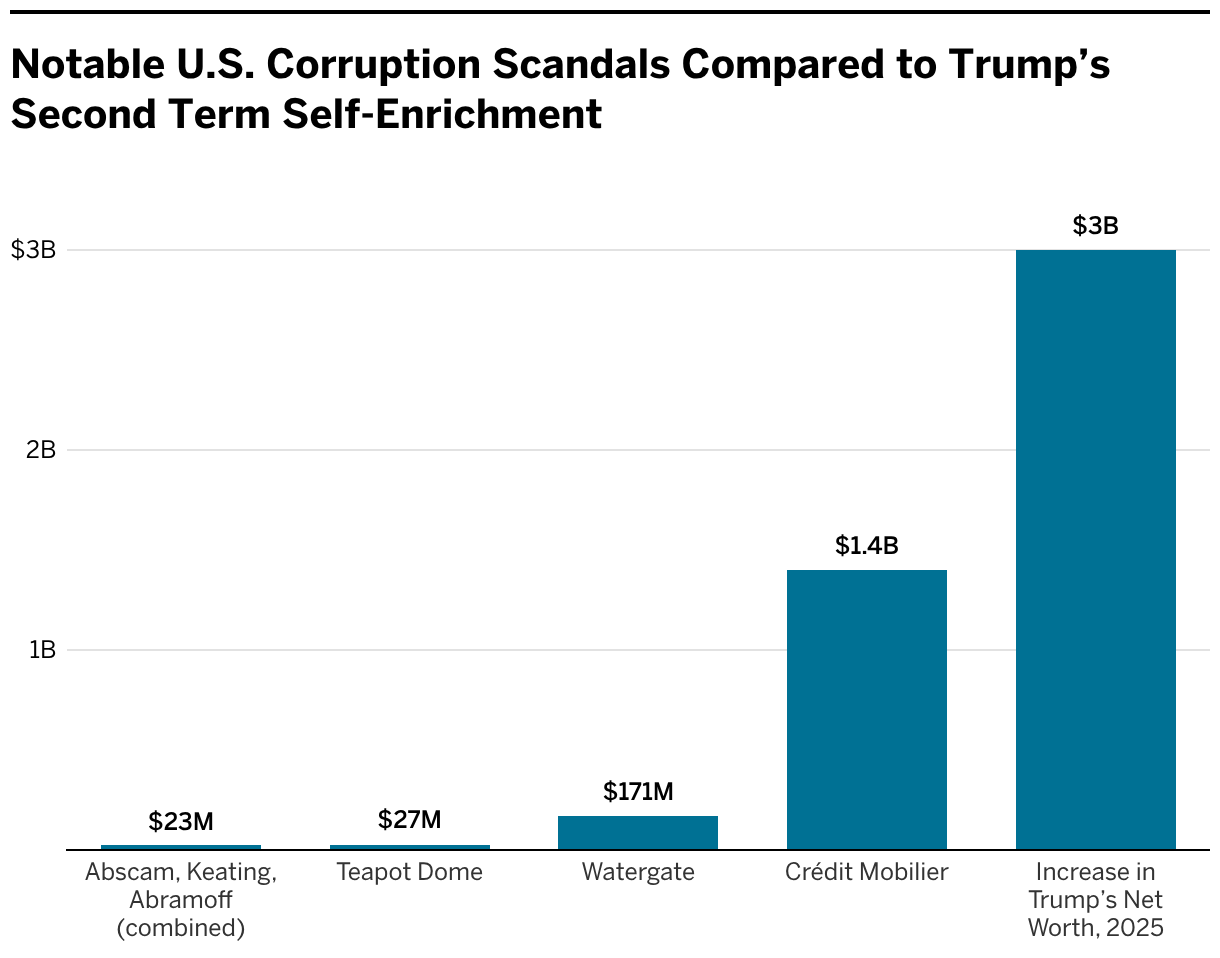
Since returning to office, President Trump has added approximately $3 billion to his net worth. Two-thirds of that increase came from the explosion of his cryptocurrency ventures, while hundreds of millions more came from the resurgence of Trump-branded international real estate deals.
The scale of these profits and the way Trump has monetized the White House to generate them are unique. Few if any of his financial entanglements are illegal on their face, because the president — like members of Congress and the Supreme Court — is exempt from ethics rules that bind most other federal officials. But by erasing the distinction between public office and private business and systematically weaving personal profit into official policy, Trump has enriched himself financially on a scale that dwarfs even the most infamous scandals in American history.
Nothing exemplifies the close connections between Trump’s presidency and his business ventures more than the Trump family’s cryptocurrency venture, World Liberty Financial, which has netted the Trumps approximately $1 billion since its creation shortly before the president took office for the second time.
World Liberty’s dealings with foreign governments raise stark questions about who is influencing key U.S. foreign policy and national security decisions. For instance, shortly before Trump’s second inauguration, Sheikh Tahnoon bin Zayed Al Nahyan, a member of the Emirati royal family, bought a 49 percent stake in the company for half a billion dollars, netting the Trump family roughly $187 million, with another $31 million going to entities affiliated with Trump’s special envoy to the Middle East, Steve Witkoff. In May, a state-backed Emirati investment fund agreed to use USD1, World Liberty’s stablecoin, to finance a $2 billion investment in the cryptocurrency giant Binance, an arrangement that could net World Liberty up to $80 million per year in interest. Two weeks later, the White House announced a deal — brokered by Sheikh Tahnoon with Witkoff’s help — to give the UAE access to the United States’ most advanced and closely guarded computer chip technology, despite long-standing national security concerns about the country’s ties with China.
The UAE chip deal is one of many examples of World Liberty purchasers and other partners receiving favorable treatment from the U.S. government. In October, after Binance helped launch USD1 and bolster its credibility with investors, Trump pardoned the company’s founder, Chinese billionaire Changpeng Zhao. Zhao and Binance pleaded guilty in 2023 to violating U.S. rules against money laundering, after the company allowed terrorists, cybercriminals, and sanctioned users in Iran and Russia, among others, to move billions of dollars through the exchange. And last February, the Securities and Exchange Commission paused its fraud investigation into Justin Sun, another Chinese crypto billionaire, who has purchased $90 million worth of Trump family cryptocurrencies.
This tangle of personal business and government policy is a pattern across the administration’s actions. Several foreign governments that have struck deals for new Trump-branded projects in multibillion-dollar real estate developments, such as Saudi Arabia and Qatar, have also received access to advanced U.S. microchips, as well as weapons systems (and in Saudi Crown Prince Mohammed bin Salman’s case, diplomatic erasure of culpability for the brutal 2018 murder of journalist Jamal Khashoggi). In other countries like Vietnam, officials bypassed normal rules and regulations to fast-track existing Trump properties even as they were negotiating with the U.S. government over tariffs.
No other administration in modern history has cashed in like this. Presidents generally have tried to avoid even the appearance of impropriety by selling off their assets or putting them in blind trusts before taking office. President Jimmy Carter famously did so with his family’s peanut farm. The revenue involved was less than 1 percent of the increase in Trump’s net worth since he took office last year: In 1975, Carter’s farm grossed $2.5 million, or about $14.3 million in today’s dollars.
Even when past administrations faced scandals that consumed much of the political oxygen of the day, the amount of money at stake pales in comparison to Trump’s profits. Republicans, including President Trump, have decried President Joe Biden and his family for allegedly trading on his public office to enrich themselves. Yet the source of their outrage — payments totaling $35 million over 10 years — amounts to roughly 1 percent of what Trump made in just the last year.
Democrats accused Vice President Dick Cheney of profiteering from the war in Iraq over money he received from Halliburton. But the payments, which totaled $2 million (about $3.6 million today), represented deferred compensation Cheney earned before taking office. And while the Clinton administration faced campaign finance and fundraising scandals in the late 1990s, they involved less than $10 million (about $20 million today) and were not connected to personal financial holdings or businesses owned by the president.
Not even the most notorious public corruption scandals from American history can match the scale of Trump’s profiteering in terms of total dollar amount. One of the nation’s first and biggest episodes of grand political corruption, the Crédit Mobilier scandal of the late 1860s, involved Union Pacific Railroad executives fraudulently overcharging for railroad construction costs and bribing members of Congress to avoid oversight. This multiyear scheme ultimately bilked the U.S. government out of $44 million and saw federal officials accept stock shares and other bribes worth $9 million — in sum, equivalent to about $1.4 billion today, or less than half of Trump’s 2025 profits.
Another infamous example, the Teapot Dome scandal of the early 1920s, resulted in Interior Secretary Albert Fall going to prison, the first time a U.S. cabinet official was convicted of a felony. In 1922, Fall leased federally controlled oil fields in Wyoming and California to two private companies on favorable terms in exchange for bribes totaling roughly $400,000, or around $8 million today. The oil companies later paid another $1 million, about $19 million today, to newspaper publishers to try to keep the story out of the press. The financial component of Watergate, one of the most corrosive corruption scandals in the nation’s history, involved $22 million (more than $170 million today) in illegal campaign contributions and hush money. Other major corruption scandals over the past few decades — Abscam, the Keating Five, and Jack Abramoff — collectively involved bribes and other payments connected to government accounts and officials totaling approximately $23 million in today’s dollars.
To be sure, this is not an exhaustive accounting of every American political scandal. But with one exception, the amounts involved in these notable episodes are an order of magnitude smaller than what President Trump has raked in so far in his second term. Only the 160-year-old Crédit Mobilier affair, at about half of Trump’s recent income, is even in the same ballpark.
This personalist, profit-maximizing approach to governing undermines the notion of public office as a public trust. It fuels Americans’ sense that politics and policy are rigged to serve wealthy elite interests rather than solving the problems that matter to most people in their daily lives. In the past, particularly following the Gilded Age and Watergate, corruption sparked public outrage and ultimately reform. The same can be true today. But it will require a bold agenda for reform and leaders who will make enacting it a priority.
Campaign Finance Stories We’re Watching
An Unprecedented Super PAC Haul
MAGA Inc., the pro-Trump super PAC, raised a record-breaking $305 million after Trump was reelected, even though he can’t run again. Megadonors provided the funds, with 96 percent of the group’s revenue coming from donations of $1 million or more. Many of the donors have clear interests in the administration’s policies and have benefited from weakened regulations of their industries, administration appointments, or pardons. The super PAC haul adds to other huge sums Trump’s allies have raised, including funds for the White House ballroom and events commemorating the nation’s 250th anniversary, while offering megadonors access to the president.
Big Fundraising in Races for Governor
Early in the 2026 cycle, some gubernatorial candidates in battleground states are breaking fundraising records.
- In Arizona, Gov. Katie Hobbs (D) raised $5.9 million for reelection last year, a record for a nonelection year. Karrin Taylor Robson, who spent almost $17 million of her own money on a failed gubernatorial bid in 2022, is leading the GOP money race so far this cycle, thanks to over $2 million in self-funding.
- Nevada Gov. Joe Lombardo’s (R) reelection campaign has raised a record-breaking $9 million, four and a half times more than his best-funded challenger. Lombardo’s campaign website claims $15 million in cash on hand, however, by counting the revenue of “two affiliated PACs.” These super PACs, mostly funded by casino interests, are legally allowed to raise unlimited amounts only if they operate independently of the candidate.
- The Michigan open-seat contest is on track to potentially break campaign finance records. Secretary of State Jocelyn Benson (D) raised $5.7 million through December. She’s trailed closely by Detroit Mayor Mike Duggan (I) and former attorney general Mike Cox (R), who gave his own campaign most of the $5 million it has raised. In addition, Rep. John James (R) has taken in approximately $4.5 million while enjoying the support of a super PAC that accepted $5 million from the DeVos family, the major funders of conservative Michigan politics.
- We are also watching battleground open-seat races in Georgia and Wisconsin, although fundraising is not especially high in either contest — yet.
Heated Primaries in Kentucky
Congressional GOP primaries in Kentucky are showing early signs of big spending.
- In the race for the Senate seat opened up by Mitch McConnell’s retirement, Elon Musk reportedly donated $10 million last month to a super PAC backing Nate Morris, who has self-funded his campaign to the tune of $3 million. Independent spending in the race is already well underway, with $6 million spent by groups targeting Morris or Rep. Andy Barr.
- Thomas Massie, who has broken with Trump on prominent issues like the July 2025 funding bill and the release of records concerning Jeffrey Epstein, is facing a Trump-endorsed primary challenger, Ed Gallrein. Two pro-Trump megadonors have spent millions to fund dueling super PACs, with Paul Singer behind an anti-Massie group and Jeffrey Yass indirectly funding a pro-Massie group.
New Mayors Win with Public Campaign Financing
Four mayors who are beginning new terms this year won with campaigns that relied on public financing. New York City Mayor Zohran Mamdani (D) received the maximum available amount from the city’s small-donor matching program and told supporters to stop giving in September. In Albuquerque, Mayor Tim Keller (D), the only publicly financed candidate in the race, won reelection in a December runoff. Santa Fe elected Michael Garcia, one of two publicly financed candidates in an eight-way race. In Seattle, Katie Wilson defeated the incumbent mayor in a contest where both candidates accepted the city’s democracy vouchers.
Legal Developments
In December, the U.S. Supreme Court heard oral argument in a challenge to decades-old federal rules that limit how much national political parties can spend in coordination with their candidates. The case, brought by the National Republican Senatorial Committee, seeks to further weaken campaign contribution limits, since limits on party fundraising are dozens of times higher than those on candidates. The Brennan Center’s amicus brief argues the Court should uphold the limits. Although many observers expect the Roberts Court to continue its streak of striking down campaign finance restrictions, some justices in the conservative majority did not telegraph their position at oral argument, making the outcome hard to predict.
The legal challenge to Maine’s law imposing a $5,000 contribution limit on all political committees, effectively banning super PACs, is wending its way through the courts. After the trial court blocked the law in July, the state appealed to the federal First Circuit Court of Appeals. Supporters of the law filed nine amicus briefs asking the court to uphold it, including a bipartisan group of former members of Congress and governors, a group of “very wealthy Americans,” and several pro-democracy organizations. The Brennan Center’s brief explained how the reality of super PAC activity belies the Citizens United Court’s assumptions.
Simultaneously, states are pursuing innovative ways of pushing back against the courts’ disastrous campaign finance rulings. Virginia lawmakers introduced a “trigger law” stating that Citizens United and other deregulatory court opinions were wrongly decided. The bill establishes campaign contribution and expenditure limits barred by current constitutional jurisprudence, but it says they will only take effect if those restrictions change due to a new Court opinion or a constitutional amendment. The idea originated with a Brennan Center proposal.
In Montana, advocates have proposed a ballot initiative that would change the state’s corporate laws to establish that corporations have no right to engage in political spending. Organizers are seeking the state’s approval of the ballot language and 60,000 signatures to get the initiative on the ballot this year.
In Case You Missed It: Recent Brennan Center Work
Nine solutions for political corruption — Daniel Weiner, Joanna Zdanys, and Eric Petry lay out nine ambitious proposals for Congress to tackle unprecedented political corruption, the first in a series of policy reform agendas the Brennan Center will release in the coming months. READ MORE. Michael Waldman, Daniel Weiner, and pollster Celinda Lake discuss the need for these reforms here.
Unprecedented money for a lame duck — Ian Vandewalker delves into the fundraising of the pro-Trump super PAC, MAGA Inc. READ MORE
Warped incentives in Congress — Maya Kornberg explains how developments in the way Congress operates have pushed members toward attention-driven messaging and away from constituent service and legislative work. READ MORE
Campaign finance at the Supreme Court — Eric Petry lays out the stakes of the party limits case at the Supreme Court. READ MORE
Odd-year elections break spending records — Ian Vandewalker discusses record-breaking spending in 2025’s state and local elections, underscoring how the Citizens United era is increasingly ballooning the costs of campaigns beyond federal races. READ MORE
A new Gilded Age — Michael Waldman warns that we are entering an era of crony capitalism reminiscent of the corruption-addled Gilded Age of the late 19th century, with similar risks to the economy. READ MORE
Anticipating the end of the Citizens United era — Jay Swanson and Eric Petry make the case for states to use trigger laws to oppose mistaken court rulings striking down campaign finance rules and provide for new laws that will take effect once they’re overturned. READ MORE
Enforcement against emoluments — Eric Petry, Daniel Weiner, and Harry Isiah Black argue that Congress must enact legislation to codify the Constitution’s Emoluments Clauses, implementing the bar the founders placed on the president and other federal officials receiving benefits from foreign governments. READ MORE
CLARIFICATION: This post has been updated to include the value of stock shares that members of Congress accepted in connection with Crédit Mobilier and the value of payments to newspaper publishers related to the Teapot Dome scandal and to clarify the scope of the payments involved in the Abscam, Keating, and Abramoff scandals.
Part of
More from the Money in the 2026 Election series
-
Pro-Trump Super PAC Raises Record-Breaking $305 Million
MAGA Inc. has relied on multimillion-dollar donors to raise an unprecedented amount in support of a lame duck president. -
Money in Politics Roundup — October 2025
Our new recurring feature covers key stories from the world of campaign finance and influence buying, from the AI industry to super PAC support for a lame-duck president. -
Big Money Breaks Records, Boosts GOP: 5 Things to Know About the Midterms
From unprecedented spending to public outrage over corruption, here’s how big money is shaping the 2026 election.


Stay up to date