The Boston Police Department’s social media monitoring is often conducted informally, without specific policies governing use, and with minimal documentation or safeguards despite the broad scope of surveillance, according to a Brennan Center investigation. Documents produced by the department, along with our conversations with the department’s attorney, provided much-needed transparency into practices that have long been opaque.
The Brennan Center submitted a public records request to the BPD in January 2020 seeking information about how it uses social media to collect information about individuals, groups, and activities. After the BPD failed to produce any documents, we filed an appeal with the Massachusetts supervisor of records that December, and the department was subsequently ordered to respond.
Over the course of several years, the Brennan Center engaged extensively, through multiple conversations and written responses to our questions, with the BPD and the Boston Regional Intelligence Center (BRIC), the department’s fusion center that coordinates information sharing and collaboration among local, state, federal, and regional law enforcement and public safety agencies. These discussions, along with more than 1,000 pages of produced documents, provided the Brennan Center with more insight into the BRIC’s activities. These include its internal structure and oversight, social media investigations, use of online aliases, November 2024 election-related monitoring, information sharing practices, and reliance on a range of controversial social media monitoring tools. We also obtained details about gang and gun violence surveillance by the Youth Violence Strike Force.
Key Findings
Analysts use online aliases to monitor social media, often without documentation.
The BRIC has no formal documentation requirements governing the ongoing use of online aliases (i.e., accounts using fictitious identities) for overt monitoring of open-source social media, which constitutes most of an analyst’s activities. As a result, much of the BRIC’s social media monitoring may be left unaccountable, with little information available to ensure that analysts are monitoring social media in accordance with best practices and department policies.
Promoting an event online can be enough to draw police surveillance.
The BRIC does not have a policy that specifically addresses targeting of individuals, yet our conversations with a BPD attorney revealed it might review an individual’s social media more regularly if that person is actively publicizing an upcoming event. The BRIC also did not provide specifics as to how analysts monitor groups but acknowledged “checking in” on groups during the college campus encampments regarding Gaza and ceasing monitoring since the “environment has changed.”
Monitoring of public events relies largely on analyst discretion.
Analysts are given wide latitude to conduct broad searches for events with an ostensible nexus to Boston, like rallies, demonstrations, or other gatherings, in order to detect threats and evaluate potential public safety implications.
The BRIC engaged in overcollection and broad circulation of information with no clear public safety value.
Situational awareness reports circulated by the BRIC ahead of the 2024 general election included information of questionable relevance, much of which had little connection to Boston, no clear public safety significance, and no indication of broader trends that would require law enforcement attention.
Information sharing is widespread but poorly tracked.
While audit functions, which help identify who accessed or received information and the nature of that information, exist in “every database,” there is no centralized audit trail. Additionally, the BRIC confirmed that the City of Boston’s email retention policies, which prohibit email deletion, override the five-year limit on data retention set out by BPD’s privacy policy, raising concerns about indefinite retention of sensitive data shared over email.
Police relied on “exigent circumstances” to procure social media monitoring.
The BRIC uses social media analysis tools to “identify potential criminal threats to public safety, including threats of mass violence, and to gain situational awareness of developments with online forums.” Some of the tools were used on a trial basis under “exigent circumstances,” which has repeatedly been invoked by the BRIC to justify using surveillance technology without prior city council approval.
The Boston Police Department engaged in unregulated social media collection targeting minors, their networks, and witnesses to violence.
The Youth Violence Strike Force collects extensive social media information for its investigations. Officers use undercover accounts to monitor and follow individuals who may be unrelated to criminal or gang-related activity, including friends, family members, associates, bystanders present at a crime, and others who are not suspected of wrongdoing. Despite the broad reach of these practices, social media monitoring within the strike force is largely unregulated, as the BPD does not have an official policy governing these activities, nor any specific guidance for interactions involving juveniles.
All documents can be viewed here.
The records and conversations summarized below reveal a broader picture of how the BRIC conducts social media surveillance, and where oversight gaps remain.
The Boston Regional Intelligence Center
Opened in 2005, the BRIC is one of around 80 nationwide fusion centers established after 9/11 as a means for sharing counterterrorism intelligence. The BRIC falls within the BPD’s Bureau of Intelligence and Analysis and has long received grant funding under the Department of Homeland Security’s Urban Area Security Initiative program, a grant designed to provide “federal funding to States and localities to prevent and respond to potential terrorist attacks and other emergencies.” It received approximately $2 million from the program in 2024, which represented roughly 22 percent of the center’s overall budget. The BRIC also monitors protests and other First Amendment-protected activity with no clear link to terrorism or emergencies. In the past, the BRIC was exposed for writing intelligence reports labeling anti-war and social justice groups as domestic extremists and using the social media software Geofeedia to target Black Lives Matter activists and Muslims.
Through an open records request, the Brennan Center came to understand that the BRIC’s analysts conduct social media monitoring — usually using an online alias — of individuals, groups, or events to support crime analysis, threat detection, public safety assessments, intelligence gathering, and criminal investigations. They use social media monitoring tools to streamline data collection and may flag groups or individuals for further investigation, at times coordinating with detectives operating under undercover aliases.
BRIC Structure and Oversight
According to an organizational chart obtained by the Brennan Center, the BRIC falls within the BPD’s Bureau of Intelligence and Analysis. The BRIC is under the leadership of both civilian and sworn personnel: The Director of the BRIC is a civilian, and the Superintendent of the Bureau of Intelligence and Analysis is sworn leadership. Unlike civilian employees, sworn officers are vested with full police powers, which comes with numerous responsibilities and authorities, such as authorization to carry firearms, and they have full arrest power.
The department’s social media surveillance is primarily carried out by analysts at the BRIC’s counterterrorism section, which consists of a supervisor and two open-source social media subject-matter experts. The BRIC’s Real-Time Crime Center also monitors social media.
The Brennan Center received several policies governing BRIC’s data collection processes, including social media monitoring. The Bureau of Justice Assistance Guidance Manual provides federal guidance for developing social media policies that protect privacy and civil liberties. The BRIC Manual on Privacy Protection (2024) regulates the handling of personally identifiable information and use of social media. The Threat Information Receipt and Triage Plan directs staff to assess threat information received from partners, while the Tips and Leads Processing Procedures establish how the BRIC collects, analyzes, and retains threat data. The Criminal Intelligence File Guidelines restrict retention of intelligence on suspected criminal activity. While the policy does not explicitly mention social media, it covers the collection, use, dissemination, retention, and safeguarding of personally identifiable information.
The BPD has been in the process of developing comprehensive policies on its use of social media since February 2022. An attorney for the BPD confirmed that these policies have still not been finalized.
On several occasions between February 2025 and January 2026, the Brennan Center met with an attorney for the BPD to better understand how its social media use works without a policy. While we were able to obtain relatively detailed information about how the BRIC tracks events, its processes for monitoring individuals or groups are more muddled. As noted above, the BRIC does not have a formal policy for monitoring individuals.
Social Media Investigations
The BRIC conducts social media investigations for several purposes, including following up on activities it identifies as threats through its continuous monitoring of social media or threat reports from the public and other law enforcement agencies. According to our conversations with a BPD attorney, threat reports and relevant social media posts are reviewed at a daily meeting by the Counterterrorism and Threat Assessment Section supervisor and a BPD sergeant detective to determine next steps, which generally follow guidance on threat triage. Only “true threats” — a threat that involves a nexus to Boston and can be investigated by a BRIC detective — may be investigated. Analysts may review social media posts and persons related to the threat, and sometimes create reports that compile information found about a user across the web, along with a person’s address and/or phone number (sometimes obtained through Accurint, a service run by data broker LexisNexis).
The BRIC sent the Brennan Center twosets of social media investigation reports from 2018 through 2022. Although the documents may not be fully representative, they highlight the BRIC’s investigations of individuals based on vague or non-specific threats. For example, after Twitter refused to turn over information about a user who posted messages identified as threatening and a judge declined to issue a warrant, the BRIC turned to the Massachusetts State Police Fusion Center. The BRIC asked that fusion center to help identify the suspect by conducting a facial recognition scan against the user’s social media photos. Over the course of its investigation, the BPD visited the individual’s workplace, collecting their personal information from their employer and adding it, the documents show, to “several BRIC databases.” Although the two people threatened stated that they were not particularly concerned and would not press charges, the BPD questioned the individual at work and demanded that they take down a Tweet they had posted months earlier.
In another investigation, a detective made several visits to the home of someone identified as having posted threatening messages on Twitter and Facebook, eventually speaking with the man on the phone to put him “on notice” to be “very careful” about his social media posts in the future. The detective noted that the posts were “not directed at any specific individual” and only “appeared to be” calling for violence.
Online Aliases
The BRIC uses online aliases for several different kinds of social media monitoring, including overt (monitoring online content without direct engagement), discreet (which includes joining a group or following someone online), and undercover activities (engaging directly online). Each of these requires a different level of approval. While the BRIC originally described a detailed approval process for use of online aliases, later conversations revealed a more informal process.
Analysts must request approval from their supervisor to create an alias account. Joining a private online group, following, subscribing, and liking are all considered discreet activities that require an analyst to submit a memo justifying their activity and to obtain approval by a BRIC representative or privacy officer. Approval is limited to a specified online space — like a private Telegram, Facebook, or Discord group — and any group joined must have some nexus to a public safety concern or to a threat.
A December 2021 “case event report” is illustrative. The BRIC sought to identify an individual who posted threatening messages about Boston Mayor Michelle Wu in a Telegram group and to collect information on his background and affiliations to determine if he was a serious threat. After reviewing the user’s Telegram profile, a BRIC analyst conducted an open-source search of the username and identified him as a member of several online bodybuilding groups:
Image
Our conversations with a BPD attorney revealed that interactions with individuals such as friending, direct messaging, and “engaging in dialogue” are considered undercover activities. While analysts may operate under online aliases, they do not impersonate specific, real individuals. When engaging in undercover social media activity, analysts operate the accounts and perform online interactions, such as direct messaging or engaging with posts, while detectives direct the investigation and approve the activity informally. These interactions require a step-by-step review process for approval. Analysts must request approval from their supervisor to create an undercover alias account. When seeking approval, analysts must articulate a justification grounded in a public safety concern or a perceived threat with a clear nexus to Boston and outline the high-level steps they intend to take while undercover. Initial approval is made in an informal, in-person discussion and is reviewed by legal counsel only after in-person approval is given. There are similarly no formal documentation requirements governing undercover activities — the BRIC instead relies on their draft social media policies.
Monitoring Events
The Brennan Center requested information about the BRIC’s use of social media related to the November 2024 elections. We learned that event monitoring is meant to be viewpoint neutral, with a focus on events that may be gaining traction online, drawing counter-protests, or posing logistical challenges that may require coordination with other agencies. Typically, analysts monitor social media for ongoing events (e.g., campus encampments related to the Israel-Hamas conflict, the election, and large conventions) or to identify events relevant to information obtained from other law enforcement agencies (e.g., threats encouraging the burning of ballot boxes following similar incidents in Oregon and Washington state). As we learned from the BRIC’s election-related disclosures, they compile and share this information in several forms: special event notifications, joint special event assessments, an events manager spreadsheet, and situation reports.
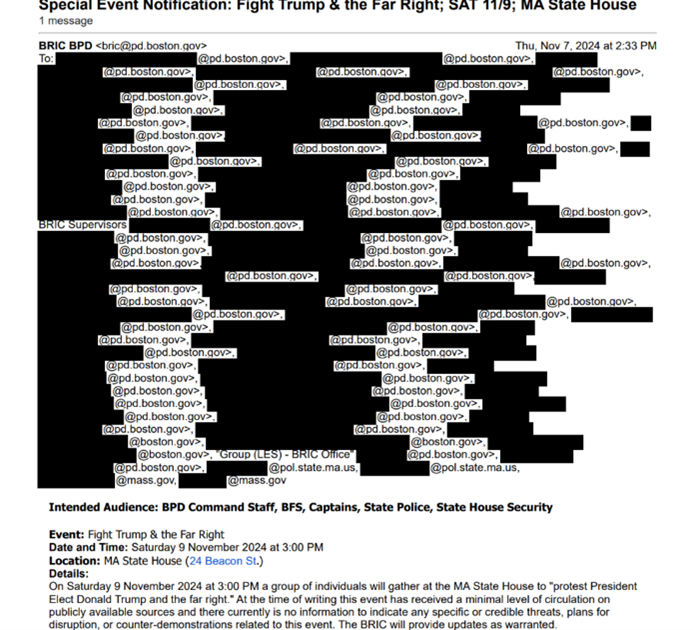
The Brennan Center received a set of 2024 election-related “Special Event Notifications,” short emails meant to summarize a specific upcoming local event for “situational awareness.” Our conversations with a BPD attorney explained that event notifications are routine; they are sometimes issued multiple times a day and disseminated to other non-governmental and government entities at the local and state level to share open-source and public-domain information about the event. There is no formal process for how analysts decide which events should be shared. However, the BRIC communicated that analysts will typically find an event on social media (such as a political protest) by conducting manual online searches without a fixed list of search terms and then determine whether it is relevant to the Boston area and whether the circumstances necessitate an event notification, weighing factors that could include the public safety impact and divisiveness of the event.
The BPD attorney we spoke with pointed out that joint Special Event Assessments are produced less frequently and for a specific, high-profile event. These documents consolidate information from various fusion centers and are often used in formal briefings for local and federal agencies. For example, the 2024 election assessment the Brennan Center received was coproduced by the BRIC, Massachusetts state government institutions, and the FBI. But much of the information seems irrelevant to the Massachusetts area, such as a screenshot of a TikTok video sharing disinformation about Kamala Harris.
The Brennan Center also received an events manager spreadsheet where BRIC analysts store links to events or event fliers collected from publicly available social media for 30 days.
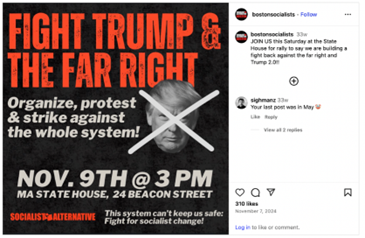
Image
Screenshot of an event post linked in the events manager spreadsheet.
The BPD attorney explained that the BRIC also uses social media to create situation reports, called SITREPs, for larger, prolonged events that require coordination across the department and with the private sector (e.g., the US Open, the Israel-Hamas conflict, the 2024 general election, etc.). SITREPs documenting threats during the 2024 election include brief summaries of notable local and national incidents, such as a shooting in front of the Democratic National Convention in Phoenix, Arizona, as well as upcoming events like a gathering in front of Boston’s Israeli Consulate condemning violence in Lebanon and Palestine.
All 18 SITREPs the Brennan Center received begin with the disclaimer that the BRIC had no “information or intelligence to indicate a specific, credible threat” related to the election. Nevertheless, the BRIC received from and circulated to other local agencies information of questionable value, such as a report from Tennessee of an individual’s attempt to fly an armed drone into an energy facility. Much of the material seems to lack a clear nexus to Boston or any discernible public safety relevance, and appears not to be indicative of any broader trends.
Information Sharing
Our conversations with BPD counsel revealed that the information the BRIC collects is shared widely, typically in accordance with the agency’s standard operating procedure, which dictates what type of information or intelligence products are shared with whom. The BRIC’s productions verify that each type of event report is shared with or circulated to external agencies.
Joint Special Event Assessments are sent to long listservs of emails, including, for example, the Massachusetts state government.
Image
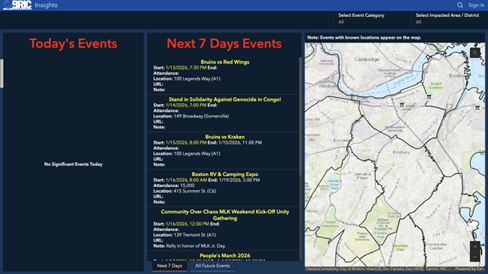
Joint Special Event Assessments are used in FBI briefings and other formal briefings across agencies. The BPD attorney we spoke to explained that some information entered into the events manager is also accessible to Boston Police and Urban Area Security Initiative partners, such as Cambridge PD, via an events dashboard, which displays maps and lists of events for the current day and the following one-to-two weeks.
Image
Example of events dashboard.
While the BRIC declined to provide a list of specific public and private sector recipients of the election SITREPs, citing privacy concerns, the BPD attorney we spoke with shared that they were sent broadly to law enforcement both within and outside the Boston area, public sector security personnel in the Boston area (e.g., corrections officers, dispatchers, and court officials), private sector personnel (e.g., corporate security, loss prevention, water and sewer, and hospitals), and “other select non-governmental partners.”
The BRIC also helps other law enforcement agencies. One email from November 2021 shows that the BRIC provided “social media workup assistance” to the New York City Police Department (NYPD), which sought information about a Facebook user connected to a shooting. The BRIC identified the individual’s family members through social media posts, found his other social media profiles, and connected that information to track down his birthdate and address. It is unclear what of this information was ultimately shared with the NYPD.
Social Media Monitoring Software
The BRIC has entered several contracts with social media monitoring vendors that gather data from social media — such as users’ public posts and data about their locations, followers, and other connections — and sell it to law enforcement agencies.
The BRIC’s disclosures under Boston’s 2021 surveillance transparency ordinance and public records received by the Brennan Center show that it has used social media monitoring tools since at least 2016. According to a 2025 transparency report, the BRIC uses social media analysis tools to “identify potential criminal threats to public safety, including threats of mass violence, and to gain situational awareness of developments with online forums.” These tools have included Chorus Intelligence Suite, SITE Intelligence Group, Cobwebs’ Tangles, Dataminr, and Geofeedia.
Chorus Intelligence Suite
We learned from our conversation with the BPD attorney that in February 2025, the BRIC purchased eight licenses for Chorus Intelligence Suite, which consists of tools designed to collect and analyze open-source data. The platform enables users to search a known identifier, such as an Instagram handle, across hundreds of other services (e.g., eCommerce, search engines, and money transfer sites) to locate linked accounts and associated digital activity. The BRIC also conducted trials with Chorus under “exigent circumstances” in October 2024 in anticipation of potential election-related threats. Chorus’s capabilities include ShadowDragon’s SocialNet, which allows users to analyze data collected from over 500 sources, including social media, to “discover and visualize networks of bad actors” and create visualizations of individuals’ online networks.”
SITE Intelligence Group
The BPD attorney explained that the BRIC has used a tool from SITE Intelligence Group, an organization that tracks and compiles the online activity of “domestic violent extremists (DVEs), foreign terrorist organizations (FTOs), and those inspired by FTOs.” The BPD has used SITE Intelligence Group’s Enterprise for over 10 years to receive threat analysis reports. In 2023, a team in the BRIC’s Counterterrorism and Threat Assessment Section used a one-month trial of SITE’s SearchFeed and SourceFeed databases under “exigent circumstances.” As of February 2025, our conversation with the BPD attorney revealed that the BRIC has obtained five licenses to access SearchFeed and SourceFeed. The BRIC’s Counterterrorism and Threat Assessment Section has used these tools to investigate threats to local elected leadership, leading to firearms arrests. The November 2024 election-related joint special events assessment we received show screenshots of a private group message with a SITE watermark. Unlike other social media monitoring tools that typically use open-source information, SITE Intelligence Group has built a reputation for accessing encrypted communications and hard-to-reach extremist spaces on the internet by “monitoring file-sharing sites, Islamist forums, and other obscure and often password-protected areas of the Internet.”
Tangles
Tangles is an open-source tool capable of searching usernames across hundreds of platforms to identify related accounts and online activity. The BRIC disclosed it used the tool under “exigent circumstances” in October 2024 in anticipation of potential election-related threats. In practice, “exigent circumstances” has repeatedly been invoked by the BRIC to justify the use of surveillance technology that would otherwise require prior city council approval. A follow-up conversation with the BRIC revealed it conducted a test using Tangles, primarily to try its functionality and assess its potential use for investigative follow-up rather than for real-time threat monitoring.
Dataminr
The BRIC experimented with Dataminr’s First Alert system to collect information around St. Patrick’s Day and June Pride events in 2023. Dataminr, a company affiliated with X, claims to detect real-time threats by sifting through unfiltered social media data, including the stream of internal data referred to as X’s firehose. In 2020, Dataminr faced blowback for leveraging its access to X’s data to gather information about Black Lives Matter protests for police tracking.
Geofeedia
In January 2015, the BRIC entered a $9,999 contract with Geofeedia, a now defunct location-based social media monitoring service, for a trial that lasted from August 2015 to January 2016. By pricing the contract below $10,000, the department and Geofeedia avoided triggering Boston’s competitive bidding requirements. In December of 2015, the city approved a $6,700 contract for another trial from February to May 2016. An earlier open records request by the American Civil Liberties Union of Massachusetts found that the BRIC was using Geofeedia as early as 2014 and has used the software to collect thousands of social media posts unrelated to law enforcement concerns. For example, the BRIC used Geofeedia to track mentions of terms related to race and religion, such as #BlackLivesMatter, #MuslimLivesMatter, Ferguson (referring to the Missouri city), and protest.
The Brennan Center asked the BRIC to disclose any formal complaints regarding its use of social media monitoring software, but the department did not respond. According to recent disclosures, there were six complaints of misuse of department software to the BRIC’s internal affairs divisions in 2024, all involving improper access to or sharing of information.
Youth Violence Strike Force
One of the ways the BPD’s sworn officers conduct social media monitoring is through the Youth Violence Strike Force, which monitors the web for information indicating gang activity, gun violence, or other violent crimes. Initially, the task force’s use of social media was limited to corroborating existing intelligence, like group affiliations or so-called “gang identifiers” such as hats and clothing indicating allegiance to a particular gang. But these types of gang identifiers have been criticized for punishing youth of color over commonly-worn items. In more than one instance, the BPD has added individuals to its gang database –– which has been criticized for racial bias –– in part for wearing Chicago Bulls apparel or certain sneaker brands, but with no other indication of suspicious activity.
The Youth Violence Strike Force is now used to generate new, actionable intelligence that can lead to arrest. It uses a broad swath of information from social media; according to its records, officers are instructed to monitor or follow accounts that may: contain information related to criminal or gang-related activity; belong to individuals suspected of involvement in such activity; belong to associates of known gang members; belong to individuals present for acts of violence; or provide information about others engaged in criminal or gang-related conduct.
These criteria are extraordinarily broad and result in the collection of large amounts of information unrelated to criminal activity, including information about friends, family members, bystanders, and community members who are not suspected of wrongdoing. The directive to monitor the accounts of “associates of known gang members” is particularly sweeping, as it allows surveillance to extend to anyone with social, familial, or online contact with a suspected individual, regardless of whether there is any reason to believe that person is involved in gang-related conduct.
The task force routinely uses social media monitoring to conduct investigations and carry out arrests. The Brennan Center received sample task force F-26 forms, officer-written reports summarizing individual cases from initial monitoring to the time of the arrest, as well as BPD reports of firearm-related arrests that do not mention the use of social media monitoring. In the former, officers mention using undercover accounts to monitor suspects on a variety of social media platforms, including Instagram, Twitter, and Snapchat, and often refer to viewing their Snapchat “My Story,” which officers would only gain access to via an accepted friend request.
Thousands of young people of color are monitored by BPD, and, in 2023, the Massachusetts attorney general’s office announced that it had opened an investigation into the task force for a suspected or alleged pattern or practice of racially biased policing. Yet social media monitoring within the task force is largely unregulated: The BPD has no official policy on social media monitoring, let alone a policy for interactions involving juveniles. The BPD did indicate that, under current standards, officers must identify some sort of nexus to criminal activity when engaging on social media, with a baseline of no social media communication absent that nexus. However, exceptions are permitted in extended investigations with supervisory approval from a lieutenant, the gang unit, or in “exigent circumstances.” The process for obtaining such approval does not appear to be formalized, with the Youth Violence Strike Force’s 2023 written responses to the Brennan Center serving as the most complete description of its internal approval process.
The BPD attorney we spoke with stated that the task force’s current goal is to come into compliance with Commonwealth v. Dilworth and Commonwealth v. Long, which collectively establish a right to reasonable discovery when defendants allege that the police have violated the guarantee of equal protection under state and federal law. Last September, the Massachusetts Supreme Judicial Court extended the holding in Long to pretrial investigations. In response, the BPD is slowly developing more formal rules regarding its use of social media, especially the task force’s documentation of undercover account use. In light of the holdings in Long and Dilworth (which related to undercover Snapchat surveillance by the task force), the department may have to produce information about its methodologies to prove that any monitoring was not racially biased.
August 27, 2021: BPD’s response (Series A) including, but not limited to, software order forms, a BRIC privacy manual, and external guidance on developing policies for social media use, developed through DOJ’s Bureau of Justice Assistance funding. The accompanying cover letter.
October 25, 2021: Our subsequent request following the insufficient production.
October 26, 2021: BPD’s response here (Series B) including but not limited to, open-source intelligence training materials, how-to sheets, additional policy manuals, and additional order forms. The accompanying cover letter.
February 11, 2022: BPD’s additional responses (Series C) including, but not limited to, dark web information sheets and the BPD offense/incident report examples. The accompanying cover letter.
March 2022 – June 2022: BPD produces “representative samples.”
March 11, 2022: These documentsdescribe instances in which the BPD’s Youth Violence Strike Force used information obtained from Snapchat to support law-enforcement actions. The materials include: observations from Snapchat that led to a firearm arrest; Snapchat intelligence that resulted in a firearm recovery; Snapchat intelligence that led to the arrest of an individual for unlawful possession of a firearm; Snapchat intelligence that led to the recovery of three firearms; and additional Snapchat intelligence that resulted in a firearm arrest.
April 1, 2022: These documentsdescribe instances in which the BRIC identified and analyzed threats through social media monitoring. Specifically, the materials reference threats to law enforcement identified on Twitter; threats directed at mayor Wu identified on an “Official New England Proud Boys” Telegram channel; social media analytical support provided to the New York Police Department; threats to public safety identified by BRIC analysts; threats to a local journalist identified by BRIC analysts; and threats targeting a Pokémon convention at Boston’s Hynes Convention Center.
June 15, 2022: These documents consist of intelligence reports following the threats made in the April 1, 2022 production. The accompanying cover letter.
August 12, 2022: Our subsequent request. The request asks BPD to conduct a comprehensive search of the BRIC management system for records related to social media monitoring from 2014 to the date of the request using specified platform-related search terms, to update and produce any adopted social media policies, and to clarify and produce records reflecting the legal justifications for such monitoring.
November 2, 2022: Our additional questionson the BPD, the BRIC, and the Youth Violence Strike Force.
January 10, 2023: BPD responds to our list of questions sent on August 12, 2022, with the following:
The BPD provides“hit-counts” that show how many times social media platform names appeared in BPD’s “relevant databases” and BRIC’s main email inbox ([email protected]) in June 2020. The search through BPD’s “relevant databases” showed over 100 hits for Twitter and Facebook. There were 1,000 hits for those same platforms in the BRIC’s inbox.
BPD provides discovery from Commonwealth v. Dilworth, which shows how officers used Snapchat in an investigation here.
February 22, 2023: BPD providesresponses to our questions regarding the Youth Violence Strike Force sent on November 2, 2022.
April 21, 2023: BPD and BRIC provide responses to our questions regarding the BPD and BRIC sent on November 2, 2022.
November 4, 2024: A new list of questions for the BPD. Our letter asked both the BPD and the BRIC to provide examples of how and when social media monitoring was used to investigate threats, including threats and protest activities relating to the November 2024 national election.
December 18, 2024: The BPD’s responseto our questions sent on November 4, 2024 (Series D).
April 3, 2025: We request additional information and records concerning the BRIC and the BPD’s operations and oversight, including organizational materials, search-term practices, information-sharing recipients, online alias authorization forms, and required surveillance reporting.
April 4, 2025: The BRIC produces a case appendix detailing the Youth Violence Strike Force’s use of social media monitoring.
April 18, 2025: The BRIC produces an organizational chart of the BPD, along with the BPD’s Police Commissioner’s Special Order detailing the Department’s organizational structure.
April 30, 2025: The BRIC producesan organizational chart of the BRIC.
June 6, 2025: The BRIC provides its operating procedures for disseminating information, which were publicly available.
June 26, 2025: The BRIC representative provides a non-exhaustive list of the considerations that the BRIC uses for entering events into its events manager.
July 8, 2025: The BRIC provides a transmittal letter, the 2024 City of Boston Annual Surveillance Report, an attachment on the Effectiveness of BPD Technology, and a letter from Police Commissioner Michael Cox reporting on the Department’s use of “Social Media Analysis Tools.”
January 23, 2026: The BRIC provides a list of the bulletin types it distributes daily in BRIC’s main email inbox ([email protected]): Missing Person, ID Wanted, BOLO, Officer Safety & Awareness, and Wanted. These bulletins are sent through the BRIC’s publicly available email address, which functions as a shared inbox accessed by multiple analysts. The BRIC also provided a screenshot of their events dashboard, which is displayed above.
We pursued additional lines of questioning with an attorney for BPD through a series of four one-hour meetings held between February 2025 and January 2026.
The Brennan Center for Justice filed public records requests in Boston, New York City, Los Angeles, Baltimore, and Washington, DC seeking information about their police departments’ use of social media monitoring.