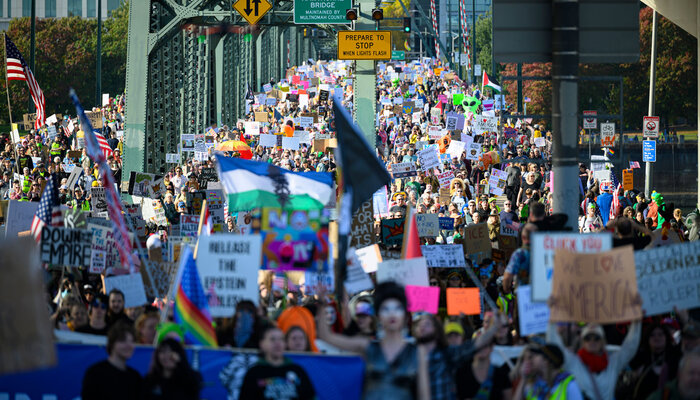


Millions of Americans marched in “No Kings” demonstrations last year, galvanized by attacks on democracy and the rule of law by the Trump administration. In recent weeks, federal agents’ killing of civilians in Minneapolis and the administration’s subsequent actions have sparked new protests. While the challenges facing American democracy can feel unique, they are in many respects part of a global phenomenon.
In recent decades, half of the world’s democracies have shown some sign of weakening. Americans can learn important lessons from these countries, particularly from those who have shown signs of reversing course. Regardless of who is in power in the United States, backsliding trends are likely to shape American politics for the foreseeable future. Examples from around the world emphasize the critical importance of protecting and maintaining core building blocks of democracy — free elections, strong democratic institutions, and independent legislatures and media.
What Is Democratic Backsliding?
Many people associate democracy with free and fair elections, but democracy as understood in the United States and other industrialized nations usually refers to a broader system that combines elections with well-established practices for the peaceful transfer of power, protections for individual rights, and widespread respect for the rule of law. “Democratic backsliding” involves the substantial weakening of these democratic practices in a shift toward authoritarianism.
Maintain Free Elections
Elections are the most direct means for citizens to hold officials accountable. When elections are completely subverted, there is much more room for government to act with impunity. In contrast, when free and fair elections are maintained, officials cannot escape the need to consider public opinion. Democratic accountability forces state actors to factor in the possibility that they will face consequences for their actions.
One of the most powerful examples of a country where elections have been almost entirely subverted is Russia. President Vladimir Putin has hollowed out the electoral system through myriad changes to the rules governing elections, including restricting political opposition. This has led to a system where opportunities to present coherent challenges to Putin are virtually nonexistent. Putin’s playbook of subverting elections has been followed in many other countries, including Belarus, Georgia, Nicaragua, and Venezuela.
Brazil presents a different story. During the rule of President Jair Bolsonaro from 2019 to 2023, Brazil experienced significant democratic backsliding, which included attacks on media independence and military neutrality. Critically, however, his efforts to change electoral rules were unsuccessful, which allowed a broad pro-democracy coalition — also notable for including traditionally nonpolitical actors — to mobilize against him in the 2022 presidential election. In the 2022 “Letter to Brazilians in defense of the Democratic Rule of Law,” for example, national business leaders were among the hundreds of thousands of Brazilian signatories to an open letter against the president’s efforts to undermine democratic institutions.
Keep Legislatures Independent
Strong national legislatures that retain their independence, have sufficient resources, and include opposition voices in decision-making are another vital protection against aspiring authoritarians. In contrast, disempowered, dysfunctional legislative bodies allow backsliding leaders to more quickly usurp control of the government.
A notable example of a national legislature that has failed to check backsliding is the Parliament of Hungary. In the years following the 2010 parliamentary election, Viktor Orbán’s Fidesz party turned the Hungarian National Assembly into a rubber stamp for partisan priorities through rule changes and patronage. These changes included lowering the threshold for constitutional revisions, which allowed Fidesz to rewrite the Hungarian constitution in 2012 in a way that significantly entrenched its power and excluded minority party influence. This transformation vastly accelerated the pace of Hungary’s shift away from democratic rule and allowed Orbán to quickly consolidate power.
In contrast, there are notable examples of strong legislatures that have stood up against democratic backsliding. The national assembly of South Korea, for instance, responded to a massive corruption scandal involving President Park Geun-hye by impeaching her. More recently, after Park’s successor, Yoon Suk Yeol, attempted a military coup, the legislature moved decisively to nullify his decree and then impeach and remove the president from office, ensuring the continued stability of South Korean democracy.
Protect Media Independence
Aspiring authoritarians almost always seek to limit media independence, going after unfavorable reporters and curtailing freedom of speech and protest, including through licensing restrictions, regulatory abuse, attacks on funding, and orchestrated ownership takeovers by regime-friendly elites. Preserving legal protection for journalists and a pluralistic media environment must be a priority.
In Italy, for example, Prime Minister Silvio Berlusconi, who was also a billionaire media magnate, controlled 3 major Italian TV channels through his private business and then was able to exert significant influence over Italian state media after he won power. In the 2000s, through these two avenues, he indirectly controlled programming for 90 percent of Italian TV viewers. In his infamous “Bulgarian Edict,” he publicly accused three journalists with popular shows on national television of using “television as a criminal means of communication.” Soon after, all three were pulled off the air. His privately owned TV channels prioritized favorable coverage and disproportionately limited dissenting political views.
Today, although media independence is still a concern in Italy, advocates have more tools than they did in Berlusconi’s days. A 2015 state media law created new safeguards to protect the editorial independence of state-owned media. In addition, the European Media Freedom Act, which went into effect last year, bolsters transparency requirements for media ownership and creates new protections against abusive lawsuits, among other provisions. The protections of this European Union regulation will be available not only in Italy but also several other countries where press freedom is threatened, including Hungary and Slovakia.
Repair Democratic Institutions
Ultimately, a return to stable democracy requires sustained effort to revitalize democratic institutions to address the underlying weaknesses that made them vulnerable to begin with. While it may be tempting for leaders to simply revert to the status quo that existed before a country started to backslide, trying to do so may actually prolong a country’s period of instability.
Peru, for instance, was ruled for more than a decade in the 1980s and 1990s by an increasingly authoritarian president, Alberto Fujimori, until he was ousted in 2000. Peru then began the transition back to full democracy, but Fujimori’s successors did little to address the country’s rampant corruption and weak safeguards for the rule of law. The result has been a series of political crises that have left Peruvian democracy exceptionally fragile.
Similarly, after Sri Lanka’s antidemocratic leader, Mahinda Rajapaksa, lost reelection in 2015, his successor did little to reform the government in response to abuses under the Rajapaksa regime. Public dissatisfaction paved the way for a restoration of the Rajapaksa dynasty several years later under the former president’s brother, Gotabaya (who was himself ousted after protesters stormed his residence in 2022).
A potential counter-example is Poland, where an opposition coalition led by Prime Minister Donald Tusk won that country’s 2023 elections emphasizing the importance of restoring Polish democracy and institutions after a decade of erosion by the authoritarian-leaning Law and Justice party. The new government has worked to institute new norms of fair process and independence for the high-level executive functions of government. But even in Poland, the government has struggled to fulfill its more ambitious reform promises while remaining faithful to its own democratic commitments.
• • •
Poland illustrates an important truth: Reversing democratic backsliding cannot be achieved through one election or other political event. It requires sustained, cross-partisan commitment to building stronger, more resilient democratic infrastructure. An understanding of what has worked to protect individual freedom and political accountability in other countries, and the potential pitfalls, allows citizens and policymakers in the United States to work toward the long-term health of our democracy.

