Explainer
The Insurrection Act, Explained
The vague and rarely used law gives the president broad power to deploy the military domestically — but it’s not a blank check.


Part of
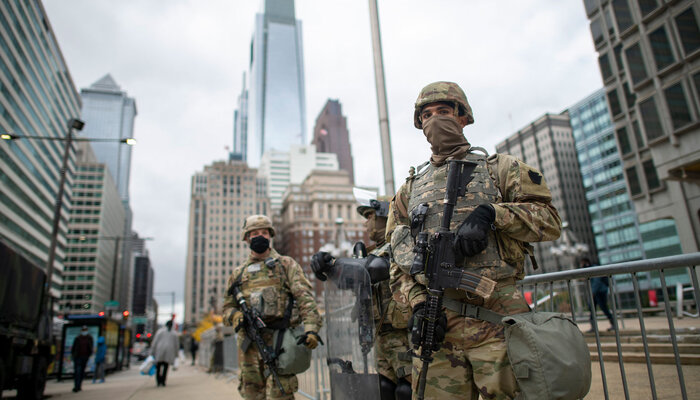
Enacted in 1792, the Insurrection Act grants the president the authority to deploy the U.S. military domestically and use it against Americans under certain conditions. While there are rare circumstances in which such authority might be necessary, the law, which has not been meaningfully updated in over 150 years, is dangerously overbroad and ripe for abuse. President Trump has threatened to invoke the Insurrection Act to deploy active-duty troops in American cities if courts shut down his efforts to federalize and deploy National Guard forces under a different law.
More on Domestic Deployment of the Military >>
What is the Insurrection Act?
The Insurrection Act authorizes the president to deploy military forces inside the United States to suppress rebellion or domestic violence or to enforce the law in certain situations. The statute implements Congress’s authority under the Constitution to “provide for calling forth the Militia to execute the Laws of the Union, suppress Insurrections and repel Invasions.” It is the primary exception to the Posse Comitatus Act, under which federal military forces are generally barred from participating in civilian law enforcement activities.
Although it is often referred to as the “Insurrection Act of 1807,” the law is actually an amalgamation of different statutes enacted by Congress between 1792 and 1871. Today, these provisions occupy Sections 251 through 255 in Title 10 of the United States Code.
What does invoking the Insurrection Act allow the president and military to do?
Under normal circumstances, the Posse Comitatus Act forbids the U.S. military — including federal armed forces and National Guard troops who have been called into federal service — from taking part in civilian law enforcement. This prohibition reflects an American tradition that views military interference in civilian government as being inherently dangerous to liberty.
Invoking the Insurrection Act temporarily suspends this rule and allows the president to deploy the military to assist civilian authorities with law enforcement. That might involve soldiers doing anything from enforcing a federal court order to suppressing an uprising against the government. Of course, not every domestic use of the military involves law enforcement activity. Other laws, such as the Stafford Act, allow the military to be used to respond to natural disasters, public health crises, and other similar events without waiving the restrictions of the Posse Comitatus Act.
In theory, the Insurrection Act should be used only in a crisis that is truly beyond the capacity of civilian authorities to manage. However, the Insurrection Act fails to adequately define or limit when it may be used and instead gives the president significant power to decide when and where to deploy U.S. military forces domestically.
When can the president invoke the Insurrection Act?
Troops can be deployed under three sections of the Insurrection Act. Each of these sections is designed for a different set of situations.
Section 251 allows the president to deploy troops if a state’s legislature (or governor if the legislature is unavailable) requests federal aid to suppress an insurrection in that state. This provision is the oldest part of the law, and the one that has most often been invoked.
While Section 251 requires state consent, Sections 252 and 253 allow the president to deploy troops without a request from the affected state, even against the state’s wishes. Section 252 permits deployment in order to “enforce the laws” of the United States or to “suppress rebellion” against the U.S. government whenever “unlawful obstructions, combinations, or assemblages, or rebellion” make it “impracticable” to enforce federal law in that state by the “ordinary course of judicial proceedings.”
Section 253 has two parts. The first allows the president to use the military in a state to suppress “any insurrection, domestic violence, unlawful combination, or conspiracy” that “so hinders the execution of the laws” that any portion of the state’s inhabitants are deprived of a constitutional right and state authorities are unable or unwilling to protect that right. Presidents Dwight D. Eisenhower and John F. Kennedy relied on this provision to deploy troops to desegregate schools in the South after the Supreme Court’s landmark decision in Brown v. Board of Education.
The second part of Section 253 permits the president to deploy troops to suppress “any insurrection, domestic violence, unlawful combination, or conspiracy” in a state that “opposes or obstructs the execution of the laws of the United States or impedes the course of justice under those laws.”
What are the limitations on deployment under the Insurrection Act?
Although the Insurrection Act appears to confer wide-ranging authority, the Department of Justice has long taken the position that the law is “limited . . . by the Constitution and by tradition.” In a 1964 memorandum, the deputy attorney General wrote that the law may be invoked in three circumstances: when a state requests help in putting down an insurrection, when deployment is needed to enforce a federal court order, or when “state and local law enforcement have completely broken down.”
Moreover, even on its face, the Insurrection Act only permits the use of troops to enforce either federal laws or a narrow category of state laws (essentially, civil rights protections). Troops could not be used, for instance, to combat street crime, as that type of criminal activity is governed by state and local laws.
Most important, no statute can override the Constitution. Accordingly, troops deployed under the Insurrection Act may not violate individuals’ constitutional rights. They may not, for example, search a person’s home without a warrant. And while the Insurrection Act is an exception to the Posse Comitatus Act, it is not an exception to other federal laws that might apply to their conduct (for instance, the law criminalizing the presence of federal troops at polling places).
How has the Insurrection Act been used in the past?
The Insurrection Act has been invoked about 30 times throughout American history. Presidents George Washington and John Adams used it in response to early rebellions in the states against federal authority. President Abraham Lincoln invoked it at the start of the Civil War, and President Ulysses S. Grant used it to crush the first incarnation of the Ku Klux Klan in the 1870s. Several other presidents, including Andrew Jackson, Rutherford B. Hayes, and Grover Cleveland, have deployed troops under the Insurrection Act to intervene in labor disputes, almost always on the side of employers.
Most famously, Presidents Eisenhower, Kennedy, and Lyndon B. Johnson all invoked the Insurrection Act during the civil rights movement to enforce federal court orders desegregating schools and other institutions in the South. In the latter half of the 20th century, Presidents Johnson and George H.W. Bush each invoked the law in response to massive civil unrest that caused dozens of fatalities. These 20th-century incidents reflect a modern consensus that the Insurrection Act is an exceedingly specialized president tool. Indeed, in the past 130 years, it has been used exclusively in two circumstances: either when state and local law enforcement were overwhelmed and governors asked for federal military assistance or when state authorities were themselves actively obstructing federal civil rights laws or failing to protect constitutional rights.
When was the Insurrection Act last invoked?
The Insurrection Act was last invoked in 1992, when the governor of California requested military aid from President George H.W. Bush in response to civil unrest in Los Angeles that followed the acquittal of four white police officers charged with beating Black motorist Rodney King. The violence in Los Angeles killed 63 people and resulted in one billion dollars’ worth of property damage. At 33 years and counting, this is the longest period the United States has ever gone without an invocation of the Insurrection Act.
No president has invoked the Insurrection Act without a request from the state concerned since Johnson did so to provide protection for civil rights activists in Alabama marching from Selma to Montgomery in 1965.
Can courts review Insurrection Act deployments?
Nothing in the text of the Insurrection Act defines “insurrection,” “rebellion,” “domestic violence,” or any of the other key terms used in setting forth the prerequisites for deployment. In the 1827 case Martin v. Mott, the Court ruled that “the authority to decide whether [an exigency requiring the militia to be called out] has arisen belongs exclusively to the President, and . . . his decision is conclusive upon all other persons.”
This broad language, however, must be understood in context. The case involved a soldier who refused an order to mobilize during the War of 1812. He then challenged the fine imposed on him, arguing that the Insurrection Act didn’t authorize his mobilization. The Court found that individual soldiers couldn’t decide for themselves whether the president had lawfully called them into service; the ability of judges to review Insurrection Act deployments simply wasn’t before the Court.
In any event, even if Mott stands for the general rule that courts can’t review a president’s decision to invoke the Insurrection Act, there are exceptions. In subsequent cases, the Supreme Court has suggested that courts may step in if the president acts in bad faith, exceeds “a permitted range of honest judgment,” makes an obvious mistake, or acts in a way manifestly unauthorized by law.
Moreover, even in cases where the courts will not second-guess the decision to deploy troops, the Supreme Court clarified in Sterling v. Constantin (1932) that courts may still review the lawfulness of the military’s actions once deployed. In other words, judges may hear lawsuits claiming that federal troops deployed under the Insurrection Act have violated constitutional rights or other federal laws.
Is invoking the Insurrection Act the same as declaring martial law?
The Insurrection Act does not authorize martial law. The term “martial law” has no established definition, but it is generally understood as a power that allows the military to take over the role of civilian government in an emergency. By contrast, the Insurrection Act generally permits the military to assist civilian authorities (whether state or federal), not take their place. Under current law, the president has no authority to declare martial law.
How does the Insurrection Act differ from the law Trump used to federalize and deploy National Guard soldiers in Los Angeles, Portland, and Chicago?
President Trump relied on an obscure law (10 USC § 12406) to federalize National Guard forces and deploy them in Los Angeles, Portland, and Chicago (the Portland and Chicago deployments are currently blocked by the courts). Section 12406 permits federalization of the National Guard when there is an invasion or rebellion (or a danger of invasion or rebellion) or when the president “is unable with the regular forces to execute the laws of the United States.”
Because no previous president has used Section 12406 in this manner, courts are still in the process of determining its proper interpretation and scope. An aggressive reading of the law could turn it into something very similar to the Insurrection Act. But an Insurrection Act invocation is still a more powerful tool, and would represent a substantial escalation, in several respects.
Presidents can deploy active-duty troops, not just federalized National Guard forces, under the Insurrection Act. The bar for deployment under the Insurrection Act is in some ways lower, as there is no express requirement that the president be “unable” to execute the law without troops. There is arguably a higher level of deference required, although the Ninth Circuit federal appeals court has applied similar deference in reviewing Section 12406 deployments. And the Insurrection Act is widely understood to be an exception to the Posse Comitatus Act, while a federal judge in September held that Section 12406 is not such an exception (that decision has been stayed pending appeal).
How should the Insurrection Act be reformed?
The lack of clear standards within the Insurrection Act itself, combined with the Supreme Court’s ruling in Martin v. Mott, has created a situation where the president has extremely broad discretion to deploy federal troops in cases of civil unrest. Insufficiently constrained authority to use the military domestically has always been dangerous. In the 21st century, it is also unnecessary and untenable. The United States has changed profoundly in the 150 years since the Insurrection Act was last amended, as have the capabilities of federal, state, and local law enforcement authorities and the expectations of the American people. The Insurrection Act — arguably the most potent of the president’s emergency powers — should reflect those realities.
To address these concerns, Congress should amend the Insurrection Act to define more clearly and precisely what situations may trigger it. Congress also should establish mechanisms for review of the president’s decision that will guard against abuse while still preserving the president’s flexibility in a crisis. In the meantime, if the Insurrection Act comes before the courts, judges should determine, as the Department of Justice has in the past, that the law is limited by the Constitution and tradition.
More from the Explainers collection
-
The Posse Comitatus Act, Explained
The law generally prevents the president from using the military as a domestic police force. -
Habeas Corpus, Explained
The centuries-old tool is a bedrock principle of constitutional democracy that protects against unlawful detention. -
The 19th Amendment, Explained
It took more than a century of fighting by generations of activists to achieve suffrage for all American women.


Stay up to date