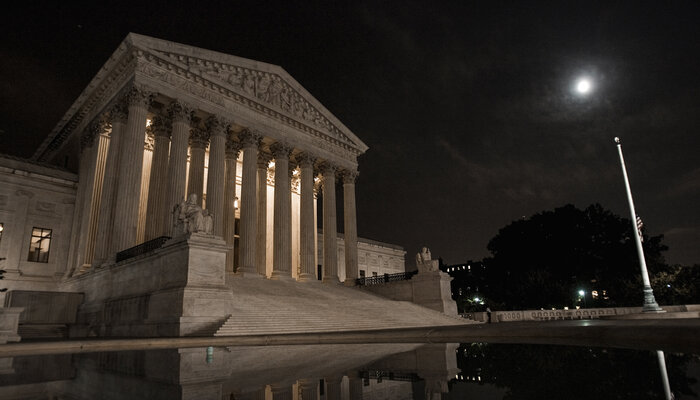


The New York Times recently published a trove of Supreme Court memos that offer a rare glimpse into the internal workings of the Supreme Court’s so-called shadow docket. They lay bare how the Court has held the Trump administration to a far more deferential standard than its Democratic predecessors — and how the shadow docket has enabled the Court to avoid accountability.
The memos date to 2016, when a majority of justices voted to bypass the lower courts to block the Obama administration’s signature climate policy, the Clean Power Plan. At the time, it was an unprecedented use of the Court’s shadow docket. Also known as the emergency docket, the shadow docket refers to applications that seek action from the Supreme Court before the case is decided on the merits. Historically, its use was generally limited to procedural issues or requests to block serious, irreparable harms, such as a pending execution. But the Court’s use of the shadow docket shifted with the Court’s 2016 climate policy ruling, which skipped the normal litigation process in order to block a national policy.
Since then, the shadow docket’s use has exploded in both frequency and impact. The second Trump administration has filed a record number of shadow docket applications and has won 80 percent of the time. In the vast majority of these rulings, the Court has provided little or no reasoning for its decision.
The leaked memos put the Court’s decision-making process in the light of day. Chief Justice John Roberts, who urged the Court to block the Clean Power Plan, warned that the Environmental Protection Agency’s regulations would generate “substantial and irreversible reordering of the domestic power sector,” leading to “irreparable harm.” As Georgetown University Law Professor Steve Vladeck has observed, this was the wrong standard given that the lower court hadn’t even been given an opportunity to rule in the case.
But even more troubling was what Roberts’s analysis left out of its consideration of irreparable harm, part of the test the Court applies when considering a request for a stay of a lower court ruling. Roberts gave no weight to the harms that the Court’s order would impose on the Obama administration’s ability to effectuate its policy priorities — much less its impact on the environment. Indeed, Roberts’s analysis didn’t engage with any counterarguments at all.
Significantly, Roberts’s reasoning is also wholly inconsistent with how he and other conservative members of the Court have been assessing irreparable harm during the second Trump administration. Over the past year, the Court has repeatedly issued stays requested by the Trump administration where there was no apparent irreparable harm to the government, other than the generalized harm it faces from any delay in implementing a desired policy. For instance, the Court, through its shadow docket, allowed mass layoffs at the Education Department, racial profiling in immigration sweeps, and the termination of legal immigration status for hundreds of thousands of people.
It is hard to read the 2016 memos and see a principled distinction. The memos gave no weight to the irreparable harm to the Obama administration’s priorities in blocking a major environmental policy. And the Court has since greenlit Trump administration policies that have generated a far greater reordering of our political, social, and economic institutions than anything envisioned by the Clean Power Plan.

