
One of the defining features of the second Trump administration has been its unprecedented assertion of presidential power — with the frequent imprimatur of the Supreme Court and its so-called shadow docket, also known as its emergency docket or interim docket. Last March, the Supreme Court issued its first shadow docket ruling related to actions taken by the Trump administration. In the year since then, the Court has considered more than 30 such applications from the administration and ruled in its favor 80 percent of the time, usually without oral arguments and with little or no explanation.
The Supreme Court is not a secret tribunal. It has an obligation to the public to explain its reasoning, especially on high-profile cases that involve the rights of large numbers of people or fundamental issues of democratic governance.
The shadow docket refers to applications that seek immediate action from the Court. These matters are expedited compared to the Court’s normal process for considering cases on the merits, which can take many months. Historically, the shadow docket was typically limited to procedural issues or requests to halt lower court actions in the face of serious, irreparable harm — for example, a pending execution. Because of their urgent nature, shadow docket applications usually do not receive extensive briefing or oral arguments, and decisions are often issued with very limited, if any, explanation.
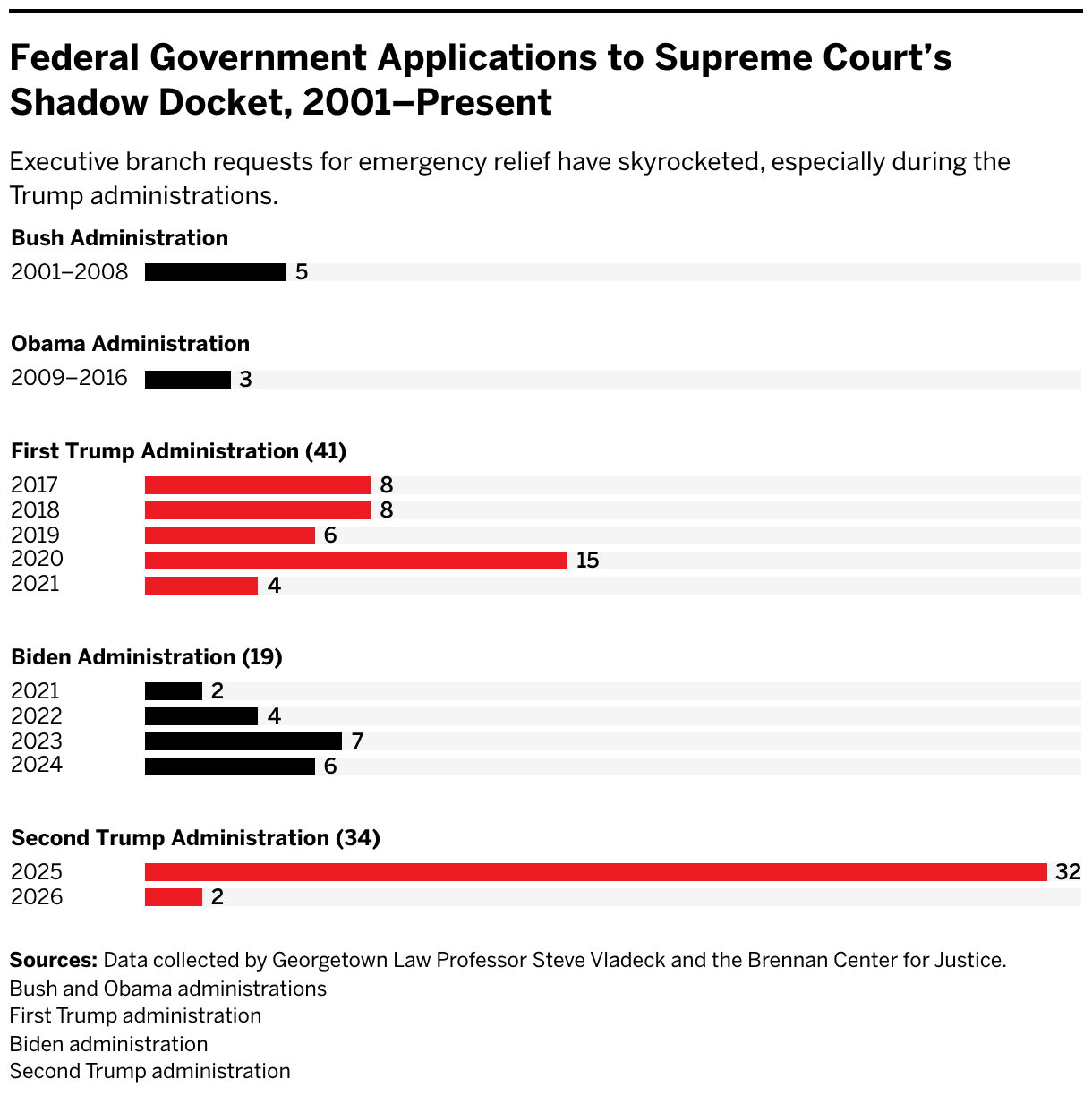
But in recent years, the Court has dramatically expanded its use of emergency rulings, prompting a surge in shadow docket motions. Between January 2001 and January 2017, the U.S. government, the most frequent litigant in the Supreme Court, asked the Court for emergency relief only 8 times. By contrast, President Trump’s first administration sought emergency relief 41 times. That number dropped to 19 during the Biden administration. Since Trump’s return to office, his second administration has filed 33 emergency applications, most of which have asked the Court to halt lower court injunctions blocking executive orders or other administration actions. The Supreme Court has expanded its use of the shadow docket in other contexts as well, including in cases related to voting and elections.
While these shadow docket applications are interim rulings that do not reflect a final judgment on the law, their stakes are often immense. Shadow docket decisions have overruled lower courts to, among other things, allow the administration to conduct immigration stops based on apparent ethnicity, deport immigrants to countries with which they have no connection, strip legal immigration status from hundreds of thousands of non-U.S. citizens, and fire thousands of civil servants. In each of those cases, lower courts had blocked the administration’s actions after determining that it had likely violated the law.
Perhaps most strikingly, the Court has repeatedly broken with precedent and advanced new legal principles to expand presidential powers via the shadow docket’s truncated process. In Trump v. Wilcox, the Supreme Court addressed whether the president has the power to fire members of two independent agencies, the National Labor Relations Board and the Merit Systems Protection Board, which have statutoryprotections against removal without good cause. Under a 1935 Supreme Court precedent, Humphrey’s Executor v. United States, such limits on presidential removal are legally enforceable, and lower courts applied this precedent to block the president’s actions. Yet the Supreme Court used the shadow docket to allow the firings to go forward, effectively overruling Humphrey’s Executor without even naming the case. Four months later, the Court similarly allowed the president to fire a member of the Federal Trade Commission in Trump v. Slaughter.
Both rulings prompted a sharp rebuke by Justice Elena Kagan, who argued in her Slaughter dissent that the Court’s emergency docket “should not be used . . . to transfer government authority from Congress to the President, and thus to reshape the Nation’s separation of powers.” The Supreme Court has now taken up Slaughter on its merits docket for the 2025–26 term.
The Court also appears to have used the shadow docket to silently change the legal standard it applies when halting lower court injunctions against the government. The test for such a stay has long included an evaluation of whether the applicant risks irreparable harm if the injunction isn’t put on hold. Yet over the past year, the Court has repeatedly issued stays requested by the Trump administration where there was no apparent harm to the government, other than the generalized harm it faces from any delay in implementing a desired policy. The Supreme Court has neither explained this new standard nor provided a justification as to why such a deferential approach is appropriate.
The Court’s expanded use of the shadow docket, including to advance major policy and constitutional changes, is an alarming departure from traditional judicial review. Particularly in high-stakes cases where the president is asserting expansive powers, the Supreme Court should provide reasoned analysis for its rulings so that the public can assess whether the Court’s justifications are fair.
Reasoned analysis is also critical for lower court judges, who have been left with little guidance as to the basis for the Court’s shadow docket rulings and how to apply them to other cases. As Justice Sonia Sotomayor wrote in her dissent in Noem v. Perdomo, where the Court, without explanation, paused a lower court order that barred racial profiling during immigration stops in Los Angeles, “neither the District Court nor the parties will know whether the majority believed the key issue was standing, the merits, or the scope of relief . . . . It will be anyone’s guess [what] the majority thought.”
Lower court judges have spoken out about how this lack of guidance has impacted their ability to do their job. A sitting federal judge, speaking anonymously to NBC News, said that “judges in the trenches need, and deserve, well-reasoned, bright-line guidance. Too often today, sweeping rulings arrive with breathtaking speed but minimal explanation, stripped of the rigor that full briefing and argument provide.”
The Supreme Court’s shadow docket rulings have also invited maximalist interpretations of presidential power by the Trump administration. For example, in McMahon v. New York, the Court issued a stay without explanation that allowed Department of Education employees to be terminated while litigation proceeds, as part of the Trump administration’s efforts to dismantle the agency. While most of the legal issues before the Court were procedural, Secretary of Education Linda McMahon declared that the Court had “confirmed” the president’s “ultimate authority” to move ahead with firings. That was almost certainly not the basis for the Court’s ruling, but the Court’s silence as to its reasons allowed the administration to fill in the blanks.
Several of the justices have attempted to justify the Court’s lack of reasoning by suggesting that shadow docket decisions are merely interim decisions. Justice Brett Kavanaugh, for example, has warned that providing written shadow docket rulings risks a “lock-in effect” when the Court has not made a final decision on the merits. This both understates the practical impact of the Court’s shadow docket rulings and overstates the extent to which the Court would be bound by any shadow docket reasoning. The Court could easily make clear that its analysis is preliminary, while offering far greater clarity to litigants, lower court judges, and the public.
To be sure, the Trump administration’s record on the shadow docket is not all wins. In December, for example, the Court refused to block an order barring the president’s federalization and deployment of the National Guard in Illinois — an important limit on executive power, and one where the Court provided legal reasoning. The Supreme Court has also issued major shadow docket rulings outside of litigation related to the Trump administration. Just this week, the Court halted a California policy that restricts teachers from notifying parents about students’ transgender status, and it blocked a New York state court ruling that had ordered the redrawing of a congressional district.
The Court’s overall shadow docket record is troubling and damaging. At a time when our democratic system is under grave strain, the Supreme Court should be both a bulwark and a model for the rule of law. Its shadow docket jurisprudence has consistently failed to meet this standard.