Alito’s sleight of hand is outrageous but not surprising.
The Supreme Court first took its sledgehammer to the Voting Rights Act in 2013. In Shelby County v. Holder, the justices suspended the provision requiring states and localities with a history of racial discrimination in voting to get approval from the federal government before they could make changes to election rules, a process known as preclearance. To get permission, the state or locality had to prove that any changes wouldn’t fall harder on racial and ethnic minorities than on white voters.
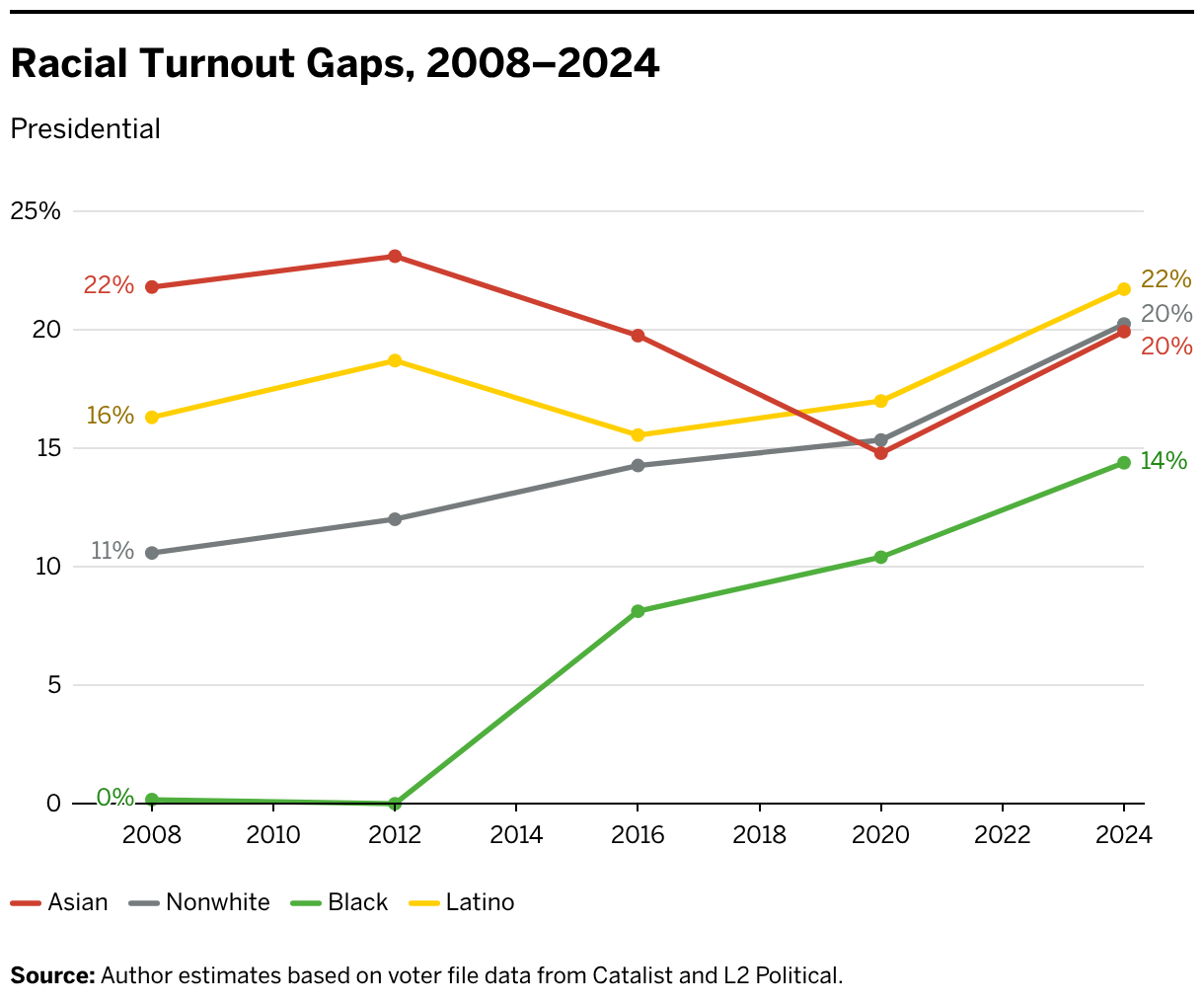
In the majority opinion, Chief Justice John Roberts cited the same two elections that Alito picked out in the new Callais decision: 2008 and 2012. Pointing to the fact that the racial turnout gap narrowed to zero in those years, Roberts argued that the Voting Rights Act had done its job and preclearance could be safely suspended.
As my colleague Michael G. Miller and I explain in our forthcoming book on the Voting Rights Act and Shelby County, the ruling was suspect even at the time. There was good reason to believe that 2008 and 2012 were anomalies — not the end of the racial turnout gap — in light of Obama’s candidacy driving up Black turnout.
And there was another possibility that the majority also refused to consider: that the protection of the law’s approval requirement itself was responsible for the narrowing of the turnout gap. As Justice Ruth Bader Ginsburg put it in her dissent, “Throwing out preclearance when it has worked and is continuing to work to stop discriminatory changes is like throwing away your umbrella in a rainstorm because you are not getting wet.”
And yet the Supreme Court continued to hammer away at the Voting Rights Act. In the 2021 case Brnovich v. Democratic National Committee, the Supreme Court effectively nullified the ability to use Section 2 of the Voting Rights Act to challenge laws that make it harder for minority voters to cast a ballot. The justices did this in direct violation of a promise in Shelby County to leave Section 2 intact. And in this week’s case, they finished off Section 2.
Which brings us back to Alito’s claim in Callais that racism in elections is over.
What Alito doesn’t mention is that since 2013, the racial turnout gap around the nation has exploded. It beggars belief that Alito was unaware of this fact. He reached back nearly 20 years to include the only two elections in American history in which Black and white turnout reached parity. Surely, he or one of his clerks checked to see whether they could update the Shelby County argument that racism in American elections was over by using more recent data. But the data is unambiguous: Roberts’s assurances in Shelby County were spectacularly wrong.
What’s worse, our research shows that much of the increase in the turnout gap was caused by the disastrous Shelby County ruling. Make no mistake: The turnout gap was always likely to expand when Obama was no longer running for office. But it would not have widened this much if preclearance were still in effect. How do we know this? In a recent peer-reviewed academic journal article, Miller and I show that Shelby County directly increased the racial turnout gap in parts of the country that were once covered by the law’s preclearance requirement. In fact, we estimate that by the 2022 midterm elections, the Shelby County effect was causing hundreds of thousands of ballots to go uncast by minority voters.
“In large part because of the Voting Rights Act, our Nation has made great strides in eliminating racial discrimination in voting,” Alito wrote in Callais. “And if, as a result of this progress, it is hard to find pertinent evidence relating to intentional present-day voting discrimination, that is cause for celebration.”
There was reason to celebrate . . . 13 years ago. The Voting Rights Act was at its strongest point ever, Black political participation rivaled white participation, and the nation had elected its first minority president.
But history didn’t stop then, and things have only gotten worse. As Alito himself wrote this week, “Far more germane [for understanding our current world] are current data and current political conditions.” He should take his own advice.