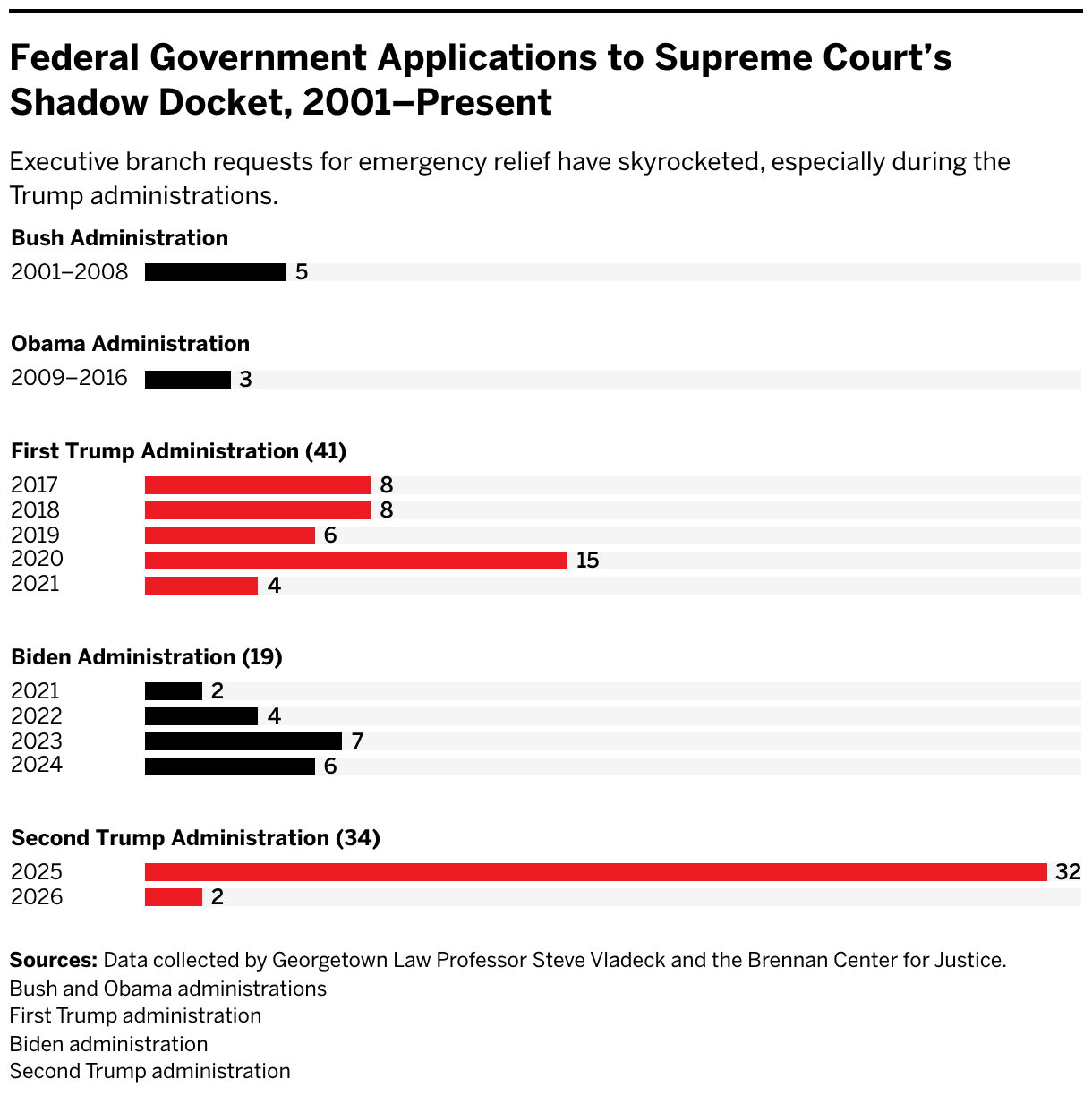
The Supreme Court is quietly changing the way it works, more frequently operating in secret than in an open courtroom. A recent ProPublica analysis of the 2024–2025 term uncovered that, for the first time, the Supreme Court decided more substantive cases on its shadow docket than on its traditional merits docket. That growing reliance on a truncated, less transparent process for significant cases falls short of the standards we should expect of our highest court.
Historically, the shadow docket — also known as the emergency or interim docket — was reserved for procedural matters and requests for the Supreme Court to swiftly pause lower court orders in the face of serious, irreparable harm, such as a pending execution. Unlike cases on the merits docket, those matters didn’t tend to require extensive briefing or oral arguments because there was a justifiable reason for a litigant to move quickly.
But in recent years, the shadow docket has exploded and is now being used to tentatively decide important legal questions. Although these rulings do not represent a final judgment on the merits — shadow docket cases typically continue through the normal litigation process in the lower courts, and some later make their way onto the Supreme Court’s merits docket — they can carry immense stakes. Yet they are still too often decided without sufficient briefing, oral arguments, or the signed opinions explaining the Court’s reasoning that accompany merits decisions.