
Skip Navigation
Gavel in a dark room
isayildiz/Getty
Analysis

The Supreme Court Is Moving More Cases into the Shadows

For the first time, the Court decided more substantive cases on its shadow docket than on its traditional merits docket.

Gavel in a dark room
isayildiz/Getty
July 13, 2026

The Supreme Court is quietly changing the way it works, more frequently operating in secret than in an open courtroom. A recent ProPublica analysis of the 2025–2026 term uncovered that, for the first time, the Supreme Court decided more substantive cases on its shadow docket than on its traditional merits docket. That growing reliance on a truncated, less transparent process for significant cases falls short of the standards we should expect of our highest court.

Historically, the shadow docket — also known as the emergency or interim docket — was reserved for procedural matters and requests for the Supreme Court to swiftly pause lower court orders in the face of serious, irreparable harm, such as a pending execution. Unlike cases on the merits docket, those matters didn’t tend to require extensive briefing or oral arguments because there was a justifiable reason for a litigant to move quickly.

But in recent years, the shadow docket has exploded and is now being used to tentatively decide important legal questions. Although these rulings do not represent a final judgment on the merits — shadow docket cases typically continue through the normal litigation process in the lower courts, and some later make their way onto the Supreme Court’s merits docket — they can carry immense stakes. Yet they are still too often decided without sufficient briefing, oral arguments, or the signed opinions explaining the Court’s reasoning that accompany merits decisions.
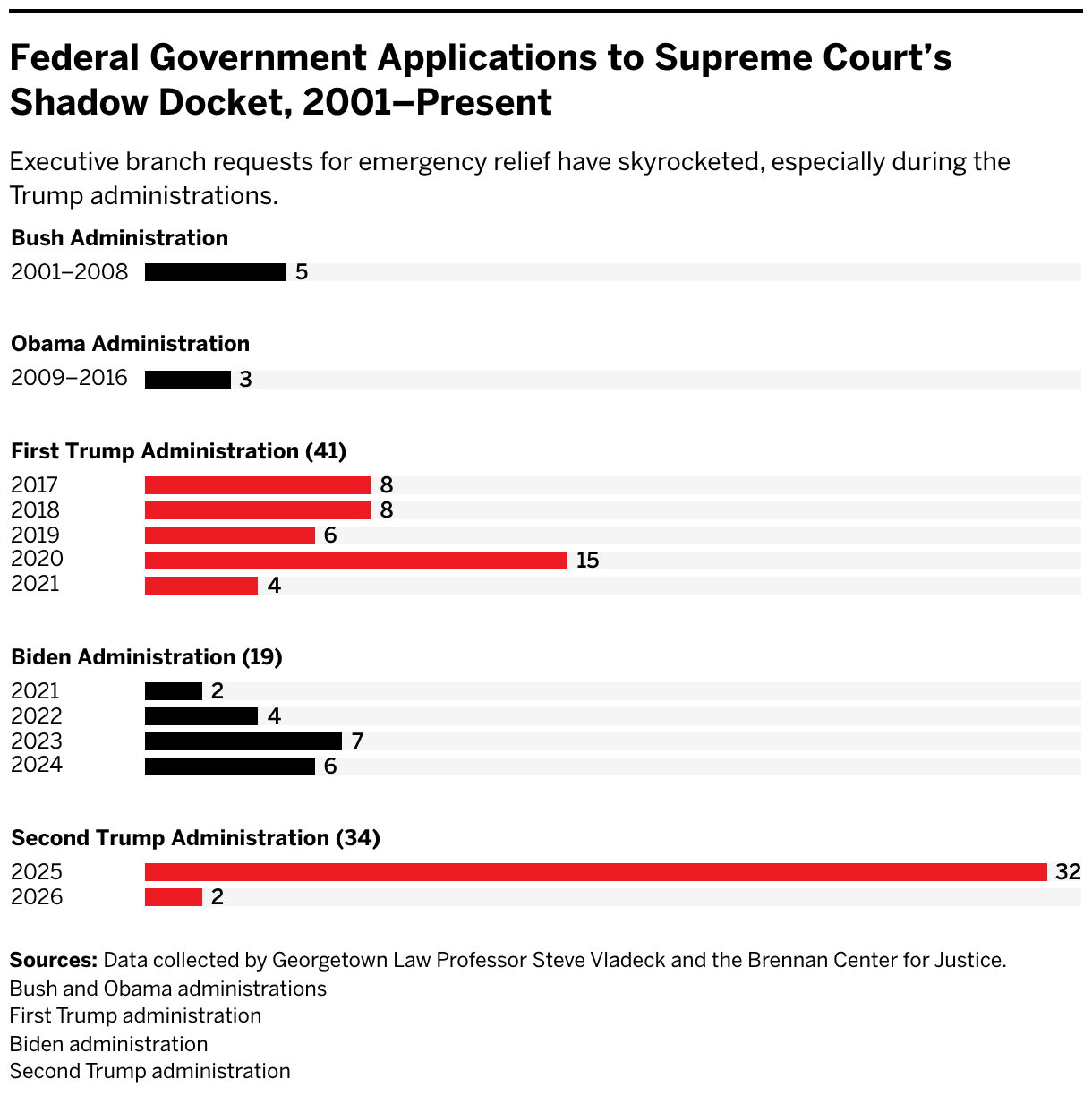
This new era of shadow docket decision-making arguably started 10 years ago when the Court skipped the normal litigation process to block a key environmental policy from the Obama administration. In 2016, that was an unprecedented move, prompting some of the justices to internally push back and express concern over the Court’s willingness to intervene, according to memos obtained by The New York Times. A decade later, this type of intervention has become the norm — and the Trump administration is making full use of it.

Since taking office in January 2025, the Trump administration has filed 34 emergency applications, most of which have asked the Court to halt lower court injunctions blocking executive orders or other administration actions. Out of those applications, the Court has issued 28 rulings, 75 percent of which have been, at least partially, in Trump’s favor. While these decisions are not final, their consequences can be devastating. Among other things, the Court has allowed the administration to conduct immigration stops based on apparent ethnicity, deport immigrants to countries with which they have no connection, strip legal immigration status from hundreds of thousands of non-U.S. citizens, and fire thousands of civil servants.

The shadow docket’s growth to the point of now outpacing the traditional merits docket is an alarming departure from traditional judicial review. The highest court in the land should abide by a decision-making process rooted in deliberation, consistency, and transparency. Abandoning those values and issuing important (albeit provisional) decisions by way of the shadow docket undermines its institutional legitimacy and invites judicial chaos. Indeed, many judges have voiced frustration over the Court’s unwillingness to explain itself. As one sitting federal judge said to NBC News, “Judges in the trenches need, and deserve, well-reasoned, bright-line guidance. Too often today, sweeping rulings arrive with breathtaking speed but minimal explanation, stripped of the rigor that full briefing and argument provide.”

Cases being fast-tracked to the Court by way of the shadow docket is not inherently wrong, and there is real value in some cases being litigated on an expedited basis. But the sheer volume of cases now being decided this way — while the merits docket continues to shrink — paints a picture of a Court not operating as it should. If our nation’s most important legal decisions are being handed down without briefing, argumentation, or reasoned analysis, Congress must act to reform the Court and make it a more democratically accountable institution.