Voters predict election winners based on prediction market odds.
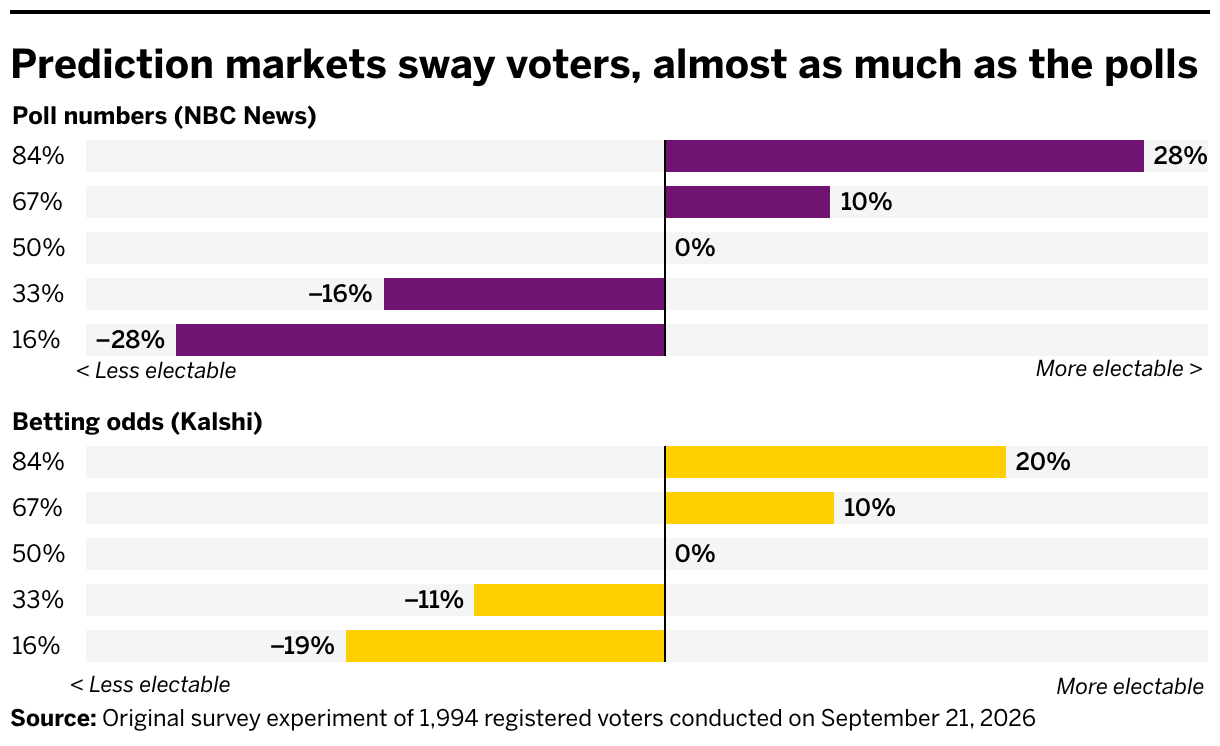
In the study, voters were asked to indicate the likely winner in a series of pairs of hypothetical congressional candidates. They were shown each candidate’s background characteristics — such as race, age, party, and previous occupation — alongside their chances of winning as estimated by both NBC News polling and Kalshi. Poll numbers and prediction market odds varied randomly to determine how respondents reacted if the two disagreed.
The results show that prediction market odds shift voters’ expectations substantially: The higher a candidate’s odds of winning on Kalshi, the more likely they were to be selected as the projected winner. Voters were 10 percentage points more likely to say a candidate with 67 percent odds on Kalshi would win, compared to a candidate with 50 percent odds. For a candidate whose Kalshi odds were at 84 percent, their perceived electability rose by 20 percentage points.
Prediction market odds can also dissuade voters from believing in a candidate’s electability. Voters were 11 percentage points less likely to say a candidate with 33 percent odds on Kalshi would win and 19 percentage points less likely to say a candidate with 16 percent odds would win. Prediction market odds had a similar effect on perceived electability as traditional polls, and a stronger effect than any of the candidates’ background traits, including demographics, occupation, or previous experience.
The implications of this finding are stark since few state-level races have regular polls for the electorate to check. Small-volume prediction markets, such as those for downballot contests, are particularly easy to move, making them vulnerable to attempts at odds manipulation. Furthermore, the money behind prediction markets is not disclosed, so voters cannot see who is shaping the odds in a given race.
At the same time, voters are overwhelmingly skeptical of election prediction markets.
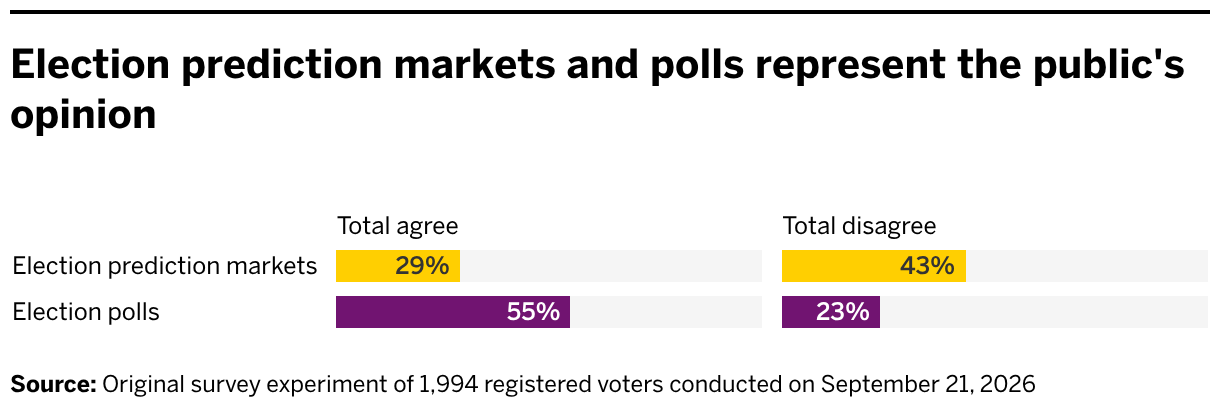
Proponents argue that prediction markets represent the “wisdom of the crowd” — put another way, more accurate forecasts. In this study, voters disagreed with such a characterization. Only 19 percent of voters believed that election prediction markets were accurate, about half the share who said the same for traditional polls (37 percent). Similarly, only 29 percent of voters said that election prediction markets represent the public’s opinion, compared to 55 percent for traditional election polls.
Notably, there is a fair amount of uncertainty among the public: When asked whether prediction markets are accurate and whether they represent the public, 37 percent and 29 percent of voters, respectively, neither agreed nor disagreed. Nevertheless, among those with a clear opinion, more were skeptical of prediction markets than not. Taken together with the experimental results, these findings suggest that while skepticism of prediction market odds is widespread, it does not protect voters from being influenced by them.
More than 8 in 10 voters want stronger government action on prediction markets.
One potential response to counteract these effects is to simply caution voters about prediction markets. The study tested that approach and found that such caution had no impact on voters’ reliance on prediction market odds to decide the likely winner. As such, stronger regulation of prediction markets is necessary.
Voters strongly favor government action. Only 14 percent said prediction markets, election-related or otherwise, should not be regulated at all. Nearly half (48 percent) said prediction markets should be regulated more strongly than they are now. Another 23 percent said some types of prediction markets should be completely banned, while 16 percent said all prediction markets should be banned completely. Calls for regulation may relate to issues with prediction markets beyond elections, such as insider trading on the death of political leaders or betting on key drug approvals and clinical trials.
Amidst demands to regulate prediction markets, policymakers and regulators have stepped up their scrutiny. But companies are unlikely to go down without a fight. When Minnesota enacted a law banning Kalshi and Polymarket this year, the companies successfully persuaded a federal judge to block the law before it took effect. Until the legal battles settle, the burden will continue to fall on voters to discount prediction markets. However, the results of this study suggest that is easier said than done.
Methodological Notes
The survey was fielded to a nationally representative sample of 1,994 self-identified registered voters on September 21, 2026. Each respondent completed five pairs of candidate comparisons. A statistical measure called an average marginal component effect was used to calculate the causal effect of prediction market odds and traditional polling on perceived electability. For questions about the study, please contact Yeji Lee.