

You’re reading Major Questions, Jesse Wegman’s newsletter on the Supreme Court — click here to receive it in your inbox twice a month.
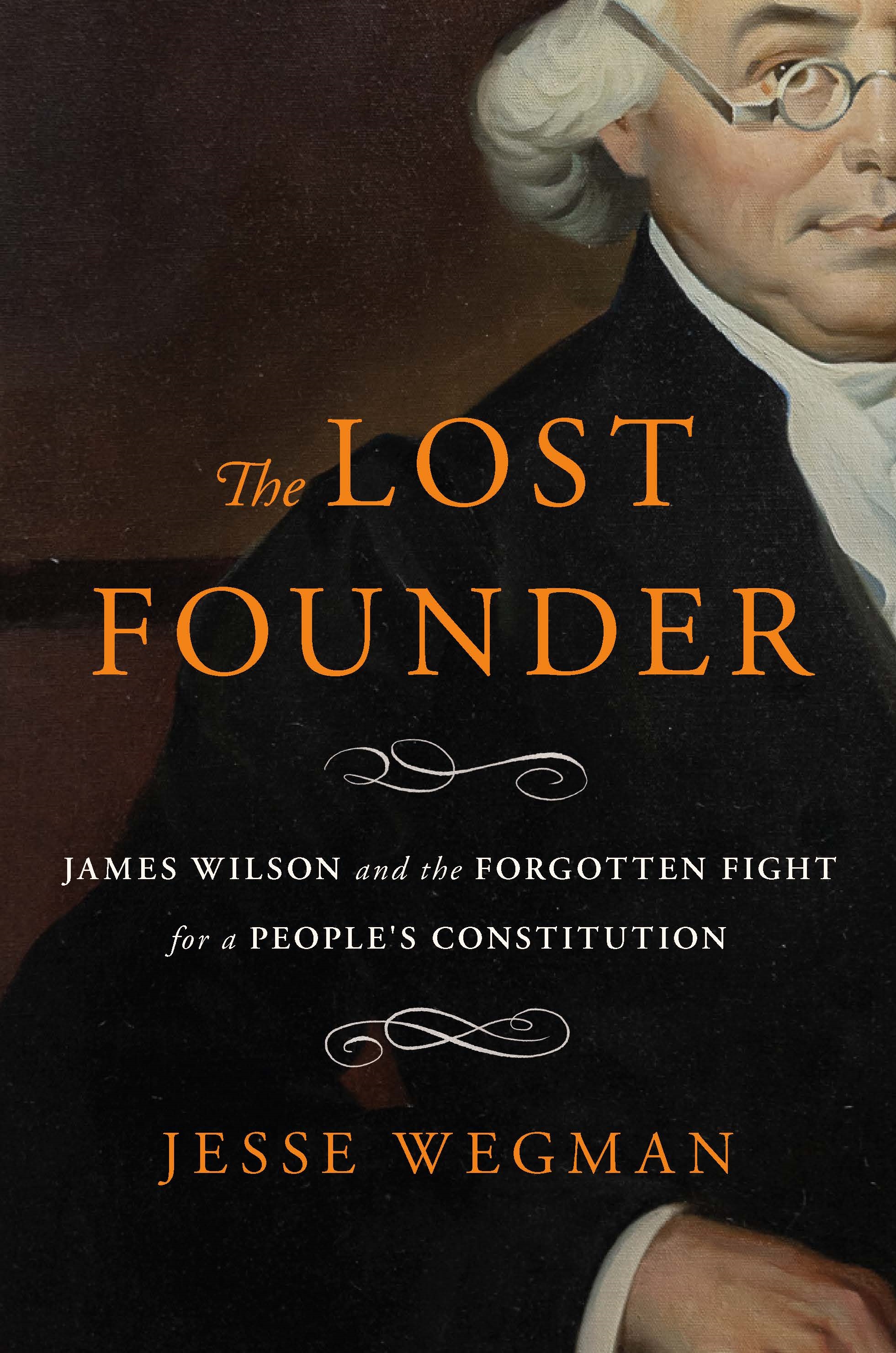
This week I want to introduce you to a Supreme Court justice and American founder you likely haven’t heard of, although I hope that’s about to change with my new book, The Lost Founder. It is the first mainstream biography of James Wilson, the most democratic of all the founders and a visionary who saw the future of America more clearly than any of his peers.
Wilson was born in 1742 to a poor farming family in the Scottish lowlands. He was raised to be a minister, but instead crossed the sea to America in 1765, where he quickly became one of the leading voices for independence. Thanks to his upbringing, which trained him in democratic principles through school and the church, Wilson was uniquely positioned to argue on behalf of a country more democratic than any of his fellow founders dared to imagine.
Driven by that worldview, he wrote an essay that multiple historians believe inspired the preamble of the Declaration of Independence, he wrote the first draft of the Constitution — including the immortal opening words “We the People,” to emphasize who was ultimately in charge — and he was named to the first Supreme Court by George Washington. By 1790, he was one of the wealthiest and most respected men in the country, sitting atop the pinnacle of American political and legal life. Less than a decade later, he was dead, a victim of malaria he caught while hiding out in the back room of a tavern in coastal North Carolina. A reckless and compulsive speculator in lands, Wilson spent his last years buried under a mountain of debt, on the run from his creditors and the law, even while he was still a sitting justice of the Supreme Court.
The Lost Founder will be published on June 23 by Celadon Books, but I’m giving my newsletter readers a small early taste of it here, with a few excerpts from the final chapter. As a response to the overly tidy histories preferred by many who call themselves originalists, I am highlighting the complexity and pathos that defined so many of our famous founders’ lives. We begin in 1796 Philadelphia, two and a half years before Wilson’s demise.
• • •
The year 1796 started badly for Wilson, and then it got worse.
In March, George Washington denied him the chief justiceship for the second time. The position had been open for nine months by then, and Washington had multiple chances to offer Wilson the job. But Wilson’s disastrous finances were now widely known, and the president had no desire to expose the leadership of a coordinate branch of government to chaos and imputations of corruption.
Meanwhile, Wilson’s law students—who, like the president’s nephew Bushrod, had paid dearly for the privilege of studying with the greatest lawyer in the nation—found him to be absent or distracted most of the time. As a teacher, he had grown “rare, distant and reserved . . . almost useless,” according to the recollections of one former student, Samuel Sitgreaves.
By the summer, the American economy was in full-blown crisis after the bubble burst in land values, upending credit markets and causing a national panic. Wilson and other major speculators like Robert Morris, who had been the wealthiest man in America, began to default on their loans.
“Ruin is staring in ye faces of most of ye land speculators,” Edward Burd, an elite Philadelphia lawyer, wrote to Jasper Yeates, a state supreme court justice and longtime associate of Wilson’s. “The day of reckoning is at hand, and no prospect of disposing of their lands. There are a great number of judgments against your friend Wilson lately confessed by him. People speak very freely as to the situation he is likely to be in very shortly.” . . .
His friend Benjamin Rush wrote that Wilson was “deeply distressed; his resource was reading novels constantly.” He skipped the entire fall term of the Supreme Court.
By December, the biggest speculators in Philadelphia were leaving town or getting locked up. “This place furnishes indication of great depravity; bankruptcies are frequently happening,” Chauncey Goodrich, a Connecticut congressman, wrote to treasury secretary Oliver Wolcott about the financial panic of 1796. “Mr. Morris is greatly embarrassed. ’Tis said that Nicholson has fled to England; that Judge Wilson has been to gaol and is out on bail; but there are so many rumors I vouch for the credit of neither.”
The rumor about Wilson, at least, was true, according to Morris. “Judge W- n was taken by the Sheriff last night,” he wrote to Nicholson on December 8. “It will be my turn next.” He added, “I am seriously uneasy for W- l- n’s affair will make the Vultures more keen after me.”
As 1797 dawned, Wilson’s finances were becoming only more entangled. One of his biggest creditors, Pierce Butler, had begun pressing him for repayment of a debt that was approaching two hundred thousand dollars and growing by the day. In late winter, Butler’s friend James Gibson reported back to him on Wilson’s condition. “The prospect before him is very gloomy,” Gibson wrote. “It is impossible at present to foretell the final issue.” Wilson was present for the court’s February 1797 term, but his attendance was no longer reliable. Many sittings of courts in his circuit could not be held because he never showed.
. . . When the August term of the Supreme Court opened, Wilson was not in his seat. “All the Judges are here but Wilson who unfortunately is in a manner absconding from his creditors, his Wife with him, the rest of the Family here!” Iredell wrote to his Hannah. “What a situation!”
Wilson didn’t get far, and staying so close to the Philadelphia area made it easy for his creditors to find him. Samuel Wallis, a fellow speculator to whom Wilson owed $120,000, tracked him down in Burlington, New Jersey, and demanded repayment. Wilson said he did not have the full amount in cash but offered to pay either half or to give Wallis lands equaling the total value. The men decided to leave matters as they were for the time being, planning to meet again and finalize a deal.
Weeks later, two of Wilson’s other creditors, Simon Gratz and Isaac Hopper, found him still in Burlington, but they were not as conciliatory as Wallis. They had him thrown in debtors’ prison. The news spread quickly.
“What shall we come to?” Thomas Shippen wrote in his diary. “One of the highest Court in the United States, one of the 6 Judges in a Jersey Gaol!”
George Washington, back home at Mount Vernon after leaving the White House, must have felt a sad sense of vindication. In a letter to Henry Lee, he mentioned as an aside, “I had declined receiving Wilson’s notes when they were proposed, because I could not depend upon converting them into cash.”
On September 6, Wilson sent another letter to [his son] Bird, this time from behind bars, and with less patience than before. He mentioned that Samuel Wallis had written to him seeking repayment, which led Wilson to express “my extreme astonishment at your not coming here before this time. At all events set out as soon as you possibly can upon receiving this letter; tomorrow morning at the latest,” he wrote. He needed six hundred dollars for bail, he told Bird, as well as “some shirts and stockings. I want them exceedingly, as also money as much as possible, without which I cannot leave this place.”
Bird came up with the funds somehow, because when circuit-riding assignments were handed out for the fall of 1797, Wilson was out of prison and explicitly requesting the southern route—the most arduous of the three and the one all the justices took pains to avoid. He had ridden it only once before, but now getting away from the North and his creditors was his best hope to avoid recapture and imprisonment. It also would give him an opportunity to canvass the lands he had purchased in the Carolinas and Georgia and to reorganize his finances. The last months of 1797 and into 1798 marked the frantic downward spiral of a man who had largely lost contact with reality.
[In December,] he wrote Bird to ask why he was not providing more updates about his debts and business situation. “To this Day I have not heard a single Syllable from you,” Wilson complained, a notable echo of the complaints his mother and relatives had made about him for years. He told Bird to meet him in Edenton, North Carolina, the home of James and Hannah Iredell, which offered a sanctuary of sorts. “I need not tell you to bring with you all the Money that shall be possible,” he closed his letter to Bird. “I have many things to say to you, which cannot be communicated by letter.”
Meanwhile in Edenton, Wilson was frantically trying to stave off Pierce Butler’s demands for repayment and his threats to sue him and have him taken into custody for the $197,000 he owed. But Butler was still trying to give Wilson a way out, offering him two to three years to make the payments, as long as Wilson put up his property in Pennsylvania as security.
The few people who would still consider doing business with Wilson consulted with each other about what to do. “I beseech you not to be his security,” Thomas Blount, a North Carolina lawmaker and landowner, wrote to his brother John. “He has no real estate anywhere that is not encumbered with at least one mortgage, & if you rely on his honor, or trust him in any thing, he will certainly deceive you. Let him go to gaol.” Another Blount brother, Jacob, was skeptical that Butler’s threats would do any good. “In my opinion it is bad policy to sue him, he having no property that can be got hold of,” Jacob wrote to John Gray. Jacob thought Wilson would be so upset by any legal action that he would double down and refuse to pay. “If he is sued[,] not being able to procure security will probably make a finish of him and the debt finally lost.”
But on April 10, a writ of debt was issued against Wilson, ordering him to pay Butler, with a court date set for October 6. Writing to Bird again to inform him of Butler’s lawsuit, Wilson said it would force him to remain in North Carolina until it was resolved.
By May, Wilson had made no progress in satisfying the debt and was full of self-pity. “I have been hunted—I may be hunted—like a wild beast,” he wrote to Thomas, his lawyer. His creditors were after him “with an avidity cruel, treacherous and insatiable.” Still, he insisted he would satisfy all debts and refused to relinquish his optimism. “I think there is reason to believe that the season is approaching when such exertions may be crowned with the most abundant success.” In closing, he wrote, “My life has not been a life of idleness or indolence. But there are times, when nothing, not ruinous, can be done. Such times I have unfortunately experienced.”
From The Lost Founder by Jesse Wegman. Copyright © 2026 by the author and reprinted with permission of Celadon Books, a division of Macmillan Publishing Group, LLC.


