

Working alongside election denier activists, the Trump administration is reportedly exploring how to use the power of the federal government to take over elections from the states. One of the justifications for this takeover is based on allegations of foreign interference in the 2020 presidential race.
Experts agree that there is no evidence of foreign interference in 2020, although there were instances of influence by countries such as Russia and Iran. Subsequent elections have been subject to a range of foreign influence efforts. Influence and interference are not the same, but President Trump and his supporters conflate the two concepts when raising the specter of foreign meddling in U.S. elections. This confusion is evident in a purported draft executive order that outlines how the administration may seek to violate the Constitution and federalize the administration of elections.
As the Brennan Center has pointed out, attempts by foreign actors or their proxies to sway American elections do not justify presidential intervention in election administration. The Constitution clearly grants the power to set election rules only to the states and Congress. The president has no role in running elections, even when the White House claims national security requires it to intervene.
If the federal government were actually interested in addressing foreign threats to U.S. elections, its proposed solutions would be very different. Instead, over the past year, the administration has made the nation more vulnerable to both influence and interference by foreign powers.
What is the difference between foreign influence and foreign interference in elections?
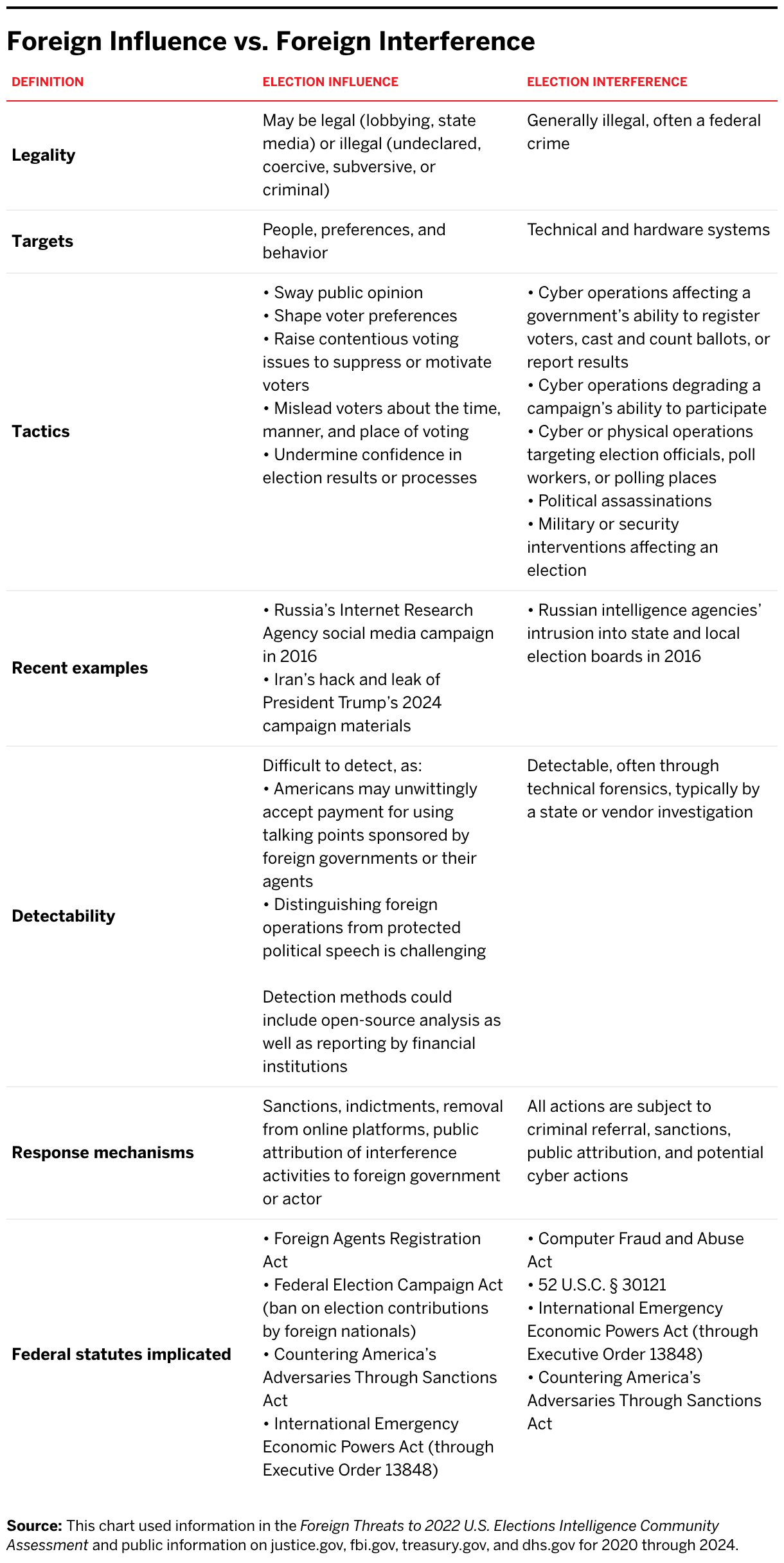
Election interference involves degrading or disrupting the ability of election administrators and election workers to conduct free and fair elections, while the broader category of foreign influence refers to a myriad of activities by foreign governments or their agents to sway the participants in elections, including candidates and voters.
In 2020, federal agencies began defining election interference and influence as separate actions with different warning signals and legal consequences. This distinction is particularly important for the federal government because its role in elections is largely limited to countering national security threats, not running elections.
Are foreign influence and interference in elections illegal?
Foreign interference in elections is generally illegal under multiple federal laws, but the legality of foreign influence activities is murkier.
Influence activities can involve forms of speech, such as social media posts, and many are designed to sway the target audience’s views. For example, during the 2024 election cycle, the U.S. Intelligence Community observed that “foreign actors . . . promote influence narratives seeking to undermine democratic institutions, foment discord, and/or change public opinion.” It also noted that foreign actors are relying on “witting and unwitting Americans to seed, promote and add credibility to narratives that serve foreign actors’ interest.”
Under the First Amendment, the government cannot limit Americans’ free speech or access to information, regardless of the source. However, it can expose the foreign source of the information when the intelligence is available and, in some cases, indict foreign actors for otherwise breaking U.S. law, such as hiding their role in sowing false election narratives and laundering money to sidestep U.S. sanctions.
Have foreign actors been held accountable for election influence operations?
Yes, the federal government has charged and sanctioned organizations and individuals for unlawful election influence.
In 2024, the Justice Department indicted two Russian nationals, Kostiantyn Kalashnikov and Elena Afanasyeva, for laundering money through a network of foreign shell companies to covertly fund a U.S. company that created content aligned with Russian government interests. The company, which news reports named as Tenet Media, sought to fund a number of media influencers in the United States and did not reveal its connection to the sanctioned Russian state–controlled organization RT (formerly known as Russia Today). The DOJ charged Kalashnikov and Afanasyeva with conspiracy to violate the Foreign Agents Registration Act and conspiracy to commit money laundering. In addition, the Treasury Department sanctioned them for their ties to the Russian government.
Also in 2024, Iranian cyber actors sent stolen, nonpublic material associated with then-candidate Trump’s presidential reelection campaign to U.S. media organizations and to individuals associated with the Biden campaign. The Intelligence Community, the FBI, and the Cybersecurity and Infrastructure Security Agency (CISA) noted that Iran sought “to stoke discord and undermine confidence in our democratic institutions . . . including through the use of cyber operations.” The DOJ indicted those responsible, and the Treasury Department sanctioned them.
Although Chinese actors have not yet been formally charged for election influence activities, in 2024, the Intelligence Community assessed that China sought to influence congressional races — with no preference for party, possibly to protect its core interests in relation to Taiwan. The FBI’s Foreign Influence Task Force led several investigations into the matter, including of individuals running an “overseas police station” that targeted Chinese Americans running for local office and researched election-related issues.
Have foreign governments interfered in any recent U.S. elections?
The only confirmed instance of election interference was in 2016, when Russia’s intelligence agencies hacked into election board infrastructure, including registration databases. The Department of Homeland Security assessed that the Russian agencies did not access voting tabulation systems. Additionally, Russia’s foreign military intelligence agency, the General Staff Main Intelligence Directorate (GRU), conducted cyber operations targeting the personal email accounts of Democratic Party officials and other political officials, exfiltrating large volumes of data from the Democratic National Committee. In response, the Obama administration expelled Russian intelligence officials from their mission based in Washington, and the Trump administration’s DOJ indicted 12 GRU members for conspiracy to engage in computer fraud, money laundering, and identity theft.
There are claims that Iran and China interfered in the 2020 elections. But as the Center for Democracy and Technology summarized in its March 2026 report, there is no evidence of interference in the 2020 federal elections. There were, however, several instances of election influence by Iran, Russia, and, to a lesser extent, China. In July 2025, Senate Judiciary Committee Chair Chuck Grassley (R-IA) released emails from the FBI indicating that China acquired fake driver’s licenses with the intent of casting fraudulent ballots. In the wake of this information, which is not a formal FBI product, the Intelligence Community has not yet revised its assessment from 2020 that it “did not identify China attempting to interfere with election infrastructure or providing funding to any candidates or parties.”
The Intelligence Community’s last report on the 2024 elections stressed that although foreign actors remained intent on using influence to undermine U.S. democracy, it had not uncovered any acts of interference. Despite a legal requirement to do so, the Office of the Director of National Intelligence has not released the formal, unclassified assessment of the 2024 elections, which would provide the final summary of the community’s collective judgement regarding foreign threats. However, soon after the 2024 presidential election, then-director of CISA Jen Easterly echoed her predecessor Chris Krebs’s 2020 positive assessment of U.S. elections, finding that there was “no evidence of any malicious activity that had any material impact on the security or integrity of our election infrastructure.”
To be clear, foreign influence targeting Americans is deeply concerning, but the activities do not justify federal attempts to take over elections or to seize state election infrastructure or ballots from prior elections, as the FBI recently did in Georgia’s Fulton County.
What can be done to stop foreign influence?
The federal government has an advantage over state or local governments when it comes to attributing foreign influence actions to adversarial governments. Yet the second Trump administration has dismantled all the offices that once focused on detecting and combating foreign influence efforts, leaving states and localities alone in this fight. The administration should restore key offices, such as CISA’s Election Security Group and the FBI’s Foreign Influence Task Force, which have successfully identified influence activity and held perpetrators accountable in the past.
Despite the amount of attention that President Trump and many of his supporters have given to past foreign influence operations, the Intelligence Community’s 2026 Annual Threat Assessment fails to even mention risks of election influence from foreign adversaries — a stark departure from recent years.
What can be done to stop foreign interference in U.S. elections?
Although the U.S. election system is highly decentralized, the federal government can use its money and intelligence capabilities to partner with state and local governments and ensure that they have the resources to identify, respond to, and recover from foreign interference, including cyberattacks on election infrastructure. This support should include free access to cybersecurity tools and assessments, funds to address identified security vulnerabilities, and information sharing about cyber threats among intelligence agencies, state and local officials, and private industry.
Following Russian interference in the 2016 election, the federal government created several structures to support election officials in protecting election infrastructure from physical and cyber threats. In 2017, DHS designated election infrastructure as critical infrastructure, allowing state and local governments to access a range of federal cybersecurity services, including continuous threat monitoring, vulnerability assessments, and security guidance. During the first Trump administration, the Cybersecurity and Infrastructure Security Agency was established within DHS to safeguard critical infrastructure against both physical and cyber threats. That same year, CISA founded the Election Infrastructure Information Analysis Center (EI-ISAC) to help coordinate information sharing between federal, state, and local entities to prepare for and respond to security threats, including foreign cyberattacks against election infrastructure. Within the Intelligence Community, the Cyber Threat Intelligence Integration Center — established in 2015 following a 2014 North Korean cyber attack on Sony Pictures — coordinated classified collection and analysis in support of DHS and FBI outreach to election officials.
Much of this work has been gutted by the second Trump administration. Earlier this year, for example, CISA terminated funding for the EI-ISAC.
The administration has also made drastic cuts to the cyber and physical security services that CISA previously offered to election officials, with current and former election officials from both major political parties expressing dismay about the lack of support as well as voicing concern that trust between the federal government and election officials has been eroded. At the same time it eliminated the Foreign Malign Influence Center, the Office of the Director of National Intelligence eliminated the Cyber Threat Intelligence Integration Center, reducing analysis and classified information sharing on cyber threats to election infrastructure.
• • •
Foreign influence and interference are each real and serious threats, but they are different problems that require different responses. Under no circumstances do they require a federal takeover of election administration, or investigations of ballots cast in long-settled elections. If the Trump administration wants to combat these dangers to democracy, it should rebuild the institutions and offices launched and supported during his first term, demonstrate transparency regarding foreign government actions, and rebuild trust with election officials.
Kate Lurie is a consultant with the Brennan Center who previously served as director of election security at the National Security Council.

