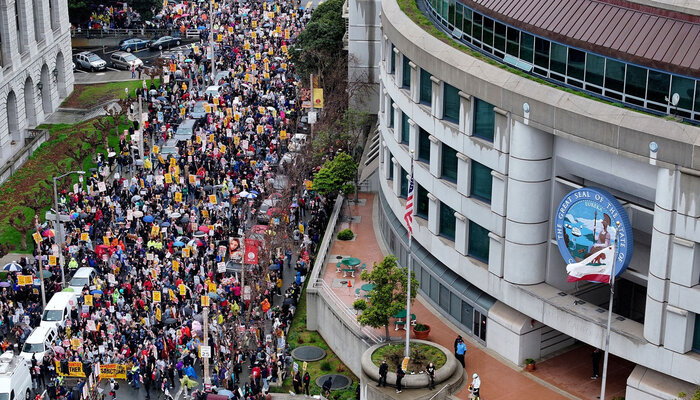

Immediately after federal immigration agents fatally shot Renee Good and Alex Pretti in Minneapolis, high-level Trump administration officials branded them as “domestic terrorists.” Amid public anger over the killings, President Trump attempted to distance himself from those false accusations. But his retreat in these high-profile cases should not obscure the wider truth: The administration has supercharged the use of domestic terrorism investigations to scare Americans away from using their First Amendment rights to oppose its policies.
These tactics risk criminalizing constitutionally protected activity — from joining a protest march to posting on social media — while inflicting draconian punishments for actions that are far removed from actual terrorism. They represent a natural extension of the government’s long-standing deployment of the domestic terrorism framework to target progressive activists. They’re also a dangerous and unwarranted expansion of the executive’s investigative and punitive authorities.
Post-9/11 Violations
The Patriot Act, passed shortly after the 9/11 attacks, introduced a legal definition of domestic terrorism: acts that are dangerous to human life, violate a state or federal law, occur primarily within the United States, and “appear to be intended to intimidate or coerce a civilian population” or “influence the policy of a government by intimidation or coercion.” Domestic terrorism itself is not a standalone crime; instead, the statute sets out over 50 other “federal crimes of terrorism,” such as bombing a building and destroying infrastructure. However, as the definition makes clear, any federal or state crime can be used as the basis for a domestic terrorism investigation if it is “dangerous to human life” and has the required intent.
This framework has long allowed the government to pursue a range of investigations justified by fighting domestic terrorism — authority it has aimed disproportionately at activists for progressive causes based in significant part on their ideology rather than violent conduct.
In 2010, the Department of Justice’s inspector general reviewed the FBI’s investigations into antiwar and pro-environmental advocacy groups and determined that the bureau had made false statements to Congress and the public. The report found that the FBI had collected information about groups’ First Amendment–protected activities, retroactively created justifications for domestic surveillance, opened inquiries on the basis of thin or nonexistent evidence of criminal activity, and kept investigations open long beyond their authorized time. Even when the monitored groups had engaged in criminal activity — including as part of civil disobedience — it rarely rose to the level of “terrorism.” While the inspector general concluded that agents did not violate FBI or DOJ policy in initiating the investigations, that was largely because those policies were so permissive in the first place.
Federal excesses did not end with the issuance of that report. Instead, the government has continued to wield its investigative and enforcement authority against disfavored groups and ideologies, targeting Muslim communities and individuals of Chinese origin and using FBI joint terrorism task forces to investigate a Black Lives Matter protest and activists opposing the Dakota Access pipeline. At the same time, the FBI has often failed to prioritize white supremacist violence or investigate it as domestic terrorism.
President Trump’s Orders
Trump is now moving aggressively to expand his authority under the banner of combating domestic terrorism. In September 2025, he issued two orders committing the government to using its domestic terrorism authority to criminalize and investigate groups adhering to a broad range of ideologies. The first was directed at the decentralized antifascist political movement known as “Antifa,” painting it as a highly organized group engaged in coordinated efforts to “execute a campaign of violence and terrorism” and “radicalize” young people. The order designated antifa as a domestic terrorist organization, despite the fact that there is no legal authority to categorize a domestic group as such. Indeed, doing so likely violates the First Amendment — the Supreme Court has long protected the freedom to associate “for the advancement of beliefs and ideas,” and the First Amendment imposes strict constraints upon the government’s ability to punish even speech advocating illegal conduct.
The order also purports — again, without legal authority — to broaden the prohibition on providing financial or other assistance to an act of domestic terrorism, known as “material support.” Under current law, a charge of material support in the domestic context requires that the person being charged have provided support for one of the specifically defined “federal crimes of terrorism.” By contrast, Trump’s order directs federal authorities to investigate the provision of material support to “any and all illegal operations.” This threatens to criminalize a wide range of activity, from handing out water at a protest featuring visible antifa supporters to supplying online messaging or social media services in the usual course of business to people ideologically aligned with antifa.
Three days later, the president issued a far more sweeping memorandum, directing the Departments of State, Justice, Treasury, and Homeland Security to prioritize domestic terrorism. The memo mashes together actual acts of political violence, such as assassination attempts, with constitutionally protected viewpoints, including “anti-Americanism, anti-capitalism, and anti-Christianity; support for the overthrow of the United States Government; extremism on migration, race, and gender; and hostility towards those who hold traditional American views on family, religion, and morality.” The memo makes concrete the conservative fantasy of a coordinated left-wing conspiracy, conjuring up the specter of “sophisticated, organizing campaigns” carried out through a “comprehensive strategy to achieve specific policy goals through radicalization and violent intimidation.” Notably, not only does the overused term “radicalization” not rise to the level of terrorism, it is not even illegal.
The memo includes directions to all the major players in the federal law enforcement and homeland security ecosystem. The FBI’s joint terrorism task forces are directed to oversee a national strategy with the chilling remit to “investigate, prosecute, and disrupt entities and individuals” engaged in any behavior that satisfies the vague category of “intimidation designed to suppress lawful political activity or obstruct the rule of law.” They are also ordered to investigate any funders, officers, and employees of organizations that are “responsible for” or “sponsor or otherwise aid and abet” the activity addressed in the memo — a clear shot across the bow against civil society organizations, charitable foundations, and even individual donors.
Taken together with the laundry list of disfavored ideologies, this language all but commands law enforcement to investigate groups that write, organize, advocate, litigate, or otherwise speak out on any issues that the administration sees as contrary to its interests, as well as anyone who donates to them. Shockingly, the memo even characterizes trespassing — typically a misdemeanor — as a “politically motivated terrorist act.” And the memo doubles down on the antifa order’s effort to invent a domestic terrorist organization category out of whole cloth, giving the attorney general the power to recommend that any group whose members are engaged in acts legally defined as domestic terrorism be designated as a “domestic terrorist organization” — again, a directive that is entirely ungrounded in any statute.
Attorney General Pam Bondi’s Order
Finally, in early December, Attorney General Pam Bondi issued a memorandum designed to implement President Trump’s earlier memo. It directs prosecutors to look for opportunities to charge people with impeding federal officers — rhetoric that takes on additional significance in light of the documentation of scores of ICE and Border Patrol agents threatening to arrest Americans who are observing agents’ activities, a constitutionally protected activity, on the grounds that they are “impeding” law enforcement.
The Bondi memorandum also imagines a vast criminal network underlying the efforts of regular Americans who have taken to the streets to stand up for their neighbors, and seeks to turn them against each other, promising that it will develop informants within groups who will testify against other members. And it repeatedly conflates action with ideology, insinuating that “extreme viewpoints on immigration, radical gender ideology, and anti-American sentiment” may be a precursor to violence and recasting protected ideas like “views in favor of mass migration” and “hostility towards traditional views on family, religion, and morality” into “agendas” that fuel violent attacks and require investigation.
• • •
These orders effectively give federal law enforcement the green light to launch investigations into individuals or groups that oppose administration policies or any contributors to those causes. Reporting suggests that the Department of Homeland Security has already embraced this invitation, collecting and adding information about protesters to its considerable data holdings. And there are reports of federal agents threatening to add Americans to a “database” of domestic terrorists in retaliation for engaging in lawful activity.
In addition to turning the entire fearsome machinery of the federal law enforcement and homeland security apparatus on civil society organizations, loose affiliations of activists, and donors to progressive causes, this effort will have substantial consequences for people who are tarred as domestic terrorism suspects, regardless of any investigation’s ultimate outcome. They will be placed on federal watchlists and likely face invasive questioning and even searches every time they travel.
Thousands of state and local police departments also have direct access to information on the watchlist, encouraging pretextual and extended law enforcement stops. Being watchlisted can interfere with the ability to carry out basic financial transactions like banking, credit, and money transfers. And the public stigma of being investigated as a domestic terrorist can be severe, as individuals targeted in these investigations risk losing access to employment or housing as employers or landlords learn about the investigation.
In the end, as these investigations ramp up, and as the space for lawful dissent and nonviolent civil disobedience inexorably narrows, it is the American people who will lose. Congress and the public should demand that our federal law enforcement and homeland security agencies protect our core constitutional rights, abide by the rule of law, and be held to account when they fail to do so.

