The most expensive judicial election in U.S. history took place in Wisconsin in 2023. The race saw $51 million in spending and flipped the court’s ideological majority for the first time in 15 years. Just two years later, the 2025 election for the same court shattered that record with more than $100 million in spending by an influx of national interest groups and donors, perhaps most notably the world’s richest man, Elon Musk. Each of those races had more than double the spending of any prior election for a single state supreme court seat, reflecting an era of rapidly intensifying state judicial politics.
Because these were among the most consequential judicial elections being held since the U.S. Supreme Court’s 2022 decision overturning Roe v. Wade, the record-breaking spending was in some ways unsurprising. That decision pushed state high courts across the country onto center stage in the fight for reproductive freedom as advocates turned to them to rule that state law protects abortion rights. Such cases have led political parties, donors, the press, and the broader public to pay greater attention to state courts nationally, and ultimately to the justices who serve on them. In fact, sandwiched between those two Wisconsin races, a 2023 race for an open seat on Pennsylvania’s supreme court that garnered much less national attention attracted $27 million, making it the third most expensive judicial election ever.
But other factors — like state high courts’ role in determining voting rules in the lead-up to national elections — likely also attracted major donors to judicial elections (which 38 states use to select their high court judges or to determine whether sitting judges will serve additional terms). In both Wisconsin and Pennsylvania, for example, the abovementioned elections determined who sat on the high courts as they heard high-stakes litigation leading up to the 2024 presidential election, and who will be on the bench for the 2026 midterms.
The Brennan Center has been tracking spending in state supreme court elections for 25 years as part of its biennial Politics of Judicial Elections series. The following analysis provides a detailed account of the 2023–24 cycle. Some of these races may appear quaint in comparison with the $100 million Wisconsin election, but together they reflect a solidification of this new era of state judicial politics. While the 1990s and 2000s saw expensive judicial races as business interests and trial lawyers competed for influence on state high courts, big money elections happened more often in the 2010s as conservative national interests increasingly viewed state courts as obstacles to their policy priorities and as central to redistricting fights. But today’s supreme court elections — some almost indistinguishable from gubernatorial and senate elections happening in the same states — are unlike anything the Brennan Center has documented before.
Here are the biggest takeaways from the 2023–24 cycle of state supreme court elections:
It was the most expensive cycle of judicial elections ever. The $157 million that candidates, interest groups, and political parties spent on these races was 35 percent higher than the 2019–20 cycle and almost twice that spent during the 2015–16 cycle.
Seven states saw their most expensive judicial elections ever. The Wisconsin and Pennsylvania Supreme Court elections set state and national records, but they were not the only ones. Montana had its two most expensive judicial races ever and saw three times as much money spent on judicial elections as in any prior cycle. North Carolina set a state record with its first $10 million judicial election. Arizona, Kentucky, and Oklahoma set state records as well.
Interest groups outspent candidates for the first time ever, and more of that money came from groups on the left. In total, interest groups spent $85 million on judicial races in 2023–24, compared with $70 million spent by candidates. While interest group spending surged after the U.S. Supreme Court’s Citizens United v. Federal Election Commission decision cleared the way for unlimited outside spending in 2010, never before has total interest group spending outpaced spending by candidates themselves. Just as noteworthy is the fact that more of that money, 64 percent, came from groups on the left. For the last two decades, conservatives have significantly outspent progressives in judicial races, but the escalating influence of state high courts on issues that liberals care about may have reversed that dynamic.
The fight for abortion rights has reshaped judicial races. The new prominence of state supreme courts in the fight over reproductive freedom attracted new donors and interest groups to these races. Candidates and interest groups on the left adapted by featuring reproductive rights in their campaign ads in a way not seen in prior state high court elections — 30 percent of all TV ad spots in this cycle’s state supreme court contests mentioned abortion rights compared with just 3 percent in the 2020 cycle.
Spending Breakdown
In 2023–24, 35 states held elections for 79 seats on their state supreme courts (though elections for two seats were canceled after only one candidate qualified for the ballot). In total, candidates, interest groups, and political parties spent at least $157.3 million on these elections — 35 percent more than any prior cycle of judicial elections. While two seats in Wisconsin and Pennsylvania accounted for nearly half of that total, at $78 million in combined spending, another four states saw more than $10 million each, and another eight states saw more than $1 million spent on their high court races. Six states with $10 million spent on judicial elections is the most of any prior cycle, surpassing the previous high-water mark of five states in 2020. Before 2020, no more than a single state had seen $10 million spent on judicial races in an election cycle. (All historical figures are adjusted for inflation.) Table 1 shows spending in high court races, including contested and retention elections, in the 23 states for which the Brennan Center documented spending for the 2023–24 cycle.
For the first time ever in 2023–24, direct spending by interest groups accounted for more than half of the money in supreme court elections — $85 million, or 54 percent of all the money in these races. Candidates spent $70 million, or 45 percent of all money spent. Political parties spent only $2 million independently of candidates, but they played a more impactful role as conduits for large contributions to those candidates. That is because some state campaign finance laws allow parties both to receive large or unlimited contributions and to make large or unlimited contributions to candidates. In total, political parties funneled $15 million to candidates this cycle in Michigan, North Carolina, Ohio, Pennsylvania, and Wisconsin — including $9 million alone from the Democratic Party of Wisconsin to Milwaukee County Circuit Court Judge Janet Protasiewicz’s successful 2023 campaign for a seat on the Wisconsin Supreme Court.
As Figure 1 shows, the elections in Wisconsin and Pennsylvania were by far the most expensive. While Wisconsin has historically had some of the most expensive judicial elections in the country, the 2023 election amounted to a perfect storm for galvanized judicial politics. First, the court’s ideological majority was up for grabs after a 15-year period of conservative control. The court was also poised to decide high-profile cases about abortion rights at a time when the U.S. Supreme Court’s decision in Dobbs v. Jackson Women’s Health Organization was less than a year old, yet enough state court litigation had transpired since that decision to clarify how central state courts would be to continuing fights for abortion access. Finally, the battleground state judicial election took place in the lead-up to the 2024 presidential election, after the court had been involved in high-stakes election litigation before the 2022 and 2020 elections, and when it was likely to decide key cases about everything from ballot drop boxes to redistricting.
As a result, Protasiewicz and conservative former Wisconsin Supreme Court Justice Daniel Kelly raised a combined, record-setting $21 million, but they were still outspent by interest groups that poured $29 million into the race. At least 69 different groups spent money on digital and TV ads, canvassing, radio spots, and mailers, the largest of them A Better Wisconsin Together, which spent $6 million supporting Protasiewicz. Most of A Better Wisconsin Together’s funding came via dark money groups along with large donations from labor unions and national liberal donors. Close behind were Wisconsin Manufacturers & Commerce (WMC), a dark money group representing business interests; and Fair Courts America PAC (FCA), a group funded by national GOP donor Richard Uihlein. Each of those groups spent more than $5 million supporting Kelly. Turnout broke records for a state supreme court election, and Protasiewicz’s win gave liberals a 4–3 majority on the court.
In Pennsylvania, the partisan 2023 election between lower court judges Daniel McCaffery (a Democrat) and Carolyn Carluccio (a Republican) was the most expensive race for a single seat on the court in state history. (When three seats were up for reelection in 2015, the race saw slightly more aggregate spending after adjusting for inflation.) The court had a 5–2 Democratic supermajority in the lead-up to the 2023 election, and the election was for a seat previously held by a Democrat (Chief Justice Max Baer, who passed away in 2022). Yet Pennsylvania’s high court has often avoided dividing on party lines in high-profile decisions; the Democrats have at times split on cases around voting and abortion rights. As such, the election could have changed the outcome in major cases related to rules for counting absentee ballots and certain limitations on abortion access.
The race’s biggest donor was the Commonwealth Children’s Choice Fund, which made $4.3 million of in-kind contributions to Carluccio in the form of television, digital, and mail advertising. The group received nearly all of its money from Students First PAC, which received all $16 million of the funds it took in that year from Jeffrey Yass, a Pennsylvania billionaire and national Republican megadonor. But with the backing of nearly $13 million in outside spending by interest groups (compared with $4 million for Carluccio), McCaffery won 54 percent of the vote and maintained the Democratic supermajority.
Even with less spending, record-breaking races in other states illustrated the dramatically raised stakes in judicial elections. Justice Allison Riggs (a Democrat) of the North Carolina Supreme Court won her first full term on the court in a $10.5 million race — a state record but only part of the story. After Riggs’s narrow victory in November 2024, her opponent, Judge Jefferson Griffin (together with the state Republican Party) pursued six months of legal challenges in which he asked the courts to throw out thousands of votes. That court battle led Riggs and Griffin to raise an additional $2 million to pay for legal fees, only for Griffin to concede after a federal court ruled that the federal constitution does not “permit[] a state to alter the rules of an election after the fact,” and that any claim to the contrary “threatens to undermine public confidence in the federal courts, state agencies, and the elections themselves.” While the outcome maintained the court’s 5–2 Republican supermajority, it also keeps alive Democrats’ hope of reclaiming a majority in 2028.
Montana too had its two most expensive judicial elections ever in the 2023–24 cycle: Attorney Cory Swanson and Judge Katherine Bidegaray won elections that saw $6.8 and $5.9 million in spending, respectively. Montana elects justices in nonpartisan elections, but state Republican legislators have made clear recently that they see the court as an obstacle. After the state supreme court in 2024 struck down new abortion restrictions and voter registration barriers and upheld a lower court ruling enforcing the state constitution’s guarantee of a “clean and healthful environment,” one state Republican leader called the court “one of the most liberal courts in the nation” acting as a “de facto executive branch.” Despite this rhetoric from Republicans, more than 83 percent of the money in the 2024 high court elections went to backing the more liberal candidates, and more than a quarter of the money came from the American Civil Liberties Union (ACLU) and Planned Parenthood alone.
Ultimately, one candidate supported by each party won a seat on the court — Swanson (supported by the Republican Party) won the race for chief justice and Bidegaray (supported by the Democratic Party) won the open associate justice seat. Republican legislators in Montana responded to the voters’ split decision by trying to make future state judicial elections partisan to give their preferred candidates an upper hand. Though the governor supported the effort, it ultimately failed, in no small part because newly elected Chief Justice Swanson himself told the legislature that the change would “ultimately harm Montana citizens.”
While the above states are no strangers to politicized high court elections, there are signs that things are changing in states that have not previously seen significant spending in judicial elections. This shifting trend includes states that hold retention elections, which have generally not attracted the level of spending that competitive elections have. In retention elections, sitting justices do not have an opponent; voters instead simply vote yes or no as to whether the justice should serve an additional term on the court. If voters do not retain a justice in a retention election, the governor typically appoints a replacement.
In Oklahoma in 2024, for example, Justice Yvonne Kauger lost a retention election for the first time in the state’s history. After the state supreme court issued decisions halting abortion restrictions and ordering an end to public support for a religious charter school, groups allied with Gov. Kevin Stitt and charter school advocates — People for Opportunity and the 46 Action PAC — spent $2 million on ads attacking Kauger and two other justices as liberals supported by trial lawyers. An Ohio-based dark money group called Protect Our Freedoms responded with $1.3 million in ads supporting the three justices; the $3.6 million in total that groups spent in the race far outstripped the $600,000 that interest groups spent when four justices were up for retention in 2012 — the state’s previous spending record (adjusted for inflation). In the end, Kauger won only 49.8 percent of the vote, and the governor’s allies successfully ousted a key vote in some of the court’s biggest cases.
In Arizona as well, after an April 2024 ruling by the state supreme court upholding an 1864 law criminalizing nearly all abortions, progressive advocates launched an anti-retention campaign against Justices Kathryn Hackett King and Clint Bolick, who both joined that decision and happened to be up for retention that November. Uihlein’s FCA and the Judicial Independence Defense PAC, whose largest funder was Pennsylvania billionaire Yass, combined to spend $1 million on ads supporting King and Bolick. Though a large-scale anti-retention campaign never materialized, the prospect of one unnerved Republicans in the legislature enough that they simultaneously put before voters a proposed constitutional amendment to end retention elections in Arizona. The amendment went as far as to nullify the results of any retention elections that year if voters declined to retain the two justices. While King and Bolick easily held their seats, voters rejected the constitutional amendment with 78 percent of the vote.
Across the country, campaigns made abortion rights central to judicial races in a way they never have before. Since the U.S. Supreme Court overruled Roe v. Wade, advocates have asked state courts in 23 states to decide cases about abortion rights under state law, making clear that for the foreseeable future, state courts will be key decision-makers in one of today’s most polarizing policy fights. Accordingly, abortion rights groups’ spending in judicial elections has accelerated, and some Democratic and liberal nonpartisan judicial candidates have centered their campaigns around the issue of reproductive rights.
In each of the seven highest-spending states during the 2023–24 cycle, TV ads run by candidates, interest groups, or both highlighted the role that the state supreme court would play in determining abortion rights in a given state. In all, 30 percent of the 119,000 TV ad spots run in state supreme court elections mentioned abortion rights, and all those mentions referred to the importance of protecting those rights. By comparison, in 2020, only 3 percent of judicial election ad spots even mentioned abortion, and most of those were for candidates touting their antiabortion credentials. In a sign of the shift in how abortion features in state judicial races today, the only Republican or conservative candidate to run a TV ad mentioning abortion in the 2023–24 cycle was Judge Carluccio in Pennsylvania, whose ad said, “I will uphold the law, including women’s reproductive rights.” No candidate this cycle ran a TV ad saying they opposed abortion access or identifying as pro-life.
The Role of Outside Interest Groups
For the first time ever, outside interest groups spent more money on supreme court elections in the 2023–24 cycle than candidates themselves — $85 million compared with $70 million, respectively. This shift continues a clear trend of the post–Citizens United era. In 2010, the U.S. Supreme Court cleared the way for unlimited campaign spending by outside groups in elections, ruling that independent political spending by groups (i.e., not in coordination with a candidate) poses no risk of corruption and thus cannot be limited without violating First Amendment rights. Since then, interest group contributions have grown from comprising less than 20 percent of the money spent on judicial races to now accounting for more than 50 percent of all spending.
Though outside interest groups outspend candidates in some congressional elections, outside spending has not surpassed candidate spending nationally. Judicial elections may be distinctly susceptible to disproportionate influence by interest groups owing to the lower national profile of the races and the candidates, which decreases candidate fundraising but does not diminish interest from sophisticated and well-resourced political groups attuned to the significance of state high courts.
Historically, conservative groups have far outspent liberal groups in judicial races, but for the first time ever in the 2023–24 election cycle, outside interest groups on the left spent more than groups on the right: Interest groups supporting liberal candidates spent $55 million in judicial races compared with $30 million by groups supporting conservative candidates. This dynamic varied across states, however. In Michigan, Montana, North Carolina, and Pennsylvania, groups on the left accounted for more than 75 percent of outside spending in state supreme court races. And in Kentucky, all $1 million in outside spending — much of it from PACs associated with Democratic Gov. Andy Beshear — supported Judge Pamela Goodwine, who became the first Black woman to serve on the Kentucky Supreme Court. But conservative groups in Wisconsin and Ohio defied this trend, accounting for 60 percent of outside spending in state high court races. And in Arizona, conservative groups accounted for nearly all interest group spending.
Interest group spending during the 2023–24 cycle also reflected the continued nationalization of state judicial elections. Two decades ago, the biggest judicial election spenders were in-state business interests and trial lawyers who grasped the financial impact that state high court decisions could have on them and their clients. That began to change in the 2010s as national partisan and ideological groups — most vocally the Republican State Leadership Committee (RSLC) — began to express frustration that Republican policy priorities at the state level were “running into a hard stop with judges who aren’t in touch with the public.” Since then, the RSLC’s Judicial Fairness Initiative (RSLC-JFI) has become the leading national spender on judicial elections: As of February 2025, the RSLC-JFI reports having spent more than $29 million in state judicial races.
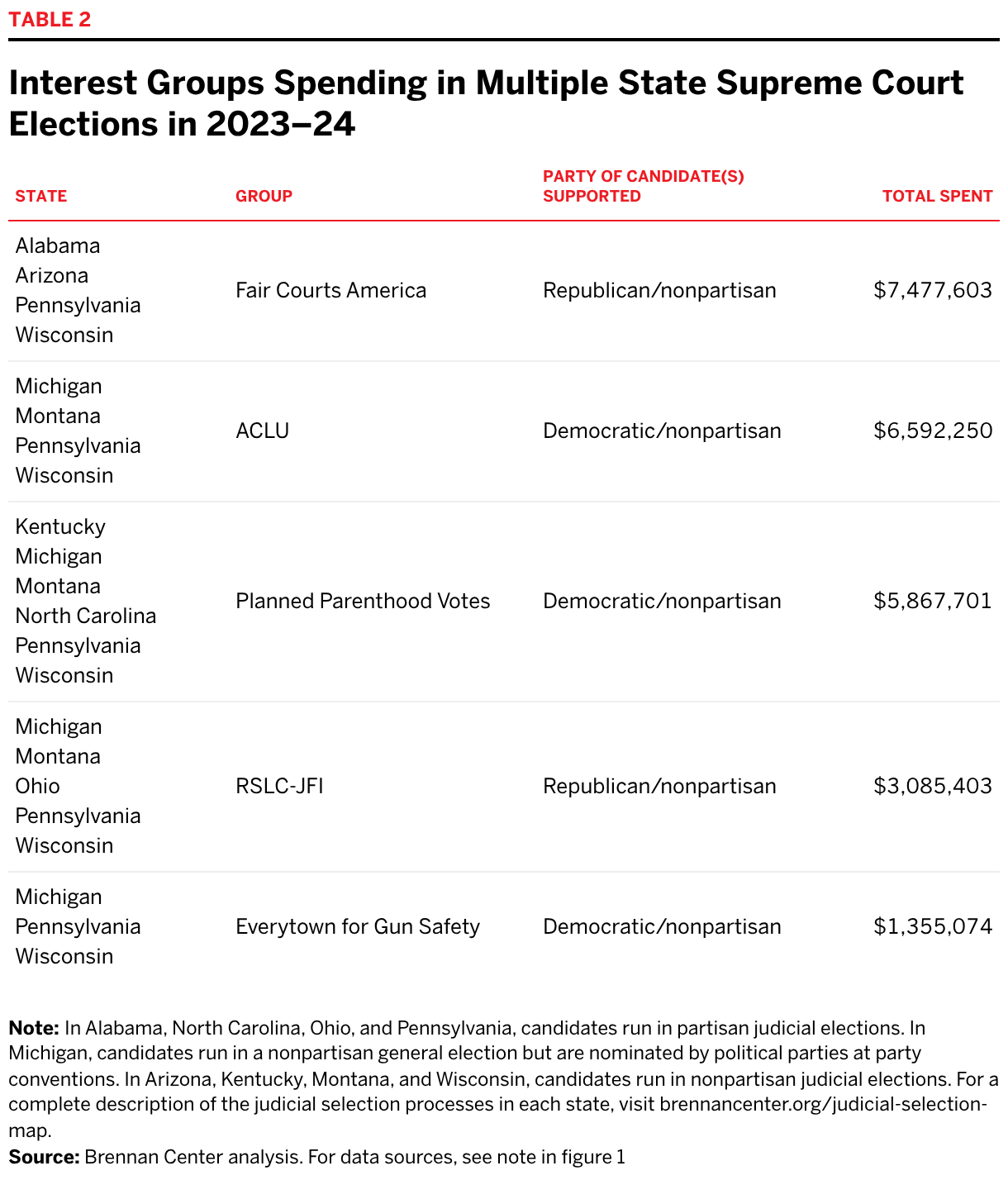
In the wake of major state court decisions about abortion access and redistricting, more national interest groups on both the left and the right have mobilized around these races. In the 2020 cycle, only the RSLC-JFI spent more than $1 million on judicial elections combined across multiple states, but in 2023–24, five different national interest groups did. As Table 2 shows, the conservative groups Fair Courts America and the RSLC-JFI and the liberal groups the ACLU, Planned Parenthood, and Everytown for Gun Safety each spent in Wisconsin and Pennsylvania’s judicial elections. Several of those groups also spent millions in Alabama, Kentucky, Michigan, Montana, North Carolina, and Ohio.
The leading interest groups in this cycle’s judicial races operated with varying levels of transparency, some revealing the true sources of their funds and others leaving the public largely in the dark. Fair Courts America, for example, operates with relative transparency, and so the public can glean that of the $12 million that FCA took in between 2023 and 2024, $9 million came from GOP-megadonor Uihlein. The extent of Uihlein’s involvement was public information while FCA was running ads in the judicial elections, such that voters and journalists could see who was attempting to influence the races. The RSLC-JFI, on the other hand, reports only that it receives all its funds from its parent entity, the Republican State Leadership Committee. The RSLC then reveals its donors long after elections have taken place in IRS filings. Those filings covering the 2023–24 cycle show millions from large corporations as well as $2.9 million in contributions from the Concord Fund, an entity tied to Leonard Leo, who has overseen a network of opaque groups designed to influence state and federal courts.
On the left, groups affiliated with The Justice Project (TJP), a DC-based political organization, gave $8 million to the biggest-spending groups in judicial elections in Michigan, Montana, and North Carolina. Like the RSLC, TJP makes its donors public only via IRS filings long after Election Day, but its biggest donors include Oklahoma billionaire philanthropist Lynn Schusterman and Our American Future Action, a 501(c)(4) group that takes in contributions from a related 501(c)(3), Our American Future Foundation, which in turn received substantial funding from the Open Society Foundations.
Finally, while this report only analyzes spending in state supreme court elections, outside interest groups may also be expanding their influence to lower courts. Elon Musk, for example, received considerable attention for his massive spending in the 2025 Wisconsin Supreme Court election, but that was not his first foray into judicial politics. In 2024, the Texas-based Judicial Fairness PAC received $18 million from Musk, other Texas business interests, and the Concord Fund. Judicial Fairness spent that money supporting intermediate appellate and lower court judges across the state, including $8 million to support Stop Houston Murders PAC, which targeted and helped defeat a slate of Democratic judges in Harris County, Texas, that it labeled as “judges who look out for killers before families.”
• • •
The public must be able to trust that state judges are deciding cases based on their understanding of the law — and not embracing the raw politics that define the other branches of government. However, in some states at least, today’s judicial elections risk undermining that trust. Elected officials, judges, and the public can and should take steps to ensure the integrity of judicial elections, whether considering alternatives to judicial elections, establishing lengthy single terms for justices, or implementing robust campaign finance and ethics reforms. Measures like these would better ensure that the ideal of equal justice is within reach, even in this hyperpoliticized era of judicial elections.
Eric Velasco provided research and data analysis to this report.
Kansans will decide in August on an amendment that would change how judges are selected, a vote that could bring a surge of special interest spending and unwanted political pressure on judges.
In the wake of the U.S. Supreme Court decision gutting the Voting Rights Act, state courts in particular will play a major role in a new wave of legal and political battles.