


President Trump ran for reelection in 2024 vowing to “carry out the largest deportation operation in American history.” To do so, the administration has tasked immigration and law enforcement agencies with arresting at least 3,000 immigrants a day inside the country — not counting those apprehended at the border. This figure is more than seven times the daily number of interior arrests during Trump’s first term, which averaged just above 400 per day.
Trump has repeatedly and falsely portrayed immigrants as violent criminals, and senior administration officials have asserted that they are arresting “the worst of the worst” — those who threaten national security or public safety. But that is not true. While immigrants are less likely to commit crimes than native-born Americans, the administration is not focused on arresting those who do. As the head of Immigration and Customs Enforcement (ICE) admitted, the agency has “opened up the whole aperture.” ICE is now arresting broad swaths of immigrants — in some cases, only on the basis of their accent, apparent ethnicity, or work — including people in the United States lawfully. Many immigrants, regardless of status, have been arrested while attending their immigration hearings or during a routine check-in with ICE.
In fact, despite an influx of money from Congress that has transformed ICE into the country’s largest law enforcement agency, arrests of immigrants with criminal convictions — particularly for violent crimes — have flatlined. The reason for ICE’s failure to boost arrests of violent criminals is the administration’s singular focus on meeting quotas for total immigrant apprehensions. To boost its numbers, the administration has reassigned law enforcement officers across the federal government from conducting targeted investigations to arresting and detaining people who might pose a threat to the community. Instead, officers are increasingly picking up easy-to-find people with no criminal record because officers suspect they are immigrants.
In past administrations, ICE prioritized arrest and deportation of immigrants who posed a public safety or national security threat for arrest; now, it insists on locking up nearly everyone officers think may be an immigrant while their legal status is assessed. Keeping them in jail during the weeks or months it takes to resolve their cases leaves taxpayers on the hook for millions of dollars a day to imprison noncriminals. Incarceration costs the government approximately $152 per day per person, 38 times the $4 per day it costs to release someone who doesn’t pose a public safety risk from detention and assign them a case worker to ensure that they show up for key appointments and comply with immigration law.
Far from keeping the public safe, the administration is wasting significant public safety resources from across government to find and jail people who pose no discernible threat.
Diverting law enforcement agents to immigration enforcement has not led to more criminal arrests.
To meet the administration’s ambitious quotas, law enforcement agencies across the federal government have diverted agents from criminal investigations to help the 6,000 ICE Enforcement and Removal Operations officers tasked with arresting immigrants. That includes nearly 3,000 FBI agents — nearly one in every five — who have been reassigned to arrest immigrants instead of conducting complex criminal investigations of corruption, espionage, terrorism, cyberattacks, and transnational gangs. It also includes around one in every two Drug Enforcement Agency (DEA) agents; two in three Bureau of Alcohol, Tobacco, Firearms and Explosives (ATF) agents; and one in five U.S. marshals, based on the most recent available staffing numbers. From within ICE, it also includes 6,000 Homeland Security Investigations (HSI) agents — almost the subagency’s entire contingent of law enforcement officers — at the expense of their stated mission of combating transnational crimes such as drug and weapons smuggling, child exploitation, and human trafficking.

The result of all these law enforcement personnel being redirected? Arrests have soared, but a diminishing share of those arrested have criminal records. And remarkably, despite ICE tripling its budget since 2024 and more than doubling the number of its officers and agents, the total number of individuals with a criminal history it arrests and detains each day is flat or dropping.
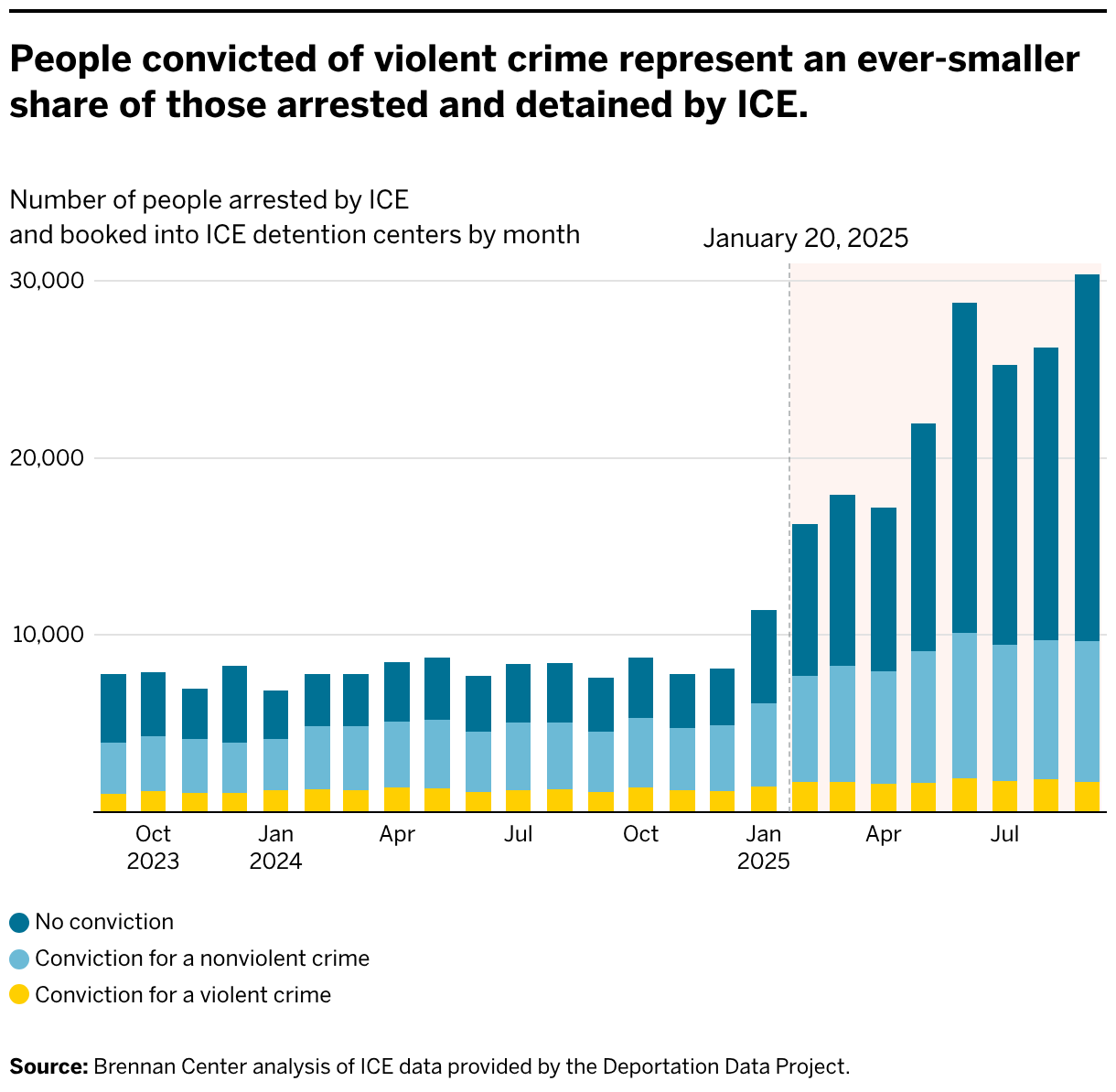
According to data provided by ICE to the Deportation Data Project in response to a Freedom of Information Act request and analyzed by the Brennan Center, the share of immigrants arrested and detained by ICE with a criminal conviction has fallen dramatically since the start of the Trump administration. In the first two weeks of October 2025, just 31 percent of new detainees had a criminal conviction, compared with 63 percent in the two weeks preceding President Trump’s inauguration.

DHS categorizes people with only misdemeanor or administrative offenses — such as driving without a license — as “convicted criminals,” implying that they are dangerous even if they only have a traffic ticket. Nevertheless, in the most recent data, fewer than one in three immigrants in ICE custody were classified as “convicted criminals” under DHS’s broad definition. And ICE is arresting and detaining those with administrative, misdemeanor, and nonviolent offenses (defined narrowly, consistent with prior Brennan Center analysis) at unprecedented rates.
Take immigrants whose only offense is the misdemeanor of crossing the border without documentation, known in the law as an improper entry. Someone with an improper entry offense might be ordered deported after a hearing by an immigration judge. But their crime does not inherently make them a danger to the community such that they should be kept behind bars while awaiting the judge’s decision. Yet in September 2025, ICE detained more individuals whose most serious crime was improper entry or reentry (1,776) than those guilty of violent crimes such as assault or robbery (1,707). Of the 30,000 immigrants ICE arrested and jailed that month, only a fraction of a percent had been convicted of the most heinous criminal offenses, amounting to 0.05 percent for murder and 0.2 percent for rape.
That same month, ICE imprisoned around 716 individuals whose most serious crime was a minor traffic offense, such as driving without a license. That is far higher than the number of people ICE arrested and detained in the same period for more dangerous crimes — 280 percent more than the number of people with convictions for theft, 260 percent more than the number arrested for drug trafficking, and nearly 340 percent more than the number of people convicted of burglary.
The rise in detentions is fueled by arrests of people with no criminal conviction or who committed only a nonviolent crime. Meanwhile, the share of arrests of those convicted of violent crimes is trending in the opposite direction. The share of new detainees with a conviction for a violent crime has plunged from about 16 percent in the two weeks before President Trump’s inauguration to about 6 percent in the first two weeks of October 2025.
The overall number of people detained for violent crimes has stagnated and even dropped since a peak last summer. In the first week of October 2025, ICE arrested and booked 409 people convicted of violent crimes into detention, compared with 502 in the first week of June, a nearly 20 percent decline.
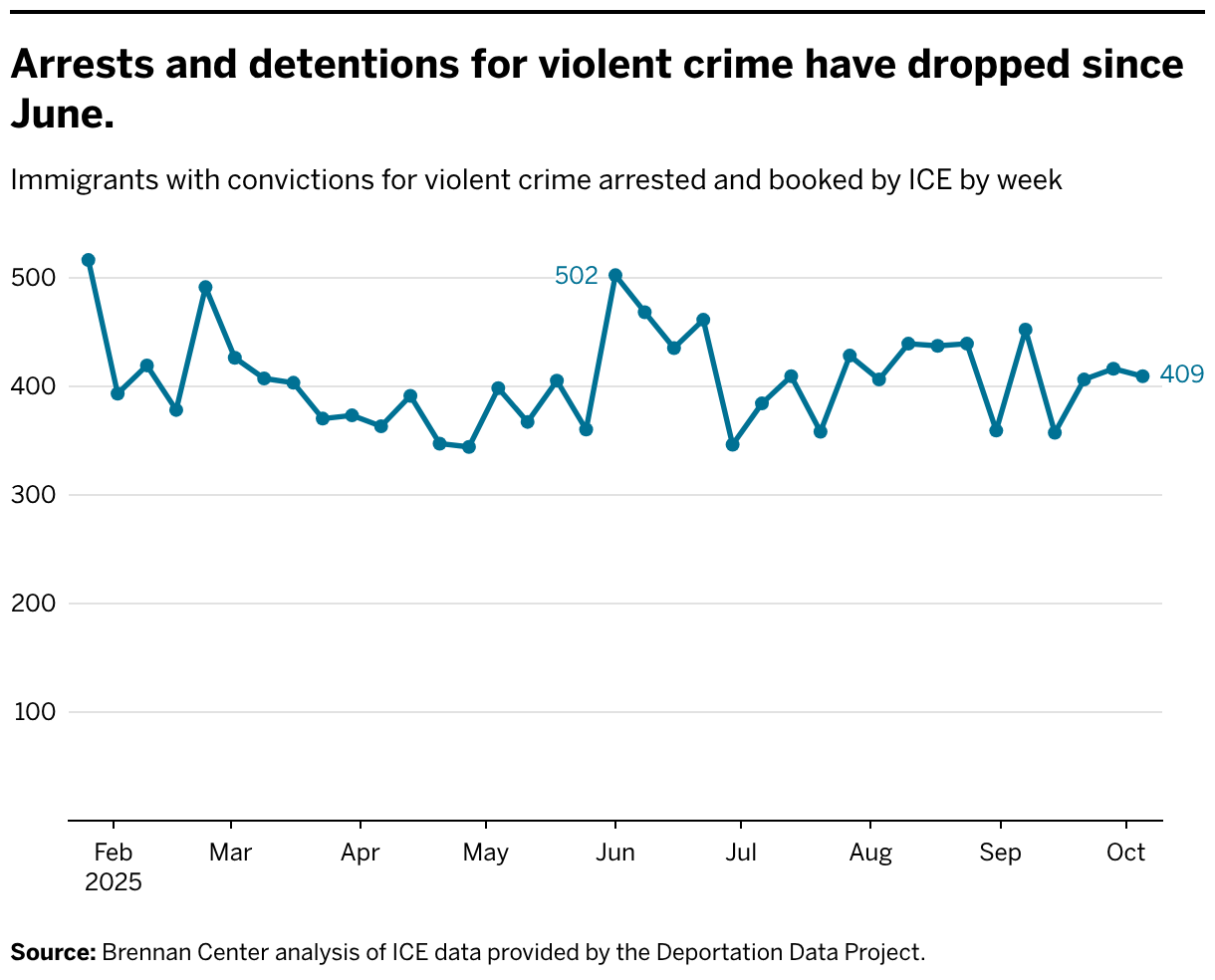
That means that the billions of dollars flowing into immigration enforcement — and away from traditional law enforcement at HSI, the FBI, the ATF, and the DEA — have failed to produce more arrests and deportations of immigrants convicted of violent crimes. Such arrests remain a tiny fraction of all immigrant arrests.
It is too soon to tell from publicly available data whether diverting specialized law enforcement officers from their core functions has reduced the number of criminal investigations and prosecutions they are pursuing. Because those officers specialize in complex cases, it may be years before we see the full effects. But using them to find and imprison noncriminal immigrants is a waste of their training and expertise.
ICE has diverted resources from its own programs focused on criminals.
ICE has programs dedicated to arresting and deporting immigrants with criminal backgrounds but, as with other federal law enforcement agencies, they too have been redirected.
Take ICE’s Fugitive Operations. Its web page proclaims: “We remove criminals from our communities.” In the last year of the Biden administration, roughly 69 percent of individuals detained by Fugitive Operations had at least one conviction. No longer. In the first nine months of the second Trump administration, the share of criminals it detained flipped: only 33 percent of people detained by Fugitive Operations had any conviction — and less than 10 percent of all people detained had a conviction for a violent crime, compared with around 20 percent in the last year of the Biden administration. The number of people convicted of a violent crime detained by Fugitive Operations fell from almost 100 per week in June 2025 (and during certain weeks under the Biden administration) to between 50 and 60 in the four weeks ending October 15, 2025.
Ditto the Criminal Alien Program (CAP), which screens people held in federal, state, and local jails and prisons for immigration status. Although CAP has been criticized for eroding relationships between immigrant communities and local law enforcement, ICE claims it is a key tool to “protect the homeland through the arrest and removal of aliens who threaten the safety of our nation’s communities.” Yet, in the first nine months of the Trump administration, only about 43 percent of people detained through CAP had any conviction at all — and that share was just 36 percent in the four weeks ending October 15. The share with a violent conviction dropped from 17 percent in the last year of the Biden administration to 9 percent in the first nine months of the second Trump administration.
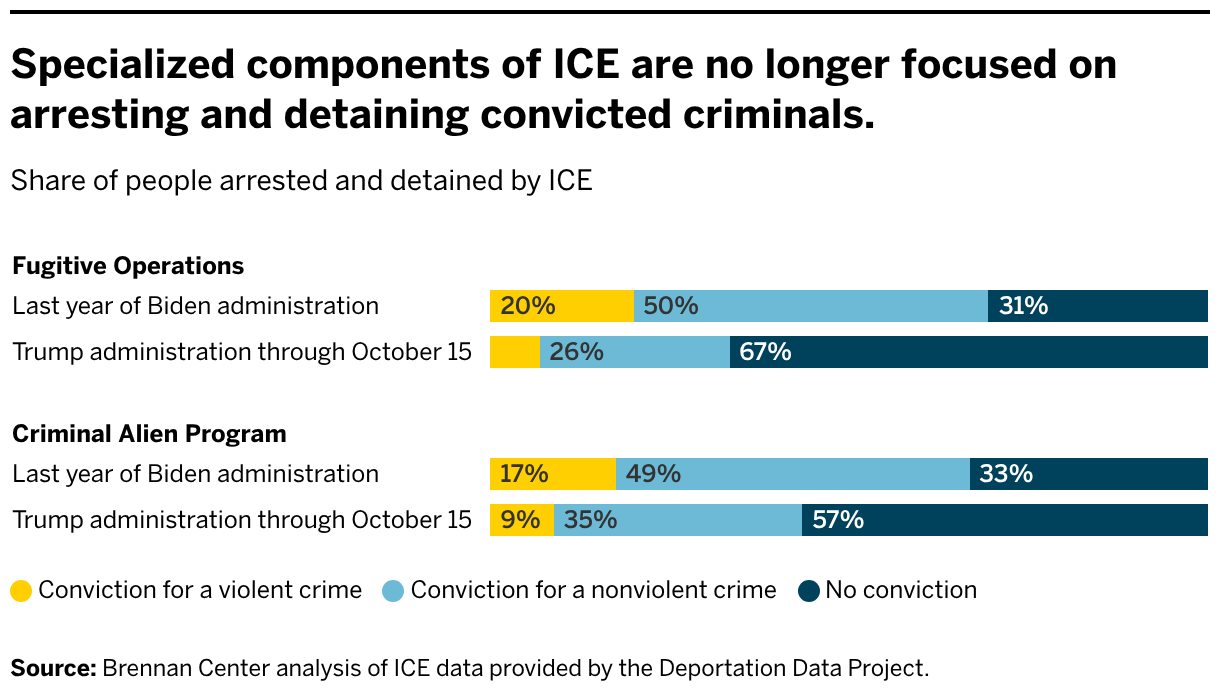
Whatever one thinks about these ICE programs, they at least claim to specialize in identifying the relatively few immigrants whose presence may pose a genuine public safety risk — “the worst of the worst,” in the administration’s words. By pulling officers from these beats to arrest and imprison immigrants who do not pose a public safety threat, they fail to make the country any safer.
Noncriminals detained by ICE are more likely to be female and Venezuelan than those with criminal convictions.
DHS’s claims notwithstanding, the overwhelming majority of detainees have never been convicted of a crime. If not individuals with criminal histories, who is ICE detaining?
The immigrants with no criminal convictions who have been caught in ICE’s dragnet are more than twice as likely to be women (12 percent) as those with criminal convictions (5 percent). The women are typically in their midthirties. On average, they spend 6.5 weeks in ICE’s prisons.
ICE does not track the personal circumstances of the women being detained. Although funding bills starting in 2019 required ICE to report the number of pregnant women in detention, the current Republican-controlled Congress removed that requirement in March of 2025. And a Biden-era policy that limited detention of pregnant, postpartum, and nursing mothers appears no longer to be “current practice.” Since these changes, ICE arrested a woman recovering from a C-section as she was on her way to visit her 15-day-old infant in intensive care. Another woman was arrested when she was five months pregnant and detained without sufficient medical care for most of the remainder of her pregnancy — 1,500 miles from her husband and two young children. Neither of the women had criminal histories. An assessment by Sen. Jon Ossoff found 14 credible reports of mistreatment of pregnant women in immigration detention between the beginning of Trump’s second term and the end of July 2025.
The Trump administration also renewed its policy of detaining families, resulting in a sixfold increase in the number of children and infants being detained since Trump returned to office.
Venezuelans are also overrepresented among detainees without convictions. Only 15 percent of Venezuelans booked into ICE detention since the start of the Trump administration have a conviction, whereas 40 percent of people of other nationalities do. Venezuelans make up 9 percent of detainees without a conviction and 2 percent of those with one. This is in part a product of the administration’s legal strategy. It invoked the wartime Alien Enemies Act by dubiously claiming that a Venezuelan gang was using “mass migration” to “undermin[e] public safety” — a move that would have stripped tens of thousands of Venezuelans in the United States of their due process rights but has been temporarily enjoined by the Supreme Court. (The Brennan Center has argued that the invocation is illegal.) The administration used that same authority to send more than 200 Venezuelans to a notorious prison in El Salvador. It has also stripped Venezuelans of lawful parole and temporary protected status and banned many Venezuelans from coming to the United States lawfully. While some of these efforts have been stymied by the courts, Venezuelans who pose no demonstrable threat to public safety remain far more likely to be imprisoned by ICE than noncriminal individuals holding any other citizenship.
ICE has not reported the number of U.S. citizens it has arrested and detained.
The ICE data on which this analysis is based does not record the arrest or detention of a single U.S. citizen. And DHS has made the demonstrably false claim that it has not arrested any citizens. ProPublica has documented more than 170 improper arrests of citizens during the second Trump administration, including children. In at least one detention facility, ICE has reportedly even designated cells for U.S. citizens. In prior years, ICE reported dozens of U.S. citizen arrests annually — figures that are likely closer to the truth despite themselves being incomplete.
The mismatch suggests the administration is hiding the extent to which U.S. citizens’ lives are being disrupted by the immigration enforcement surge.
Conclusion
Despite the administration’s claims, immigrants are less likely to commit crimes than native-born Americans. Even so, the administration is not focusing on arresting those who do. Instead, federal law enforcement officers have been sidelined from protecting the country from genuine threats, such as child exploitation and drug trafficking, to indiscriminately increase the number of immigrants arrested.
In addition to posing a profound threat to the rights of immigrants and U.S. citizens alike, the dragnet approach isn’t a good value for taxpayers. There is no reason to lock up immigrants unless they pose a threat to public safety or a demonstrable risk of flight. Detention keeps people separated from their families and prevents them from working for American employers. Instead, those who pose no risk can safely be released while they await a determination about whether they may remain in the country. Doing so would be more humane. And it would allow tax dollars to be put to better use on behalf of all Americans.

