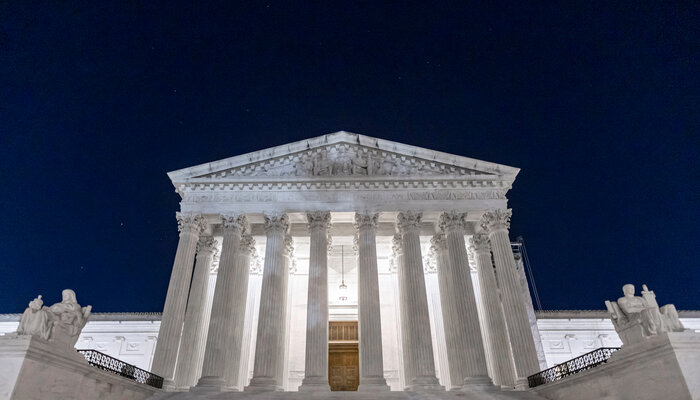


I want to tell you about something exciting and new from the Brennan Center. On Monday, March 30, we will launch a new newsletter: Major Questions. It will feature biweekly essays by the esteemed legal journalist Jesse Wegman. He’ll explain the stakes of key Supreme Court cases and rulings and consider innovative solutions for reforming the Court. We hope this will be essential reading for those looking to better understand the Court in this moment and ways we can improve this vital institution.
If you are interested, I encourage you to sign up here.
Why did we start this? We had a feeling there are lots of policymakers, journalists, activists, and fed up regular people who want to know about the Court, what it’s done wrong (and right), and how to make it the best it can be. This is part of the work we do through our Kohlberg Center on the U.S. Supreme Court. I’m very excited about this. Jesse is one of the country’s leading legal journalists and can help fill a big public gap.
Jesse joins the Brennan Center with more than 10 years of experience on the New York Times editorial board, where he wrote more than 1,000 editorials on the Supreme Court, democracy, and the law. He is also the author of Let the People Pick the President: The Case for Abolishing the Electoral College (St. Martin’s Press, 2020) and the forthcoming The Lost Founder: James Wilson and the Forgotten Fight for a People’s Constitution (Celadon, June 2026), the first full-length biography in more than 70 years of the most democratic of all the American founders. He talks often on television, radio, and podcasts about all these issues.
I recently talked with Jesse about what led him to launch this newsletter, what he plans to write about, and his broader views on the Court.
Click here to subscribe to Major Questions. And you can read my conversation with Jesse Wegman below:
Michael: You wrote about the Supreme Court and the law for more than a dozen years at The New York Times. Why is this an important topic to write about here and now?
Jesse: I loved writing for the Times, and I was grateful for the opportunity to work out my thinking about the Court in a very public forum. At the same time, as it became clearer to me how broken the Court was, I became frustrated at my inability to do anything about it other than write. I couldn’t just sit on the sidelines yelling at the refs anymore. So, it’s a thrilling opportunity to be here at the Brennan Center, an organization that is at the forefront of a national effort to reform the Court and make it the Court we know we need.
Michael: Who do you see as the target audience for the newsletter?
Jesse: I think there are a few obvious targets. The first is members of Congress and their staffs, who will be responsible for writing any Court reform legislation. The second is the American people, who both need to understand how the Court functions or doesn’t function and can influence their representatives. And the third is the groups and organizations that have spent years mobilizing around these and other issues and that we want to prioritize Supreme Court reform as soon as the opportunity arises.
Michael: Will the newsletter focus on the cases before the Court or reform more broadly?
Jesse: Just in the last decade and a half, the Court has handed down so many shocking decisions that have upended decades of settled constitutional law, eliminated constitutional rights, and overturned acts of Congress. I think of Shelby County v. Holder, which eviscerated the Voting Rights Act, Dobbs v. Jackson Women’s Health Organization, which eliminated the right to choose an abortion, and Trump v. United States, which gave the president almost complete immunity from prosecution. I think people are starting to see the radicalism of this Court for what it is.
What is less understood, and what I think this newsletter will help with, is understanding the cases that are before the Court in the broader context of a pattern of misuse of power that is deeply harmful to the democratic experiment. It’s not just the cases, because we know how these cases are coming out. It’s that the game was rigged from the start. I’m hoping that readers will see the danger of letting a court amass this much power with this little accountability.
Michael: On the one hand, you’re making the case that this Court has been wildly overreaching and ideologically driven. On the other hand, you believe it’s important that there be a strong Supreme Court that is respected and does what it’s supposed to do in our constitutional system. How do you strike the right balance?
Jesse: It is a delicate situation, because the Court is both an essential institution in American government and, right now, a very destabilizing one in its behavior. At the same time, it is an extraordinarily fragile institution. Alexander Hamilton wrote that the Court controls neither the sword nor the purse, so it depends on the support of the American public for its legitimacy and its authority.
That support, as we’ve seen in poll after poll, is at its lowest level in generations — for many good reasons. The Court has arrogated to itself far more power than it should have, overturning acts of Congress and its own precedents at an alarming rate, often by bare majorities — 5–4 or 6–3 votes. At the same time, it has increasingly insulated itself from accountability. Justices have lifetime appointments and yet are bound by no enforceable ethics code. The newsletter is going to be an effort to strike that balance: to show respect for the institution and, at the same time, to acknowledge that the only way to truly respect that institution is to reform it.
Michael: The Court has always been political by nature, and it’s often been controversial. But you think it’s really reached a breaking point. What do you see as major turning points in recent years?
Jesse: As a general matter, we should dispense with any illusion that the Court ever sat above politics. Decisions have always been influenced by where judges came from and by their political and ideological predilections. That is the price of doing business. But I think for people in my generation (I was born a few months after Roe v. Wade was decided), there were two breaking points.
The first was Bush v. Gore in 2000. This was a moment when the Court’s role in American life became something bigger and, I think, more dangerous, because of what that 5–4 ruling on partisan lines said about the Court’s willingness to take a decision as monumental as choosing the president away from the American people. I don’t think the Court’s reputation has ever fully recovered from that moment.
The second breaking point is what happened between 2016 and 2020, when Republicans in the Senate blocked President Obama from even holding a hearing for his nominee to the Court, on the spurious grounds that it was too close to an election. They held the seat open for more than a year, effectively changing the size of the Court, just to keep it open for a president who would fill it with a like-minded justice. Four years later, they reversed themselves to ram Amy Coney Barrett onto the Court, even though voting had already begun in that election. There was no principle to this other than the sheer grasp for power. And I think that added a level of toxicity to the Court that had not previously been there. What Majority Leader Mitch McConnell and the Senate Republicans did, I think, was profoundly damaging to the way the Court is understood by the public and damaging to the justices themselves, some of whom have been emboldened to behave more politically, both on and off the Court.
Symbolically, it was a really damaging thing for a court that depends on public will for its legitimacy. To be sure, the Court is not there simply to ratify the will of the people in every case, but neither can it just become unmoored from it and continue to expect support from the people. We’re seeing that play out right now.
Michael: What types of reforms will you write about?
Jesse: Among the many problems with the design of the Court is the fact that justices have lifetime appointments, especially at a time when people live far longer than they did at the founding. It’s why term limits for justices have gotten so much support across the political spectrum. The most common proposal, which is an 18-year term with regularized appointments for every president, is a sensible and easy-to-understand reform that most Americans can get behind. Multiple polls show that overwhelming majorities of Americans support term limits. That is a powerful piece of evidence that the American people are ready for a court that more accurately reflects the realities of life in the 21st century.
A second issue that is top of mind is ethics. Although there are certain justices on the Court right now that we have seen repeated problems with, we know as a general rule that giving people unfettered power is going to ultimately end in corruption. That is why the founders were so focused on building anticorruption measures into the Constitution. They understood corruption is a part of being human, and you need to guard against it. This Court has virtually no guards against it anymore, and we are seeing the effects of that in real time.
Ultimately, any representative government needs to have a court of final resort to provide both finality and fairness. Right now, people have a reason to doubt whether this Supreme Court is providing either.
Michael: What issues will you write about in the coming months?
On one level are the cases themselves, which involve the constitutionality of the Voting Rights Act, the power of the presidency, birthright citizenship, campaign finance, and more.
But the bigger picture is about reform, so I will be writing a lot on that, which means writing about Congress. As I’ve already written, Congress has an immense amount of power to shape the Court that it is not currently using. Throughout American history, presidents and Congresses have used that power, but in the last century or so, it’s gone largely unused (with a big exception). Part of what I hope this newsletter will achieve is to remind members of Congress of their constitutional authority and even obligation to shape the Court for the country that we live in.

