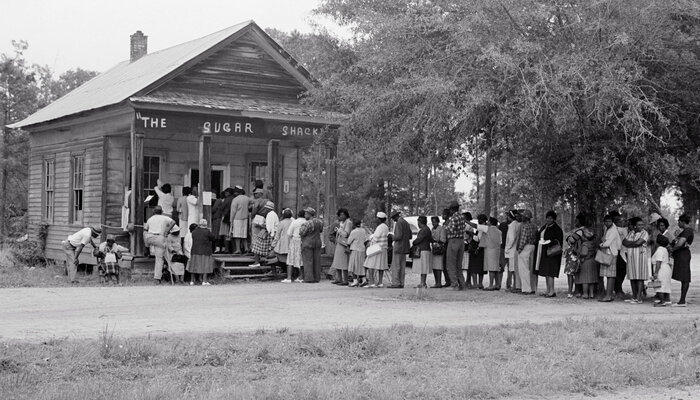

Saturday marks the 61st anniversary of the Bloody Sunday march for Black voting rights in Selma, Alabama, when the peaceful demonstrators were mercilessly beaten by local police. Images of the brutal assaults shocked the nation, and the event was pivotal in giving President Lyndon B. Johnson and Congress the political will needed to enact the landmark 1965 Voting Rights Act.
Saturday is also another, lesser-known anniversary in the nation’s fight to make good on its founding promises of a democracy open to all its citizens. On March 7, 1966 — exactly one year after the march in Selma — the Supreme Court handed down its opinion in a case called South Carolina v. Katzenbach, upholding the constitutionality of the Voting Rights Act that had been signed into law just seven months earlier. Sixty years later, the Court has gutted this achievement of the civil rights movement.
The Voting Rights Act marked a major departure from how law had previously worked. Starting in 1965, states, counties, and towns with a history of racial discrimination in voting were required to get permission, known as preclearance, from the federal government before making any changes to how they conducted elections. The requirement was designed to end the game of legislative whack-a-mole that was common in some parts of the country. In those places, as soon as courts struck down one device used to disenfranchise Black citizens, county clerks or state lawmakers would come up with a new one. Their voter suppression tactics were effective: In much of the former Confederacy, registration and turnout rates among Black citizens were well below 10 percent.
As Attorney General Nicholas Katzenbach explained, “Those who are determined to resist [allowing Black Americans to register and vote] are able, even after apparent defeat in the courts, to devise whole new methods of discrimination. And often that means beginning the whole weary process all over again.”
It was a weary process indeed. Katzenbach told the Senate that it often took the Department of Justice thousands of hours to review the records for a single challenge to allegedly discriminatory election policies. Of course, the officials responsible for running elections in the South knew that time was their friend, and they had no compunction about capitalizing on the arduousness of the litigation process to slow down the enfranchisement of Black voters.
In his majority opinion in Katzenbach, Chief Justice Earl Warren recognized the importance of the Voting Rights Act. While he acknowledged that the law “create[ed] stringent new remedies for voting discrimination,” he nevertheless held that they were necessary “to banish the blight of racial discrimination in voting, which has infected the electoral process in parts of our country for nearly a century.” Preclearance, he understood, was especially important: “Even when favorable decisions have finally been obtained, some of the States affected have merely switched to discriminatory devices not covered by the federal decrees, or have enacted difficult new tests designed to prolong the existing disparity between white and Negro registration.”
Most importantly, Warren acknowledged in his opinion how the legal process itself can be used as a tool of discrimination. He wrote, “After enduring nearly a century of systematic resistance to the Fifteenth Amendment, Congress might well decide to shift the advantage of time and inertia from the perpetrators of the evil to its victims.” The Court recognized that the 15th Amendment’s promise against race-based vote denial was being ignored and that the Court had a role to play in upholding American democracy. As Michael G. Miller and I show in our forthcoming book, An American Problem: How the Country Built — and the Supreme Court Broke — The Voting Rights Act, the Supreme Court proved an able partner in fighting the “evils” of racist voter suppression in the decades that followed. Our research shows that, over the half-century period in which this section of the Voting Rights Act was in effect, thousands of racially discriminatory voting policies were stopped before they could go into effect.
But no longer. In 2013, in Shelby County v. Holder, the Supreme Court struck down the section of the Voting Rights Act that required states and localities to preclear changes to their elections. This returned the country to an era in which the slow legal process was the only recourse for overturning discriminatory election laws. Our research shows that the result has been disastrous: After the Court shifted the “advantage of time and inertia” back to places with a history of perpetrating evil (as the Court put it in Katzenbach), the political participation of Black and other minority voters declined dramatically relative to white voters. We used advanced statistical methods to estimate that hundreds of thousands of votes have gone uncast by voters of color in recent elections, directly attributable to the practices unleashed by the Shelby County ruling. Additionally, our research shows that the ruling led to millions of additional voters being kicked off the registration rolls in these places. We also document how the loss of preclearance allowed for the adoption of racially discriminatory laws such as strict voter ID rules and cuts to mail voting. At the same time, across the country, the gap in turnout between white and minority voters has exploded in the past decade.
The Roberts Court didn’t stop in 2013, however. Since then, it has made it easier for states to hide their racial gerrymanders by calling them partisan ones. In 2021, the Court made it much more difficult to strike down laws that disproportionately make it harder for Americans of color to cast a ballot. Now the Court’s conservative supermajority seems poised to strike down what remains of the Voting Rights Act and allow states and localities to racially gerrymander. Doing so would make the votes that Americans of color are able to cast count for less. Our research indicates that gerrymandering, too, was made worse by Shelby County. After being released from preclearance, formerly covered towns began “bleaching” their populations by annexing whiter outlying areas and driving down the share of their population that was nonwhite.
This weekend, many of us will take a moment to thank the civil rights activists who came before us. The democracy we have today was bought in blood, on Selma’s Edmund Pettus Bridge and in countless other struggles throughout the South. At the same time, we should take a moment to thank the Supreme Court justices from that bygone era for recognizing the scourge of racist election rules in the United States. They knew that the 15th Amendment granted Congress the power to act and to make our democracy work for voters of all races, ethnicities, and language backgrounds. Even though today’s justices might refuse to do the same, we must never stop demanding that Congress and the courts act boldly to protect the voting rights of all Americans.

