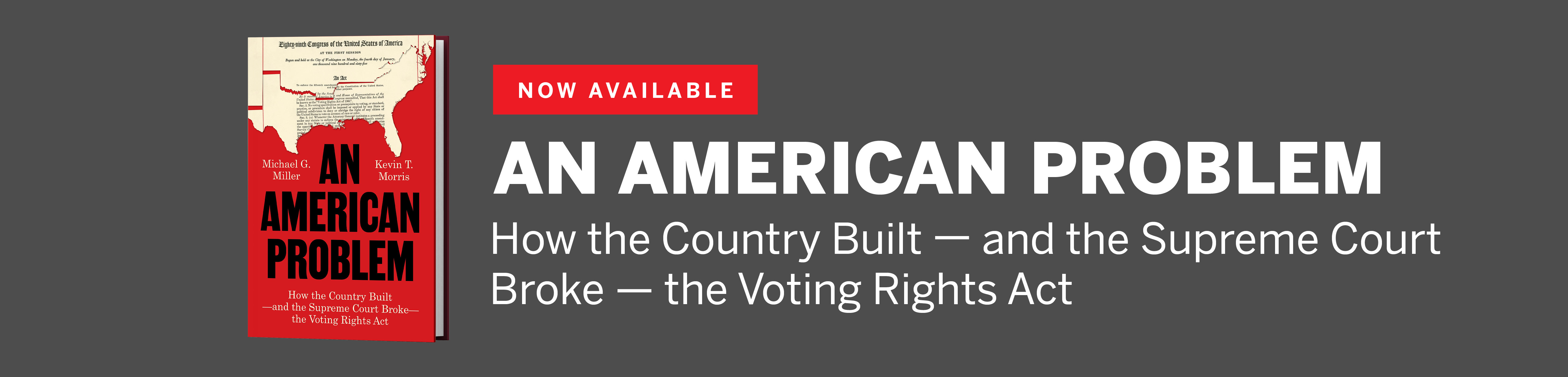
The Voting Rights Act of 1965 finally made good on the promise of the 15th Amendment, which nearly a century before had granted Black Americans the right to vote. The Voting Rights Act was the crowning achievement of the civil rights movement, which had battled for years against voting laws that made it all but impossible for Black Americans to cast a ballot.
The act was a resounding success, bringing Americans of all races and ethnicities into the democratic process. And then, in 2013, the Supreme Court brought this progress to a screeching halt with their decision in Shelby County v. Holder. In this book, Barnard College Professor Michael G. Miller and Brennan Center Senior Research Fellow Kevin T. Morris offer a sweeping history of the Voting Rights Act and the attacks it has suffered.
Miller and Morris explain that central to the act’s success was its requirement that states and localities with a history of discrimination get federal permission to change their voting rules — a novel approach known as “preclearance.” It was this requirement that the Shelby County decision eviscerated. Miller and Morris trace the devastating effect of Shelby County, using advanced research techniques to prove that the decision unleashed racially discriminatory voting policies.
The result is a nation in which Americans of color cast fewer ballots, and in which the ballots they do cast count for less. But the story does not end there: The Supreme Court continues to undermine what remains of the Voting Rights Act. What President Lyndon B. Johnson called “an American problem,” formerly kept in check by a strong federal law, once again threatens voting rights. The book will be published on October 6 by Princeton University Press.