The Data Behind Prison Reform
Preliminary studies suggest that innovative programs could improve prison conditions and outcomes after release.



Explore more

The U.S. incarceration system is broken. Prisons are largely unable to address the underlying circumstances that can lead to crime, such as mental illness and lack of housing or education. They are rife with violence, overcrowding, understaffing, and inhumane conditions. When people serve time, they are not set up to successfully reintegrate into society.
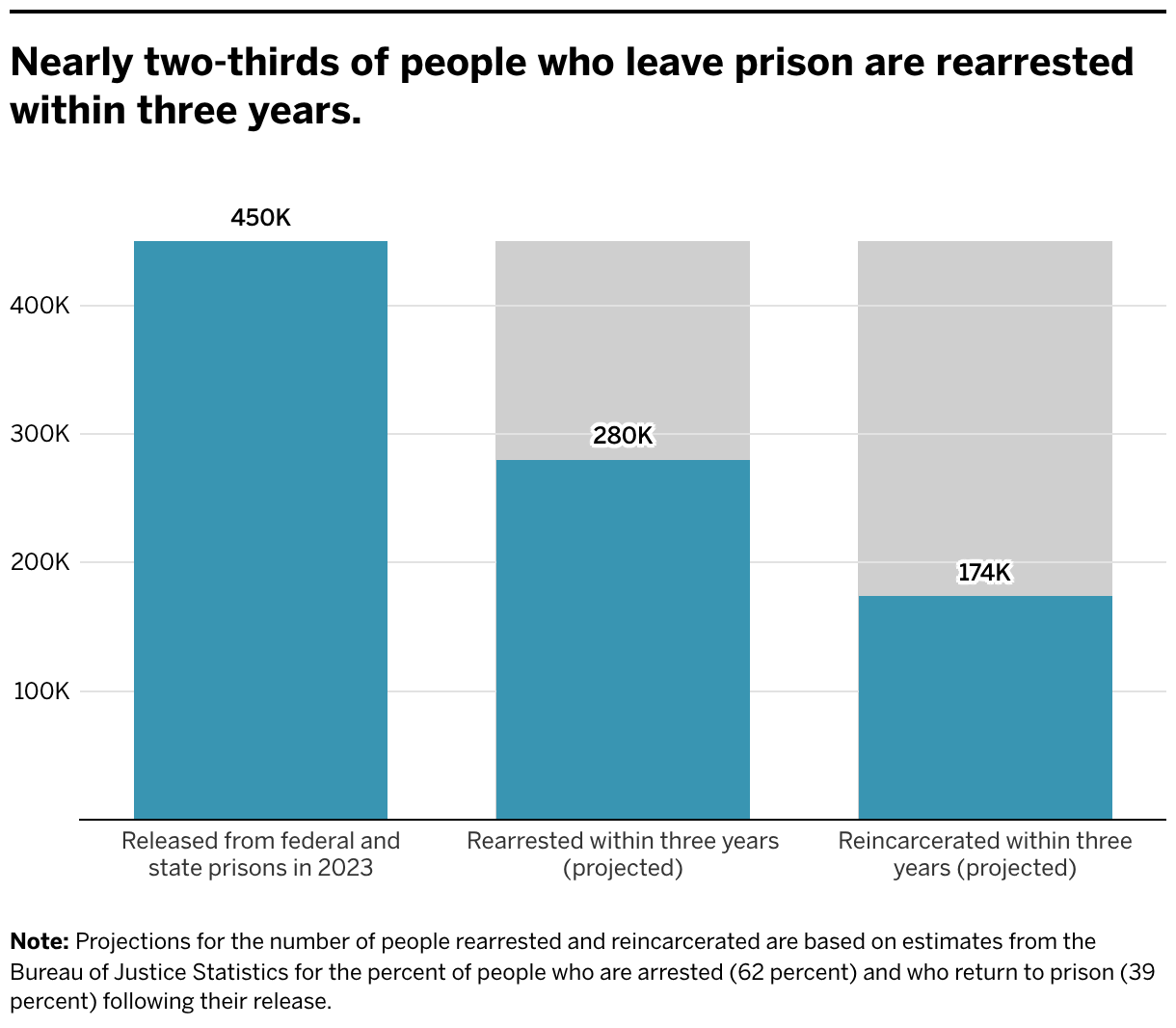
Roughly 62 percent of people who leave prison are rearrested within three years, and 39 percent return to prison. In 2023, approximately 450,000 people were released from federal and state prisons. By these odds, 280,000 of them will be rearrested before the end of 2026, and 174,000 will be reincarcerated. This is a broken cycle, and it does not make anyone safer — inside or outside prison walls. But it doesn’t have to be this way.
Over two and a half years, we visited prisons that are taking a novel approach to incarceration. Our new report documents reforms that correctional leaders and advocates are implementing in prisons throughout the country. Rather than merely locking people up, they seek to improve prison conditions for both incarcerated people and staff, address root causes of crime, and equip people to successfully reenter society.
These reforms, which are happening across a politically and geographically diverse set of states, posit that by focusing on rehabilitation rather than retribution, the U.S. prison system can reduce violence, improve working conditions for staff, and improve post-release outcomes, which would ultimately contribute to better public safety.
What do the numbers say?
Many of these programs are new or limited in scope, so we don’t have long-term effects to measure. But initial studies have shown promising results.
For example, Restoring Promise is an initiative by the Vera Institute of Justice that redesigns housing units and programming for young adults between the ages of 18 and 25, realigning corrections policies and practices with a commitment to human dignity. The program includes peer mentorship, education opportunities, and more time out of cells. Units are meant to mimic the outside world as much as possible to prepare residents to rejoin their communities.
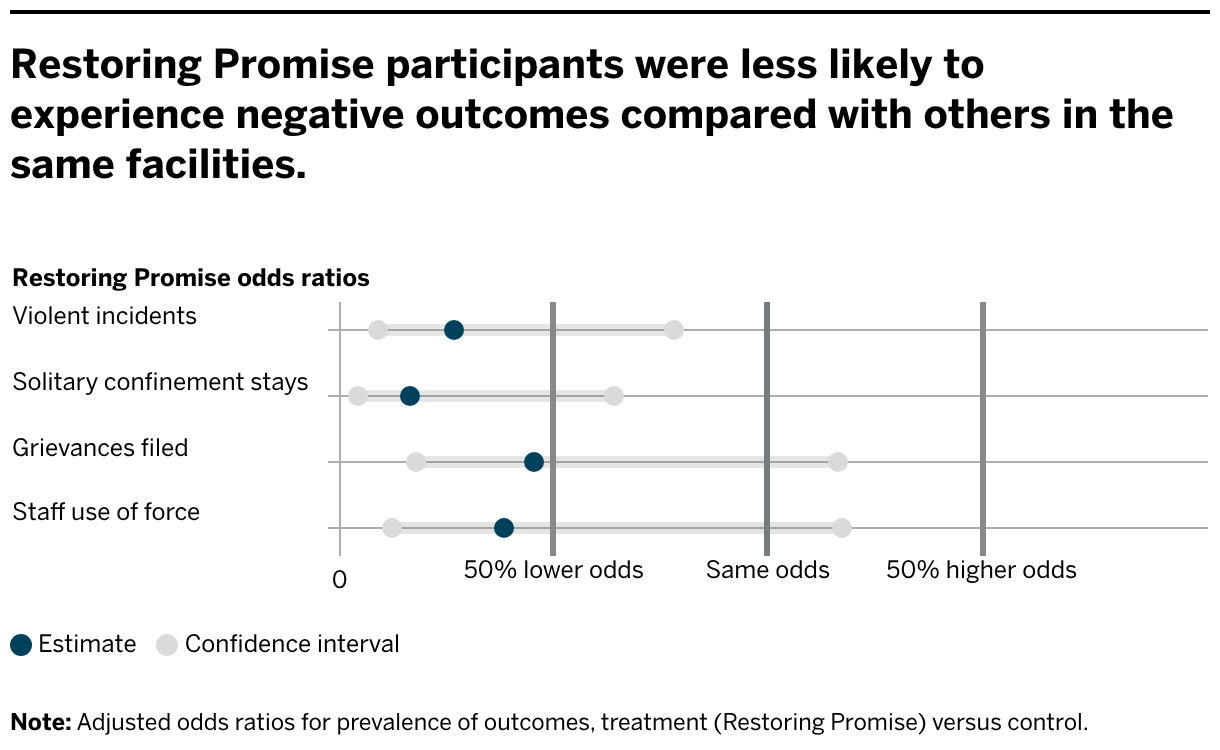
Researchers conducted a randomized control trial at Restoring Promise’s South Carolina sites to evaluate the effects of the program on violence in prison, accounting for a range of factors such as education level, race, age, and custody level. Compared with other young adults in the same facility, people in the Restoring Promise group demonstrated a 73 percent reduction in the odds of violent incidents and an 83 percent reduction in the odds of restrictive housing stays (i.e., solitary confinement).
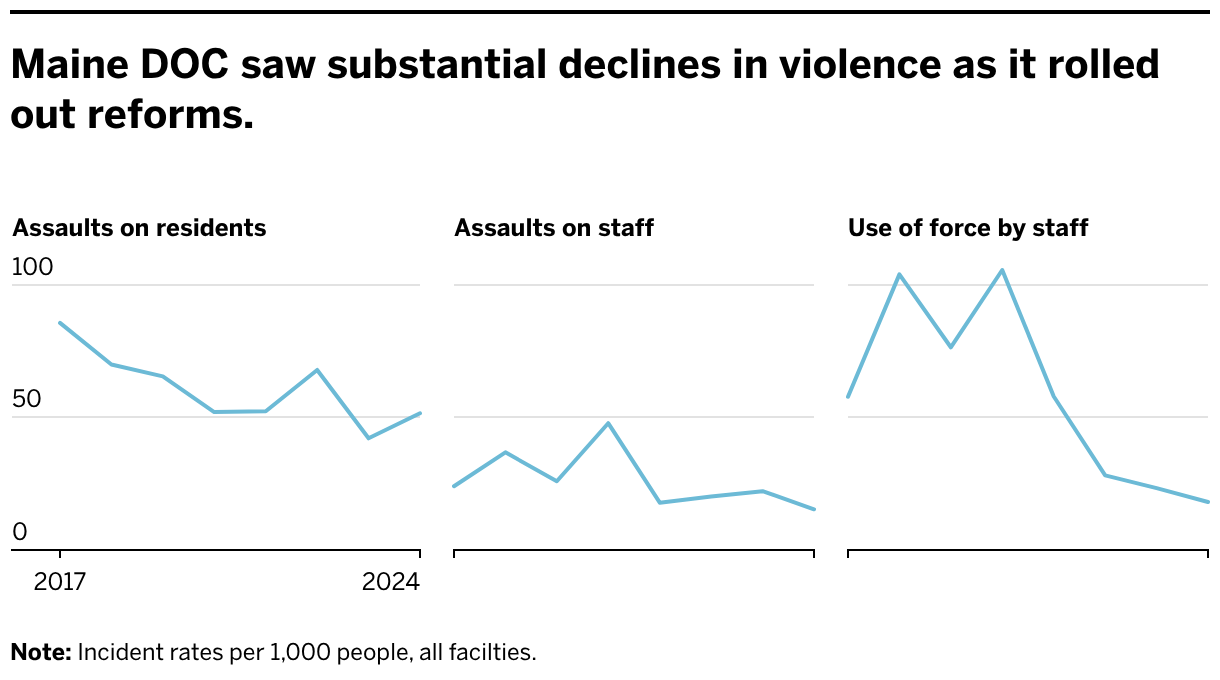
In Maine, the Department of Corrections reformed its whole system through an incremental and ongoing process that was formalized as the Maine Model of Corrections in 2022. Efforts included physical changes, such as renovations to general population units (e.g., sound-dampening materials, warmer colors, natural lighting), and policy changes, including new correctional officer roles focused on behavioral health. Between 2017, as the department began its shift, and 2024, the most recent year for which we have complete data, the state saw a 40 percent reduction in resident-on-resident assaults, a 36 percent reduction in resident-on-staff assaults, and a 69 percent reduction in staff use-of-force incidents.
Prison programs also focus on rehabilitation, or successful reentry into society. Leaders of such initiatives recognize that people who are incarcerated aren’t being offered the skills or education needed to avoid returning to prison. And they’re trying to change that.
The Last Mile is a nonprofit program that brings training in high-tech industries like software development and media production to prisons. When graduates of the program leave prison, they do so with employable skills and a network of staff and alumni to support them. More than 1,500 people have participated in the Last Mile’s courses since 2015, and more than 70 percent of graduates find employment within six months of release. By contrast, in 2018, the most recent year for which nationwide data is available, only 54 percent of people leaving federal and state prisons found employment within a year of their release.

Similarly, the Vocational Village program in Michigan trains people who are incarcerated in skilled trades with rich employment opportunities, such as construction or automotive careers. The recidivism rate — the share of people who return to prison on a new conviction or a technical violation — three years after release for people who left Michigan Department of Corrections facilities in 2020 was 22.7 percent. But for graduates of the Vocational Village program who left that same year, that rate was more than 10 percentage points lower, at 12 percent.
Michigan’s comprehensive approach — which includes training, accredited certifications, assistance with job placement, and employer tax breaks to encourage businesses to hire program graduates — and its demonstrable outcomes have made it a national model for departments of corrections looking to better prepare people for release.
Seeking to replicate these successes is a worthwhile effort: At the scale of our national prison system, a difference of even a couple of percentage points translates to tens of thousands fewer people returning to prison each year.

By and large, Americans know that the U.S. prison system doesn’t work and overwhelmingly support ways to change it. In recent Brennan Center polling, only 32 percent of registered voters agreed that prisons treat people fairly. The vast majority (72 percent) said prisons primarily focus on punishment rather than on making people better citizens (24 percent).
Support for rehabilitative proposals was nearly universal: More than 90 percent of Democratic and Republican respondents wanted to require prisons to be free of violence, offer vocational training, and offer educational opportunities for the people sentenced there.
These aren’t radical ideas. The way prisons currently operate in this country is often inhumane, unproductive, and out of step with public opinion. But there is a way forward. Even with limited data, we can see that treating people with dignity can make prisons less violent, and investing in rehabilitation can help people stay out of prison once they’re home. Given the public’s support, the expansion of these programs and the incubation of new reforms should be a clear priority for improving public safety.

