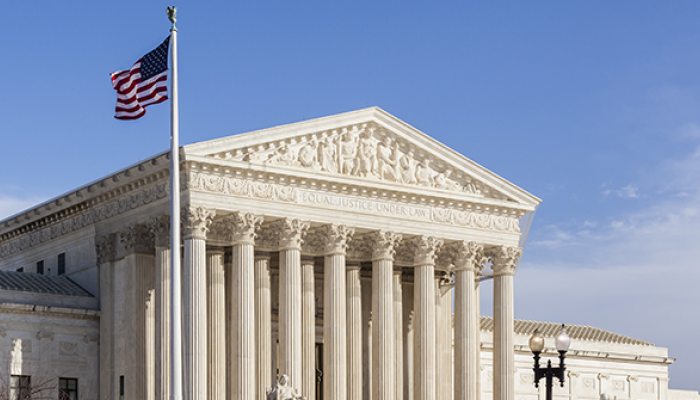

The Supreme Court is set to hear oral argument Tuesday in a challenge to decades-old federal rules that limit how much national political parties can spend in coordination with their candidates. Most observers expect that the Court will continue its streak of invalidating campaign finance laws, which started with Citizens United v. Federal Election Commission 15 years ago. To be sure, the campaign finance system needs reform, and it’s fair to ask whether party coordination rules remain effective today in light of changes to the political landscape since they were enacted. But evaluating those sorts of policy considerations is the job of Congress, not the Supreme Court.
Limits on political parties coordinating spending with candidates have existed since 1974. The rationale behind these rules is simple: There are relatively strict limits on how much money an individual or group can donate directly to a candidate, which provide an important safeguard against bribes and the appearance of corruption. By contrast, parties are subject to much weaker limits, due in large part to the Supreme Court’s previous decisions. So if candidates and parties can coordinate their spending, it opens a loophole that donors can exploit to evade the stricter limits for candidates.
Based on this straightforward reasoning, the Court upheld the rules at issue here against a First Amendment challenge in a 2001 case, Federal Election Commission v. Colorado Republican Federal Campaign Committee. But in the current case, National Republican Senatorial Committee v. Federal Election Commission, the challengers no doubt hope that the new makeup of the Court, now controlled by a conservative supermajority, will produce a different outcome.
Their arguments largely track those that the Court rejected last time. But they add a new twist, pointing out that the political landscape is now very different. Today, political parties have to compete not only with each other but also with outside spending groups, such as super PACs, which can raise and spend unlimited amounts of money thanks to Citizens United.
Those challenging the rules aren’t wrong on this latter point. Political parties do face a more complicated landscape today. But this lawsuit is asking the wrong branch of government for relief.
For all their flaws, parties have a crucial role to play in American democracy. They have historically served as powerful engines of civic engagement and pushed disparate political actors to coalesce behind actual governing agendas. Their fundraising is also relatively transparent, and because they are long-term political players, they tend to value their credibility and reputation with voters more than super PACs and other outside groups that Citizens United enabled.
These other groups have taken center stage in elections over the past 15 years. The wealthiest donors now routinely use self-funded super PACs to funnel tens or even hundreds of millions of dollars into specific races. And so-called dark money groups that don’t disclose their donors continue to spend ever-larger sums to influence voters anonymously — more than $4.3 billion in federal elections since 2010, including $1.9 billion in the 2024 cycle alone.
Reforms are clearly needed to revitalize parties, including potentially raising or repealing party-coordinated spending limits. But any efforts to deregulate political party spending should come as part of a broader package that establishes a system of reasonable, enforceable contribution limits for all political actors. Otherwise, loosening restrictions on parties increases the risks of corruption that the Court identified in the 2001 Colorado case.
The more fundamental question is who should decide these regulations. As the Brennan Center made clear in our friend-of-the-court brief, the answer is not the Supreme Court.
The Court’s own track record on campaign finance shows why judges are poorly suited to this task. In Citizens United and subsequent cases, the Court relied on unfounded assumptions and hypotheticals rather than robust factual records. Unsurprisingly, these interventions have resulted in unintended (but predictable) consequences for American democracy.
For example, despite the Court’s repeated assurances that outside groups pose no risk of corruption because they operate “independently” from candidates, super PACs have emerged as vectors for corruption as they accept unlimited, often anonymous contributions and increasingly work hand-in-glove with campaigns. Federal elections are awash in billions of dollars from anonymous dark money sources after the Court wrongly assumed that disclosure rules would ensure donor transparency. Perhaps most troubling, trust in government has cratered despite the Court’s unfounded claim that the sale of access and influence would “not cause the electorate to lose faith in our democracy.” Huge majorities across partisan and ideological divides believe that big donors have too much sway over politics and that politicians care more about corporations and the wealthy than their constituents.
Congress is much better equipped to evaluate the complex policy considerations involved in regulating campaign finance. Lawmakers can hold hearings, weigh a broad range of evidence, and propose comprehensive frameworks that balance competing priorities and interests. Moreover, given their intimate familiarity with the realities of campaign fundraising, lawmakers have unique insight into the risks of corruption and the dangers posed by concentrated wealth and power.
Unfortunately, Congress has been missing in action. Part of the reason may be that the Supreme Court’s overreach in campaign finance issues has stifled policy innovation. But whatever the cause, congressional inaction must end. Widespread dissatisfaction with the influence of money in politics has persisted among voters of both parties for far too long.

