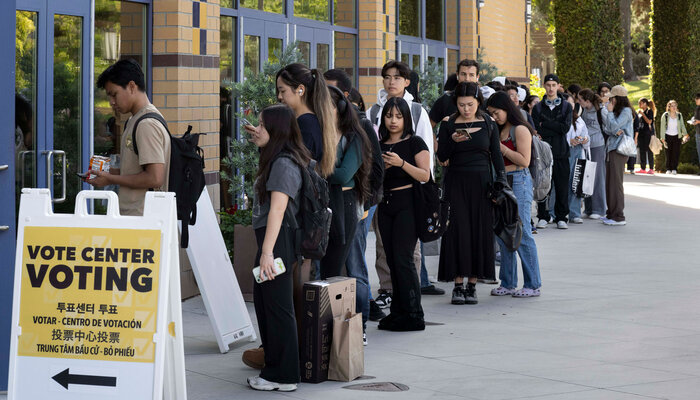


Ahead of the 2026 midterms, Trump administration allies have floated the possibility that federal immigration agents could interfere at polling sites this fall, a scenario that would violate federal and state laws.
Longtime Trump supporter Steve Bannon said last week that the deployment of ICE agents to airports is “perfect training for the fall of 2026.” Oklahoma Sen. Markwayne Mullin said during his confirmation hearing to lead the Department of Homeland Security that ICE could be sent to polling places in the event of a “specific threat.”
The White House and a top DHS official previously said there are no plans to deploy ICE agents to polling sites. Those assurances, however, do little to ease concerns over voter intimidation and chilling voter turnout because of these persistent calls.
Part of the push to deploy ICE agents to polling sites stems from the administration’s insistence, without evidence, that noncitizens are voting in droves. Noncitizen voting is already illegal and vanishingly rare, and states have multiple checks in place that ensure only American citizens vote.
Here’s what to know about why deploying ICE agents or other armed federal troops to election sites is illegal and what voters and election officials can do if the Trump administration attempts to send agents anyway.
Can the president send ICE agents to polling places?
No. Elections are special. There are specific federal and state laws that make this kind of action unlawful.
Sending ICE or any other armed federal agents to the polls is illegal because federal law bans federal officers from interfering in elections. It’s also illegal because federal law bans troops and armed federal agents from being deployed anywhere an “election is held.” While that law was passed in 1865, surely in today’s elections, that means wherever votes are cast and counted, including, polling places, vote-counting facilities, and drop boxes. And any kind of voter intimidation, including by federal agents, is illegal under both federal and state law regardless of where it happens.
Can ICE agents be near polling locations if they remain outside?
ICE has no reason to be at or near the polls. ICE is part of the Department of Homeland Security, which has no role in enforcing election laws.
Given ICE agents’ extreme actions in Minneapolis and elsewhere, even their presence at or near the polls can intimidate voters or anyone administering an election, which is illegal.
Shouldn’t law enforcement be able to respond if there is some kind of threat of violence at a polling place?
State and local election officials run elections and have primary responsibility for ensuring the safety and security of polling places. The presence of law enforcement at the polls can be intimidating, so election officials work hand in hand with state and local law enforcement to ensure they are prepared to respond appropriately in the event of emergencies without needlessly causing intimidation.
In rare instances, it might be valuable to have support from federal law enforcement, but only if they are working together with local law enforcement, and not in the form of armed deployments to the polls. In fact, the federal law prohibiting federal armed agents from the polls has been on the books since the Civil War. There is no instance in which it would make sense for immigration officers to be involved.
What can voters do if ICE agents show up at polling places?
If any voter, election official, or election worker is intimidated during an election, they can go to court to protect their rights. Courts have processes to rule quickly to prevent election disruptions or voter intimidation.
Voters should report the presence of ICE agents to their local election officials. They can also call or text 866-OUR-VOTE if they have any issues voting or questions about how to vote.
Americans should also check their voter registration status now, learn their voting options well in advance of the election, and make a plan to vote early however they choose, including in person, by mail ballot, or at a drop box where available.
What can state lawmakers do to protect voters?
What can election officials do?
Election officials are always working hard to make sure elections are free, fair, secure, and accurate — and that every eligible voter can cast a ballot without being intimidated.
Ahead of the midterms, that preparation can involve coordinating with local law enforcement and county attorneys, as well as conducting trial runs to practice how to respond in the event that ICE agents are deployed to polling places.
Election officials can also reach out to local community groups, voter engagement organizations, and the people who run schools, libraries, and other voting locations to discuss how to help the community feel safe.

