

Reading Justice Samuel Alito’s opinion in Louisiana v. Callais, a recent ruling that threw out Louisiana’s congressional map with two majority Black congressional districts, made me dwell on themes of politics presented in a recently launched play entitled Reconstruction by Pulitzer Prize winner Robert Schenkkan. The show tracks the political rise of John Lynch, Mississippi’s first Black speaker of the house — who later became one of the central figures in the Reconstruction Congress. A pivotal scene occurs between Lynch and one of his rivals, Democrat LQR Lamar (a former Confederate officer turned congressman whose antebellum views, shall we say, were not long forgotten).
As Republican fortunes in Mississippi waned, Lamar proposes a deal to split patronage appointments between Democrats and Republicans in the spirit of comity — or so it appears. Lamar promises Lynch control of all Republican appointments in Mississippi — so long as every appointment he makes is Black.
Why this condition? Of interest to Lamar was undoing Reconstruction by racially segregating the state’s politics. His strategy, aimed at white Mississippians, is a familiar one: assuring that the political futures of white voters were viewed in opposition to, rather than alliances with, Black voters.
I have thought about this scene a lot since reading Alito’s opinion. The ruling effectively squeezes any remaining usefulness out of Section 2 of the Voting Rights Act, making it nearly impossible for voters to file lawsuits challenging racial discrimination in electoral maps. The opinion is as ahistorical in assessing the law’s transformational record as it is cravenly cynical in claiming a need to revise a class of race discrimination that has worked effectively for the last four decades.
But this opinion also reveals an especially misguided and dangerous view about Southern politics, deployed to justify reworking the legal framework that Justice William Brennan Jr. developed in the mid-1980s. Specifically, Alito claims that the politics of the South have changed such that Black voter participation at times surpasses the turnout rates of white voters, which is grossly misleading at best. Further, he states that in places where Section 2 lawsuits are most common, “a full-blown two-party system has emerged.” For him, the Voting Rights Act’s enforcement regime, including its attention to race (meaning an effort to address racial inequities) impedes the development of this “normal” politics.
Alito’s suggestion that competitive politics thrives in the South is quite a challenging characterization for any Southerner, especially a social scientist like me. Readily available facts show otherwise. Over the last decade, the five states with the most Section 2 lawsuits in the country are indeed in the South — Alabama, Arkansas, Georgia, Louisiana, and Texas. But Republicans enjoy trifectas in each state, and three of them (Alabama, Arkansas, and Louisiana) also have legislative supermajorities.
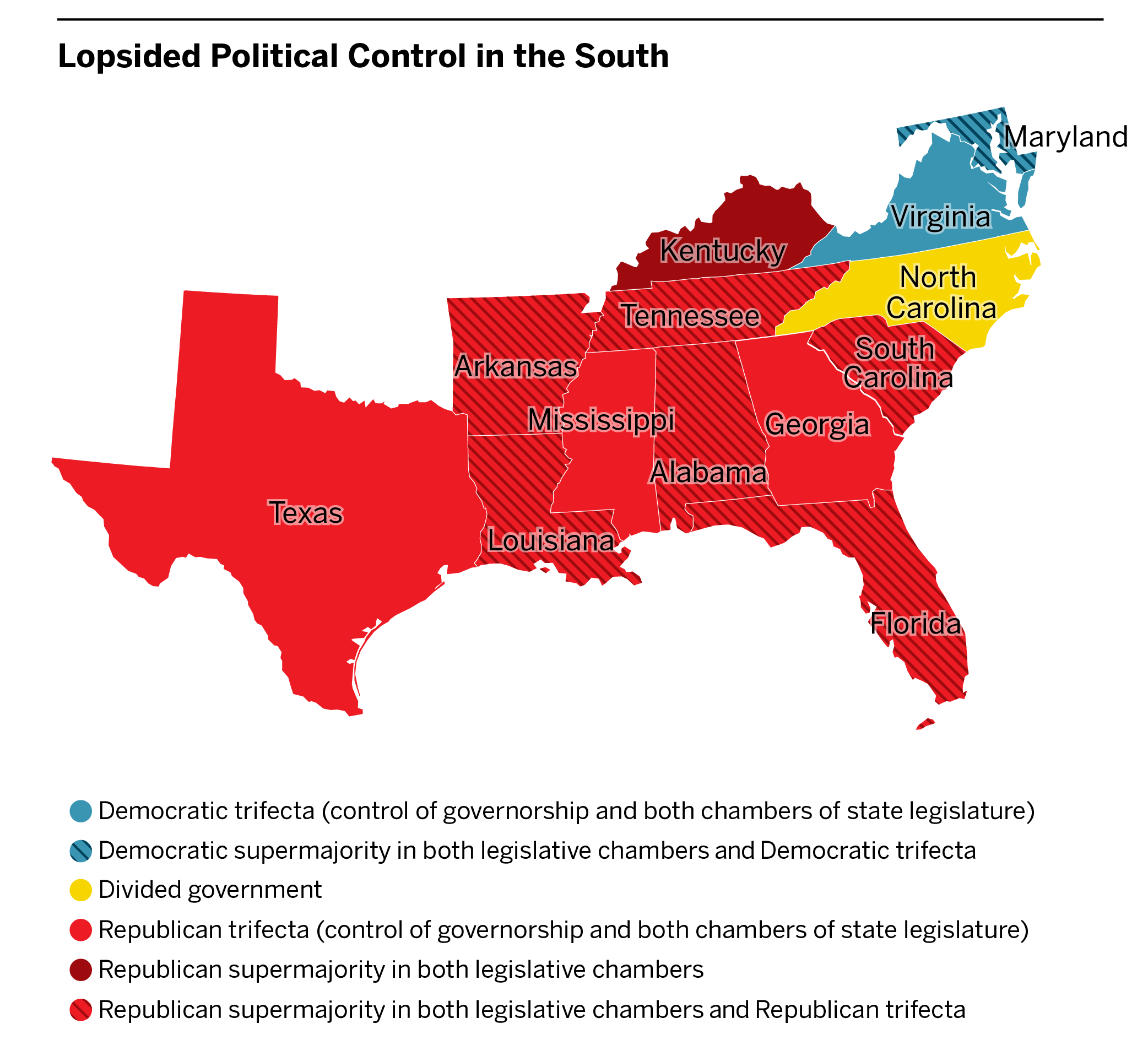
The one-party dominance in these states — not unlike Mississippi and South Carolina, where Black voters account for at least 30 percent of the state’s population — also features a decidedly racial component that produces elections and representative bodies with pronounced racial stratification. Among all 836 sitting legislators in these top Section 2 states, there is only one Black Republican member. Just one. The apparent message Callais offers to Black voters in the South is: Your political concerns only matter if they are in line with those of the partisan and racial majority.
The envisioned political system closely resembles what existed in the South’s one-party system prior to 1965. Prompted by the derailment of Reconstruction, the competition in that system was limited to white candidates within a party primary that Black voters could not join by law (and often, by force). And when federal law required states to register Black voters, partisan strategies shifted, resulting in white departure to a different structure but the same dynamics. Prompted partly by a national realignment, the site of competition in the South has now moved to a Republican primary — but the pushing, hauling, and trading (especially in closed primary states where gerrymandering is rampant) still happens among a white electorate long before most Black voters ever have a say in the general election. There is no meaningful space for building alliances either across race or across party, which looks a lot more like Lamar’s vision for Mississippi.
The artifice in Alito’s read of Southern politics is that it omits the obvious truth that race has always shaped political contestation and representation. The outrage of Callais is that it offers a callous shrug to the decided lack of opportunity when a dominant party enjoys the majority of white voter support but offers little to no effort to engage Black voters or their interests. Alito and his colleagues appear unwilling to imagine the possibility that their view of partisanship entrenches negative and targeted consequences for Black voters whose partisan interests are informed by their racial identity and not the other way around.

