Resource
Texas: Protections Against Intimidation of Voters and Election Workers
This resource details state and federal laws protecting against the intimidation of voters and election workers and the disruption of the voting process.
Part of
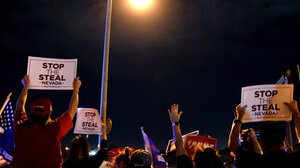
Voters in Texas have the right to vote free from intimidation under federal and state law.1 The federal protections that apply to all states are explained here. The following actions are specifically prohibited by Texas law:
- Influencing or threatening to influence a voter not to vote or to vote in a particular way.2
- Harming or threatening to harm a voter because the voter voted for or against a candidate or measure, or the voter refused to reveal how they voted.3
- Indicating to a voter in a polling place by word, sign, or gesture how the voter should or should not vote.4
- Loitering or electioneering for or against any candidate, measure, or political party within 100 feet of a polling place and within 20 feet of a parking space designated for curbside voting.5
- Tampering with voting equipment.6
The information below addresses the laws that serve as guardrails against specific threats of intimidation.
Voter Challenges
Texas does not allow challenges to voter eligibility at polling locations.7 Only state election officials can inquire into the qualifications of voters at a polling location.8
The National Voter Registration Act provides additional safeguards to protect voters from mass challenges before an election:
- The NVRA expressly recognizes that National Change of Address information is not sufficient on its own to serve as the basis for canceling a voter’s registration.9
- The NVRA prohibits the systematic removal of voters from the rolls within 90 days of a federal election.10
More information about the limitations and process for voter challenges in Texas can be found here.
Voter Intimidation by Poll Workers
Information about the rules and constraints on poll workers in Texas can be found here.
Intimidation by Election Observers
In 2021, Senate Bill 1, expanded the risk of intimidation by election observers (referred to as “poll watchers” in Texas), making it harder for election workers to stop election observer voter harassment.
Texas still has safeguards in place, however:
- In Texas, not just anyone can be an observer at the polls; unauthorized observers are not permitted at polling places.
- Observers must be appointed in advance of the election by party or candidate representatives.11
- Observers must provide a certificate of appointment and certification of completion of observer training to officials on Election Day.12
- Observers must wear identification provided by the poll manager or superintendent during the observer’s hours of service at the polling place.13 The observer must provide a sworn affidavit stating that they will not possess any enabled video or audio recording devices while serving as an observer and that they have not been convicted of certain election-related felonies.14
Texas also limits how many observers can be at the polls and what they may and may not do:
- Each candidate and party may appoint no more than two observers to each precinct polling place.15
- Pursuant to the oath all observers must take, observers should not in any way interfere with the conduct of the election.16 Observers cannot speak to voters or talk to election officers about the election (except to call attention to an irregularity).17
- An observer who continues to hinder the voting process after a warning should be removed by the precinct’s presiding election judge, consistent with the duty to preserve order and prevent breaches of the peace and violations of the election code.18
For more information on rules and constraints on election observers in Texas can be found here.
Guns, Law Enforcement, and Federal Agents at Polling Places
Guns and other weapons are prohibited on the premises of polling places.19 Therefore, the presence of any firearm in any polling place should be treated as intimidation.
Even at locations where firearms are not prohibited, carrying a firearm may constitute unlawful intimidation.20 Such conduct may consist of:
- Carrying a visible firearm while near a polling location or at a drop box or vote-counting site,
- Displaying a concealed firearm during a discussion or argument with a voter or election worker, or
- Approaching a voter or election worker while displaying a firearm.
Licensed peace officers may be appointed by the presiding judge to act as special peace officers for the polling place.21
Federal law further limits the presence of the military and other armed federal agents at polling places:
- It is a felony to deploy troops or armed persons to a polling place, “unless such force [is] necessary to repel armed enemies of the United States.”22
- It is a felony for a member of the military to intimidate voters or interfere with elections.23
Door-to-Door Intimidation
Federal and Texas law prohibits canvassing efforts that are used to intimidate voters.24 Any voter who receives a visit from a privately organized canvassing group does not have to answer any questions and should report any incidents of intimidation to their local officials.
Endnotes
-
1
See, e.g., 18 U.S.C. §§ 241, 594; 52 U.S.C. § 10101(b); Tex. Pen. Code § 36.03(a)(2); Tex. Elec. Code §§ 61.003, 61.008, 62.0115(b)(2), 85.036, 276.001.
-
2
Tex. Pen. Code § 36.03(a)(2).
-
3
Tex. Elec. Code § 276.001.
-
4
Tex. Elec. Code § 61.008.
-
5
Tex. Elec. Code §§ 61.003, 85.036.
-
6
Tex. Elec. Code § 127.127.
-
7
No provision of the Texas Election Code authorizes a voter to challenge another voter’s eligibility at a polling place. Texas allows registered voters only to challenge another voter’s registration by filing a written and sworn statement with the registrar of voters. Tex. Elec. Code Ann. §§ 16.091, 16.092.
-
8
Only election officers at polling places are authorized to accept or reject a voter who appears to cast a ballot. Tex. Elec. Code Ann. § 63.001.
-
9
52 U.S.C. § 20507(c)(1)(B).
-
10
52 U.S.C. § 20507(c)(2)(A).
-
11
Tex. Elec. Code §§ 33.002, 33.003.
-
12
Tex. Elec. Code § 33.051(a).
-
13
Tex. Elec. Code § 33.051(f).
-
14
Tex. Elec. Code § 33.006(b)(6).
-
15
Tex. Elec. Code § 33.007(a).
-
16
Tex. Elec. Code § 33.051(h).
-
17
Tex. Elec. Code § 33.058.
-
18
Tex. Elec. Code § 32.075(a).
-
19
Tex. Pen. Code §§ 46.03(a)(2), 46.15(a)(1).
-
20
See New York State Rifle & Pistol Association, Inc. v. Bruen, 142 S. Ct. 2111, 2133 (2022) (prohibitions on firearms in “sensitive places,” specifically “polling places,” are “presumptively lawful.”)
-
21
Tex. Elec. Code 32.075(b).
-
22
18 U.S.C. § 592.
-
23
18 U.S.C. § 593. See also 52 U.S.C. § 10102.
-
24
18 U.S.C. §§ 241, 594; Tex. Pen. Code § 36.03(a)(2).
More from the Laws Protecting Voters and Election Workers from Intimidation series
-
Virginia: Protections Against Intimidation of Voters and Election Workers
This resource details state and federal laws protecting against the intimidation of voters and election workers and the disruption of the voting process. -
Wisconsin: Protections Against Intimidation of Voters and Election Workers
This resource details state laws and policies protecting against the intimidation of voters and election workers and the disruption of the voting process. -
Federal Laws Protecting Against Intimidation and Election Interference
This resource details federal laws protecting against intimidation and election interference.
Stay up to date