Resource
New York: Protections Against Intimidation of Voters and Election Workers
This resource details state and federal laws protecting against the intimidation of voters and election workers and the disruption of the voting process.
Part of
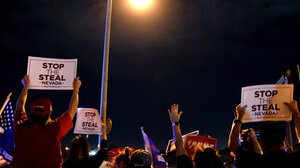
Voters in New York have the right to vote free from intimidation under federal and state law.1 The federal protections that apply to all states are explained here. In addition, the following actions are specifically prohibited by New York law:
- Using or threatening to use force, violence, or intimidation to compel or have the effect of causing any other person to vote or refrain from voting.2
- Engaging in fraudulent practices to impede, prevent, or otherwise interfere with or have the effect of causing any person to vote or refrain from voting, including spreading false rumors or making false statements that there are negative consequences to voting.3
- Obstructing, impeding, or otherwise interfering with access to any polling place or elections office, or otherwise interfering with any voter in a manner that causes delay in the voting process, including patrolling polling places to scare voters out of the voting line.4
- Electioneering within 100 feet of an entrance to a polling place.5
- Following voters to poll sites and speaking loudly about prosecuting them for illegal voting.6
Voter Challenges
Although New York allows inspectors, clerks, appointed election observers, and other registered voters properly in the polling place to challenge a voter,7 state law also provides for some guardrails:
- If a voter who has been challenged swears an oath that they are eligible to vote, they must be permitted to vote.8
- Election inspectors are required to keep a record of all challenges.9
- It is a misdemeanor to make a materially false statement in a voter challenge.10
- Aggressively challenging voters, especially if it leads to long lines or fuels baseless fears about illegal voting, could constitute illegal intimidation.11
The National Voter Registration Act (NVRA) provides additional safeguards to protect voters from mass challenges before an election:
- The NVRA expressly recognizes that National Change of Address information is not sufficient on its own to serve as the basis for canceling a voter’s registration.12
- The NVRA prohibits the systematic removal of voters from the rolls within 90 days of a federal election.13
Intimidation of Poll Workers and Election Officials
New York law prohibits any person from impeding or preventing the free exercise of the right to vote at an election.14 It is a crime to willfully disobey any lawful command issued by a board of inspectors or any of its members, including unlawfully going into the area containing the inspectors table and election equipment or remaining there after being ordered to leave by an election inspector.15 Additionally, it is a crime to induce, or attempt to induce, an election worker to violate their duties or any provision of the election law.16
Intimidation by Election Observers
State law places limits on who can serve as an election observer (known as a “watcher” in New York) and what they may or may not do:
- Only candidates on the ballot, political parties, political committees, and independent organizations with candidates on the ballot are allowed to have observers at polling places. They are limited to a maximum of three observers at each election district.17
- Observers must be a registered voter of the city or county in which they serve or an attorney who is both licensed to practice and a registered voter in New York state.18
- Observers must also have a written appointment certificate, and only one of the three observers is allowed inside the guard rail.19
- Observers are prohibited from intimidating voters, engaging in electioneering, tampering with election materials, protesting a vote ruling, accompanying a voter to the privacy booth, or pretextually challenging voters.20
- Observers are prohibited from standing in the vicinity of privacy booths or in unauthorized areas, videotaping or photographing voters, or following or harassing voters.21
Guns, Law Enforcement, and Federal Agents at Polling Places
It is a felony to possess a firearm at a polling place and in government buildings, where drop boxes may be located and votes may be counted.22
Even in places where carrying a firearm is not expressly prohibited, doing so may constitute unlawful intimidation.23 Such conduct may consist of:
- Carrying a visible firearm while near a polling location or at a drop box or vote-counting site,
- Displaying a concealed firearm during a discussion or argument with a voter or election worker, or
- Approaching a voter or election worker while displaying a firearm.
At least one police officer or peace officer must be assigned for duty from the opening until the closing of the polls in New York City only.24 In other parts of New York state, officers are neither required to be at the polls nor prohibited It is a crime to impersonate a law enforcement officer, including at a polling place, and a crime to wear a foreign military uniform or other military paraphernalia outside polling locations.25
Federal law limits the presence of the military and other armed federal agents at polling places:
- It is a felony for any federal official to send troops or armed persons to a polling place, “unless such force [is] necessary to repel armed enemies of the United States.”26
- It is a felony for a member of the military to intimidate voters or interfere with elections.27
State and local governments and their employees are prohibited from allowing immigration authorities access to a polling location for the purpose of immigration enforcement when doing so would violate these and other federal laws, except to execute a valid federal judicial warrant or court order.28
Door-to-Door Intimidation
State and federal law prohibit canvassing efforts that are used to intimidate voters.29 Any voter who receives a visit from a privately organized canvassing group does not have to answer any questions and should report any incidents of intimidation to the New York Attorney General’s office. Additionally, it is a misdemeanor in New York to impersonate a public servant or pretend to represent an organization with the intent to defraud another person.30
Endnotes
-
1
See, e.g., 18 U.S.C. §§ 241, 594; 52 U.S.C. § 10101(b); N.Y. Elec. Law §§ 17–150, 17–212.
-
2
N.Y. Elec. Law §§ 17–150(1), 17–154(1), 17–212(1)(b)(i).
-
3
N.Y. Elec. Law §§ 17–150(2), 17–212(1)(b)(ii); Letitia James (attorney general, New York) to Election Official and Law Enforcement Partners, Re: New York State Election Advisory, October 5, 2026, 5, https://perma.cc/D848-MYV4.
-
4
N.Y. Elec. Law §§ 17–130(3), 17–212(1)(b)(iii); James to Election Official and Law Enforcement Partners, October 5, 2026, 1.
-
5
N.Y. Elec. Law §§ 8–104(1), 17–130(4).
-
6
James to Election Official and Law Enforcement Partners, October 5, 2026, 2n8, citing Temporary Restraining Order, Daschle v. Thune, No. 4:04-cv-04177-LLP (D.S.D. Nov. 1, 2004) (restraining poll watchers for a Republican candidate who allegedly followed Native American voters in polling places and spoke loudly about them being prosecuted for illegal voting) (cited by Nat’l Coal. on Black Civic Participation v. Wohl, 498 F. Supp. 3d 457, 481 (S.D.N.Y. 2020))
-
7
N.Y. Elec. Law § 8–502.
-
8
N.Y. Elec. Law § 8–504(6).
-
9
N.Y. Elec. Law §§ 8–504(7), 8–508(2)(b).
-
10
N.Y. Elec. Law § 17–108(2).
-
11
James to Election Official and Law Enforcement Partners, October 5, 2026, 1. See also N.Y. Elec. Law § 17–212(1)(b)(i).
-
12
52 U.S.C. § 20507(c)(1)(B).
-
13
52 U.S.C. § 20507(c)(1)(B).
-
14
N.Y. Elec. Law § 17–150(2).
-
15
N.Y. Elec. Law § 17–130(21).
-
16
N.Y. Elec. Law § 17–130(22).
-
17
N.Y. Elec. Law § 8–500(1)–(2).
-
18
N.Y. Elec. Law § 8–500(5).
-
19
N.Y. Elec. Law § 8–500(1)–(2), (4).
-
20
James to Election Official and Law Enforcement Partners, October 5, 2026, 6.
-
21
James to Election Official and Law Enforcement Partners, October 5, 2026, 1, 6.
-
22
N.Y. Penal Law § 265.01-e(2)(a), (q).
-
23
James to Election Official and Law Enforcement Partners, October 5, 2026, 4–5. See also New York State Rifle & Pistol Association, Inc. v. Bruen, 142 S. Ct. 2111, 2133 (2022) (prohibitions on firearms in “sensitive places,” specifically “polling places,” are “presumptively lawful.”).
-
24
N.Y. Elec. Law § 8–104(6).
-
25
N.Y. Penal Law § 190.25(3)(a); N.Y. Mil. Law § 238-c; James to Election Official and Law Enforcement Partners, October 5, 2026, 1.
-
26
18 U.S.C. § 592.
-
27
18 U.S.C. § 593. See also 52 U.S.C. § 10102.
-
28
N.Y. Exec. Law § 319-a(6)(a)(ii), (9); N.Y. Gen. Mun. Law § 996-A(6)(a)(ii), (9).
-
29
See, e.g., N.Y. Elec. Law § 17–212; 18 U.S.C. §§ 241, 594.
-
30
N.Y. Penal Law § 190.25(2)–(3)(a).
More from the Laws Protecting Voters and Election Workers from Intimidation series
-
North Carolina: Protections Against Intimidation of Voters and Election Workers
This resource details state and federal laws protecting against the intimidation of voters and election workers and the disruption of the voting process. -
Ohio: Protections Against Intimidation of Voters and Election Workers
This resource details state laws and policies protecting against the intimidation of voters and election workers and the disruption of the voting process. -
Pennsylvania: Protections Against Intimidation of Voters and Election Workers
This resource details state and federal laws protecting against the intimidation of voters and election workers and the disruption of the voting process.
Stay up to date