
Part of
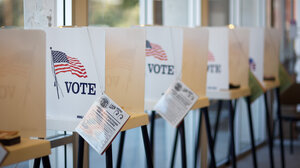
As the November 2022 midterms approach, voters face a voting rights landscape that has changed significantly since the 2020 election. 2021 was a record-breaking year for legislative activity around voting rights, and many of the same trends have continued into 2022.
Between January 1, 2022, and September 12, 2022, state lawmakers have enacted the following voting laws:
- At least seven states enacted 10 restrictive laws, and the state legislature of Arizona passed a restrictive constitutional amendment proposal that will be placed on the ballot this November.[1] Legislation is categorized as restrictive if it would make it harder for eligible Americans to register, stay on the rolls, and/or vote as compared to existing state law.
- At least seven states have enacted 12 election interference laws.[2]Legislation is categorized as election interference if it does one of two things: opens the door to partisan interference in elections, or threatens the people and processes that make elections work.
- At least twelve states have enacted 19 laws that expand access to the vote.[3]Legislation is categorized as expansive if it would make it easier for eligible Americans to register, stay on the rolls, and/or vote as compared to existing state law.
Since the beginning of 2021, lawmakers have passed at least 42 restrictive laws in 21 states.[4] Restrictive provisions of 35 of these laws will be in effect for the November 2022 midterms.[5] Although election years tend to have less legislative activity overall, the ten new restrictive laws enacted in 2022 are the most passed in any single year, other than 2021, in the last decade.[6]
While legislative activity to restrict voting access continues apace, state legislatures have actually enacted more election interference laws than restrictive laws this year. That is notable since these election interference laws first appeared as a trend just last year.
There is considerable overlap in the list of states that have enacted restrictive, interference, and expansive laws this year. Three of the seven states that enacted election interference laws have also enacted restrictive laws, signaling an ongoing legislative push to both undermine faith in elections and make it harder to vote. Five of the seven states that enacted restrictive laws also enacted expansive laws. However, this overlap will largely still mean a more restrictive experience for voters, because the restrictive provisions passed in these states impose significant burdens while most of the expansive provisions are relatively narrow.[7]
The continued trend of legislatures passing restrictive voting and election interference laws is particularly concerning given the looming threat of Moore v. Harper, a case pending before the Supreme Court. The state legislators that appealed that case are asking the Court to remove many checks on state voting legislation by adopting the radical notion of the “independent state legislature.”
Restrictive Legislation
Between January 1 and September 12, at least seven states enacted 10 restrictive laws.[8] Eight of the new laws were enacted since our last Roundup in May. In addition, legislators placed a restrictive constitutional amendment proposal on the ballot in Arizona.[9] Seven of these new laws will be in effect for the November 2022 midterm elections.[10] Overall, lawmakers in 39 states have proposed at least 405 restrictive bills for the 2022 legislative session.[11]
These new laws restrict access to the ballot box in a number of ways: make it harder to vote by mail, establish or expand documentary proof of citizenship requirements for voter registration, impose new photo ID requirements, limit Election Day registration, make it more difficult for individuals without traditional addresses to register to vote, and increase the likelihood of faulty voter purges. But there is a common theme that ties these various restrictions together: by and large, they appear designed to address false concerns that grow out of conspiracy theories about election fraud.
 Phillip Nelson/Getty
[Insert Map of Restrictive Laws]
State lawmakers continue their focus on mail voting, as they did in 2021, with half of the new restrictive laws creating new barriers to voting by mail.[12] Like last year’s laws, they include new requirements that voters provide identification numbers when they apply to vote by mail, prohibitions on drop boxes, and limitations on permanent absentee voting. This backlash against mail voting followed the 2020 elections, when a much larger proportion of the electorate relied on mail voting than in the past due to the coronavirus pandemic. The expansion of mail voting in 2020 helped ensure that elections could continue during the height of the pandemic. But despite a complete lack of evidence that this expansion led to any significant incidence or increase in fraud, many of the conspiracy theories claiming that the 2020 election was rigged revolve around mail voting. Our research has shown the manylinks between these conspiracy theories and trends in restrictive legislation.
Another set of laws targets the accuracy of voter rolls, in apparent response to conspiracy theories that people are able to cast ballots on behalf of those who have moved or died and that noncitizens are able to register and vote. Three laws in Arizona, Oklahoma, and South Carolina increase the risk of faulty voter purges. AZ H.B. 2243 and SC S.B. 108 both allow voters to be purged based on information from databases that suggest they are noncitizens. Purges based on similar databases have been found unreliable. The South Carolina law does not even provide any notice to the affected voters or an opportunity to correct an error, which greatly increases the risk that eligible voters will be mistakenly removed from the rolls.[13]
As discussed in the May roundup, Arizona and Mississippi enacted laws imposing or expanding restrictive documentary proof of citizenship requirements for voter registration.[14] These laws also seem to respond to the conspiracy theory that non-citizens are voting, which first gained prominence following the 2016 presidential election, when Donald Trump claimed that millions of noncitizens cast ballots. But that theory was debunked. The Arizona law, which applies retroactively and risks the voter registration status of some 200,000 voters, is currently the subject of numerouslegalchallenges, for what the head of the Justice Department’s Civil Rights Division described as “a textbook violation of the National Voter Registration Act.”[15]
In addition, Oklahoma enacted a relatively unique law that will make it more difficult for voters without traditional addresses–such as voters living on tribal lands and homeless voters–to register to vote and cast a ballot. OK H.B. 3365 requires any newly-registered voter to complete an address confirmation form before being allowed to vote if the voter ID card mailed to the voter is returned undeliverable or if the voter has an “invalid address.” The law defines a “valid address” as one with “a street name, street number, city, state, and ZIP code,” leaving other types of addresses of non-traditional addresses as invalid.[16] Many voters living on tribal land do not have traditional street addresses. Because almost half of Oklahoma’s area is tribal land, and Native Americans make up about 10% of the state’s population, the address confirmation form requirement could affect a significant share of Oklahoma voters. In addition, the law could restrict access for homeless voters, despite courts affirming that a homeless individual cannot be denied the right to vote, if they are otherwise eligible, merely because they lack a traditional street address.[17] Already, less than 10% of individuals experiencing homelessness in the U.S. exercise their right to vote. This new law could make registering to vote while experiencing homelessness even more difficult.
Proposed Constitutional Amendments
In addition to the restrictive voting laws enacted so far in 2022, the Arizona legislature approved a restrictive proposed constitutional amendment that will go to the voters in November.[18] The proposal would impose stricter voter photo ID requirements for in-person and mail voting, and would require mail voters to provide an ID number – an AZ driver’s license number, an AZ state ID card number, the last four digits of a Social Security number, or a voter ID number – on the ballot return envelope in order for the ballot to be counted.
A restrictive constitutional amendment proposal also passed in the Pennsylvania legislature this year. The proposal would require government-issued ID for voting in-person or by mail.[19] Current law provides more flexibility, allowing voters to use various forms of photo and non-photo identification to vote. The amendment must pass again during the next legislative session and be approved by the voters before it can go into effect. The proposal could go before the voters as early as 2023.
Election Interference Legislation
Between January 1 and September 12, at least seven states enacted 12 election interference laws.[20] Three of the laws were enacted since our Roundup in May. These laws create risks of partisan interference with elections or threaten the people and processes that make elections work. Eleven of these new laws will be in effect for the November 2022 midterm elections.[21] Overall, at least 151 election interference bills have been introduced in 27 states this year.[22]
[Insert Map of Election Interference Laws]
At least four new laws in two states create a risk of partisan interference with elections and election results.[23] These laws rearrange who can regulate elections or declare the results, placing more power in the hands of partisan actors or eliminating valuable checks and balances. Three of these laws were passed in Georgia. While these laws differ in their specifics, all three create a risk of partisan interference in elections by shifting authority over elections from specific experienced election administrators to partisan-controlled county election boards, either by establishing a partisan election board for the first time or changing the way members are appointed on an existing election board. Similar bills passed in 2021 allowed county officials to remove a number of Black Democrats from election boards across the state.
The fourth such law, and the only one passed since our May Roundup, is OK S.B. 523. That law forbids any state entity, including the governor, state election board, or state courts, from altering or amending election laws, effectively removing any checks on the state legislature. Barring the governor and election officials from implementing policies to respond to unexpected situations could cause complications in the administration of future elections. But taken a step further and assuming this law effectively bars state courts from even hearing challenges to burdensome or discriminatory election laws because they are now unable to “amend or alter” them is a dangerous move that violates separation of power principles, fits with a national trend of undermining the power of the court to serve as a check on other branches of government, and will leave many state constitutional protections practically unenforceable. It essentially makes an extreme version of the independent state legislature notion the law of the land in Oklahoma.
The majority of election interference laws passed this year, however, threaten elections in a different way. At least six laws in five states create new criminal or civil penalties for election officials.[24] And at least two laws in two states dedicate new resources toward pursuing election crimes against voters or election officials.[25] These laws serve to intimidate election officials, election workers, and voters themselves. They contribute to an atmosphere of fear surrounding elections and create a risk that the people who run elections may be more concerned with avoiding criminal liability than protecting voters.
For example, in an apparent response to yet another conspiracy theory concerning private funding for election administration, laws passed in Alabama, Kentucky, Missouri, and Oklahoma, make it a crime or impose a civil penalty for receiving or spending private funding for election-related activity.[26] These laws do not just represent a policy decision about the proper source of election funding. They threaten often resource-strapped election officials with severe penalties, and are often so vaguely worded that officials may fear accepting non-monetary forms of support, like volunteers or locations that can be used as a polling sites.
Such laws put election officials on the defensive, second guessing their own work for fear of being harassed or prosecuted by law enforcement. They compound the threats of violence and harassment election officials already face from private actors. Working from this defensive posture forces election officials away from their traditional role of ensuring free and fair election with the voter at the center, and risks deterring individuals from serving as election officials in the future.
These laws also intimidate voters. Voters in Florida are already experiencing the impact of this election-related criminalization. Under the directive of FL S.B. 524, which created a new state office to initiate investigations into “election irregularities,” several people were recently arrested. The individuals were all people with past felony convictions, confused about the byzantine nature of Florida‘s voting rights restoration rules, and many of whom had been told by official actors that they were eligible to vote. Prosecuting voters for honest mistakes creates fear and intimidation amongst voters, and demonstrates how dangerous these laws can be in the hands of politically motivated state officials.
Expansive Legislation
Between January 1 and September 12, at least 12 states enacted 19 laws that expand access to the vote.[27] Fourteen of these laws were enacted since our Roundup in May. Eighteen of the expansive laws will be in effect for the November 2022 midterm elections.[28]
Nine laws in six states make mail voting easier or improve the mail voting process[29], eight laws in six states make voting easier for voters with disabilities,[30] six laws in six states expand opportunities for individuals to register to vote,[31] and three laws in three states create or expand early in-person voting.[32] Overall, lawmakers in 44 states and Washington, D.C. have proposed at least 627 expansive bills for the 2022 legislative session.[33]
[Insert Map of Expansive Laws]
Notably, in June, New York enacted the landmark John Lewis Voting Rights Act, a state expansion of the federal Voting Rights Act.[34] It expands access to the vote for racial-, ethnic-, and language-minority voters by creating new legal protections against voter suppression, vote dilution, and voter intimidation. The Act additionally requires jurisdictions with a history of discrimination to seek preclearance before enacting certain changes to elections, a process similar to the federal preclearance system that the United States Supreme Court made ineffective in 2013.[35]
New York was not alone in passing significant expansive laws in June. Massachusetts enacted S. 2924, a comprehensive expansive law that makes several covid-era reforms permanent and enacts other new expansive policies. The law pushes back the voter registration deadline by ten days, codifies the state’s no-excuse mail voting policy implemented as a response to the covid-19 pandemic, expands the number of days of early voting, creates new protections for voters with disabilities, and requires correctional facilities to assist eligible incarcerated voters in casting mail ballots. South Carolina’s mixed omnibus bill SC S.B. 108 established no-excuse early in-person voting, and Delaware’s DE H.B. 25 enacted election day registration.
More from the State Voting Laws Roundups series
-
Voting Laws Roundup: October 2022
Voters in some states are facing new barriers as they cast ballots in the midterms. Other new state laws are increasing the risk of election interference this fall and in future elections. -
Voting Laws Roundup: May 2022
This year, state lawmakers have focused on enacting election interference legislation, with six states already passing nine laws that threaten to undermine voters’ confidence in the security of elections. -
Voting Laws Roundup: February 2022
As the 2022 state legislative sessions begin, lawmakers have already introduced more new restrictive voting legislation than at this time last year. They have also continued to introduce bills designed to undermine the electoral process.


Stay up to date