Cross-post from CityLimits.org
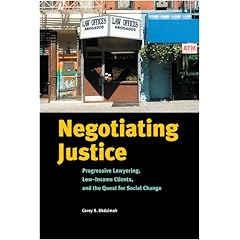
Negotiating Justice: Progressive Lawyering, Low-Income Clients, and the Quest for Social Change, by Corey S. Shdaimah, NYU Press, $45.
Amid the surfeit of bad news that has surfaced of late is the less than obvious connection between the economic downturn generally and the budget crisis now being faced by legal service providers. Due to a quirk in the manner in which many organizations receive funding, hard times for Wall Street now means it’s even harder than usual to fund lawyers who serve the poor.
The decline in interest rates undercuts the interest earned on a key kind of account maintained by lawyers, called the Interest on Lawyers Trust Accounts (IOLTA), a major source of funding for legal aid organizations. Cash-strapped legal aid groups may be fielding more demands than ever, yet find themselves less able to provide services than they were even just last year.
And it is no secret that, even in flush times, the best efforts of these groups barely scratch the surface of the legal needs of poor communities and families. While the victims of Bernie Madoff will almost certainly have their day in court, it’s clear that for many victims of mortgage fraud and predatory lending schemes, workplace harassment, landlord-tenant disputes, credit problems, or those grappling with mental illness, securing a lawyer with the time and inclination to properly address their needs remains a pipedream.
A new book by Corey S. Shdaimah, “Negotiating Justice: Progressive Lawyering, Low-Income Clients, and the Quest for Social Change,” makes a measured, observation-based analysis of the operation of a single legal service clinic, named with the pseudonym “Northeast Legal Services” or NELS, that serves poor clients in a medium-sized American city.
Through interviews, the author applies social science methods in evaluating day-to-day interactions of lawyers and clients. The book is particularly meticulous in examining whether the work in the clinic maps onto the contours of what has been a vigorous conversation in academic and legal services circles concerning the goals and nature of community-based legal practice.
Starting several decades ago, some legal scholars and practitioners on the left began to question whether the potential for empowering clients in legal work was being realized in practice. Law professors and pioneering theorists Gerald Lopez of UCLA, Lucie White at Harvard, and Amherst College’s Austin Sarat, among others, asked whether legal services lawyers were able to, or did, assist clients in achieving social justice through litigation and advocacy, or whether power dynamics within the lawyer-client relationship were actually reinforcing poor clients’ difficulty in effecting change.
After losing many of the struggles to enshrine social entitlements that were part of the so-called “War on Poverty,” immediate goals for legal practitioners did – and had to – rise to the forefront as part of a far more piecemeal approach to legal practice.
Particularly against the current legal backdrop of largely conservative courts, as well as federal funding restrictions that prohibit many legal aid lawyers from bringing class actions and other important types of cases, it became more crucial for legal services and community-based lawyers to ensure that their work did not re-victimize poor clients as those clients sought justice.
Scores of law review articles were published as part of what Shdaimah calls the “progressive lawyering” approach, which encouraged legal services lawyers to use opportunities to listen more closely to clients, to maximize client autonomy and lawyer-client collaboration, and to gain self-awareness about the limitations of lawyerly expertise in telling client stories. The obvious class divisions among lawyers and poor clients were also highlighted.
As a conversation, it revealed a clear need for community-based and more holistic, inclusive approaches to the practice of law that included access to non-legal help as well as self-help, and justified organizations’ attempts to transcend a narrowly legal approach by grappling with at least some other negative pressures in clients’ lives.
Most of these insights are now accepted widely by legal services lawyers. They are an important aspect of both aspirations and achievements of legal services organizations, including such local, multi-dimensional organizations such as Make the Road by Walking or The Neighborhood Defender Service of Harlem.
Shdaimah’s book is an important recent addition to this tradition of closely examining public interest legal practice. Isolating certain themes concerning progressive lawyering, Shdaimah – a lawyer and assistant professor in the University of Maryland School of Social Work – probes them carefully. Her innovation is to ask directly about, for example, lawyer-client collaboration and client autonomy. The book contains substantial excerpts from interviews, in which we hear both the lawyers’ and clients’ voices and perspectives.
Shdaimah argues with some force that much of the earlier scholarship lacked a substantial empirical component, and this was to its detriment. From her perspective, the literature has saddled practitioners with a set of abstract and difficult-to-achieve goals, thereby burdening lawyers with the unattainable.
Her most pointed example concerns the value of collaboration: Shdaimah asks whether wealthy clients get their legal needs met without being asked to shoulder a laboring oar, and therefore whether it is fair for clients with far fewer resources to be expected to perform tasks (such as getting affidavits signed) as a precondition of receiving services. She rightly points out that, for many clients, securing access to competent legal counsel is no small victory in itself.
Yet the book makes it clear that, in practice, lawyers need client assistance on many aspects of a case due to both the pressure of caseloads and the greater efficiency of client action on a matter. In interviews, the lawyers also directly linked their hopes for collaboration in a particular case to their assessments of client capacity. One lawyer indicated that he would do far more than usual in the case of one specific client, a woman who was particularly vulnerable and easily overwhelmed. In short, a mixture of transactional and resource realities (and compassion) informed lawyers’ judgments in applying the abstract notion of collaboration to particular clients and circumstances.
The book, as a whole, will be a terrific resource for students who would like to leaven their academic scholarship with insights gained from observations, surveys and interviews at a real legal clinic. It would also be a deeply helpful companion text in seminars accompanying clinical legal studies programs, wherein law students work alongside lawyers to serve clients.
However, with the collaboration question, as with many of the others that Shdaimah highlights, I found myself far more drawn to the direct sources and stories she assembled than to her critique of the scholarship. Much of what Shdaimah found confirms that lawyers are able to work with clients to secure measurable improvements in their lives, and are valued in this role by the clients, despite the fact that no transformational change in the overall conditions of poverty is on the horizon.
Her descriptions underlined the significance of the core lawyer-client collaboration – “naming, claiming and blaming” – which both confirms the clients’ feelings of righteousness in their cause, and makes the most of lawyers’ skills in framing challenges and possible solutions.
Moreover, through the interviews, it was clear that the lawyers at NELS were very familiar with at least the broad contours of the literature, and aware of its conceptual significance for community-based legal centers. Shdaimah did not have the liberty of studying this kind of legal practice before and after the notion of progressive lawyering took shape, and these notions appear to already pervade legal practice at NELS.
My own view is that the lawyers’ attempt to apply such values, however constrained in practice or by compassion, is a rarely celebrated, but crucially important, advance in how we have come to imagine legal practice in these and other settings. When I was a law student, I admit to being captivated by this literature, and credit it with providing me and countless others tools for self-examination and self-awareness that have proven an invaluable part of whatever I have done.
While scholars such as Lucie White do exhort practitioners to a set of engagement-oriented norms, equally important for her and others is a call to situated practice, informed by real-life contingencies and a clear-eyed assessment of what is possible. So while Shdaimah appears somewhat dismayed by the distance between the literature and reality, I am instead reassured by how far we have come in understanding the challenges and pitfalls of lawyering in poor communities. Shdaimah’s findings at NELS of attentive, hardworking lawyers, who sensitively work with clients to secure incremental change, are actually a happy, and somewhat overdue, confirmation that real-world application of these values creates a legal practice well worth doing.